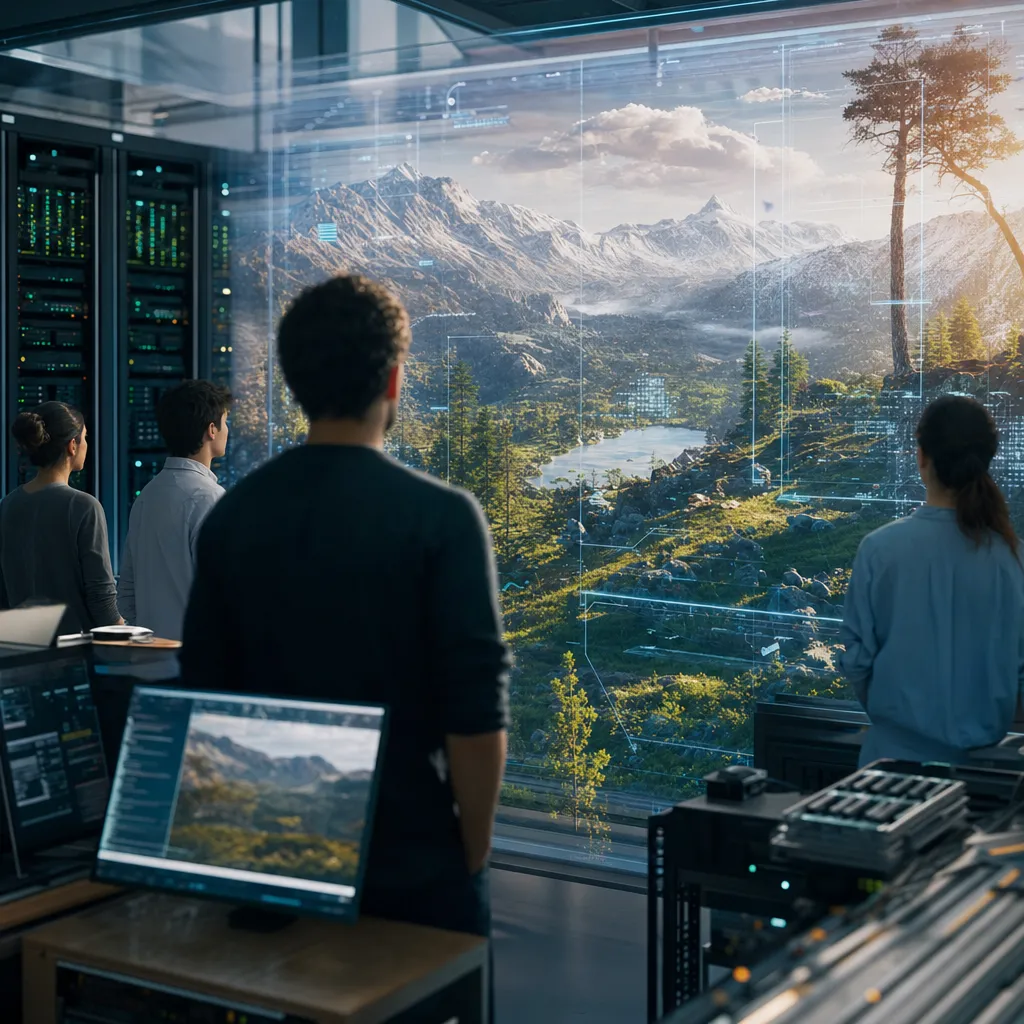
Google DeepMind has opened Genie 4, its interactive real-time world generation model, to developers via the Gemini API at $0.10 per second of output — the first model on Google's new Live Interactions API.
Google Opens Genie 4 — Its Real-Time World Generation Model — to Developers
Google DeepMind has made Genie 4 available to developers through the Gemini API and Google AI Studio, opening access to a model that generates continuous, interactive virtual worlds in real time. The release puts a capability that was previously a research demo into the hands of anyone building applications — and it comes with a live pricing model: roughly $0.10 per second of generated output.
What Genie 4 Does
Genie 4 is an interactive world model. Feed it a prompt — text, an image, or a combination — and it streams back a continuous virtual environment: 720p video at 24 frames per second, with synchronized ambient audio, sound effects, and dialogue. The environment responds to user input in real time, meaning the generated world changes based on what the user does or says.
That last point is what makes Genie 4 different from a video generation model. Tools like Sora or Runway generate video clips — a fixed output that plays back unchanged. Genie 4 generates a world that reacts. The distinction is the difference between watching a movie and playing a game.
Background: Where Genie Came From
Google DeepMind first published research on Genie in early 2024, describing a generative interactive environment model trained on internet video. The original Genie could generate simple 2D game-like environments from a single image prompt. Genie 2, announced in December 2024, extended the capability to photorealistic 3D worlds with consistent physics — objects fell, water flowed, NPCs moved.
Genie 4 is the production-ready version of that research lineage, now packaged for the API with pricing and documentation.
The Technical Delivery Layer: Live Interactions API
Genie 4 is the first model on Google's new Live Interactions API, which supports both WebRTC and WebSocket protocols. WebRTC — the same standard used by video calling apps — enables low-latency bidirectional streaming between a user's browser or app and the model. WebSocket provides an alternative for server-to-server integrations.
This delivery architecture matters for developers. Building an interactive AI environment requires not just generating output, but streaming it continuously with low enough latency that it feels responsive. A model that takes two seconds to generate each frame is unusable for interaction. The Live Interactions API is Google's infrastructure answer to that problem.
Get this in your inbox.
Daily AI intelligence. Free. No spam.
Pricing and Access
At $0.10 per second of generated output, the cost adds up quickly for sustained use:
- 1 minute of output: $6.00
- 10 minutes: $60.00
- 1 hour: $360.00
For comparison, a typical video game costs nothing per second of play. This pricing model makes Genie 4 unsuitable as a backend for a continuously running game — the economics don't work for consumer entertainment. But it may work for:
- Short-form interactive demos where a few minutes of experience has high value
- Training data generation for robotics and embodied AI, where interactive environments are used to train models rather than entertain users
- Prototyping and design tools that generate interactive previews on demand
- Educational and enterprise applications with controlled session lengths
Developers can access Genie 4 through Google AI Studio today, with Gemini API access available via standard API keys.
What This Means for Developers
The opening of Genie 4 to the API turns a research capability into a buildable product. A few things are now possible that weren't before:
Interactive AI-generated onboarding. A SaaS company could generate a custom interactive product demo tailored to a prospect's industry, rendered live rather than from a pre-recorded video library.
Generative training environments. Robotics and embodied AI teams — companies training physical robots or AI agents to navigate environments — currently spend significant resources building simulation environments. Genie 4 could let them generate diverse, varied environments on demand, potentially accelerating training data production.
AI-native game prototyping. A game designer could describe a world in text and walk through it interactively before a single asset is built. The economics don't support shipping a game on Genie 4, but the prototyping use case is different.
Immersive educational content. A history platform could let students walk through interactive re-creations of historical settings. A science education tool could generate exploreable visualizations of cellular processes or geological formations.
What to Watch
The near-term story is adoption: which developers build on the Live Interactions API first, and what use cases emerge at scale. The pricing will likely drop as Google scales infrastructure — the $0.10/second figure is a launch price, not necessarily a floor. Watch also for whether competing labs (OpenAI, Meta) move to match Genie 4's interactive world capabilities or position their own models differently.
The longer-term question is whether interactive world generation becomes a standard API category — a commodity layer that developers expect from every major AI provider — or whether Google maintains a meaningful lead in the space.
Hector Herrera covers AI developments at NexChron.
Did this help you understand AI better?
Your feedback helps us write more useful content.
Get tomorrow's AI briefing
Join readers who start their day with NexChron. Free, daily, no spam.