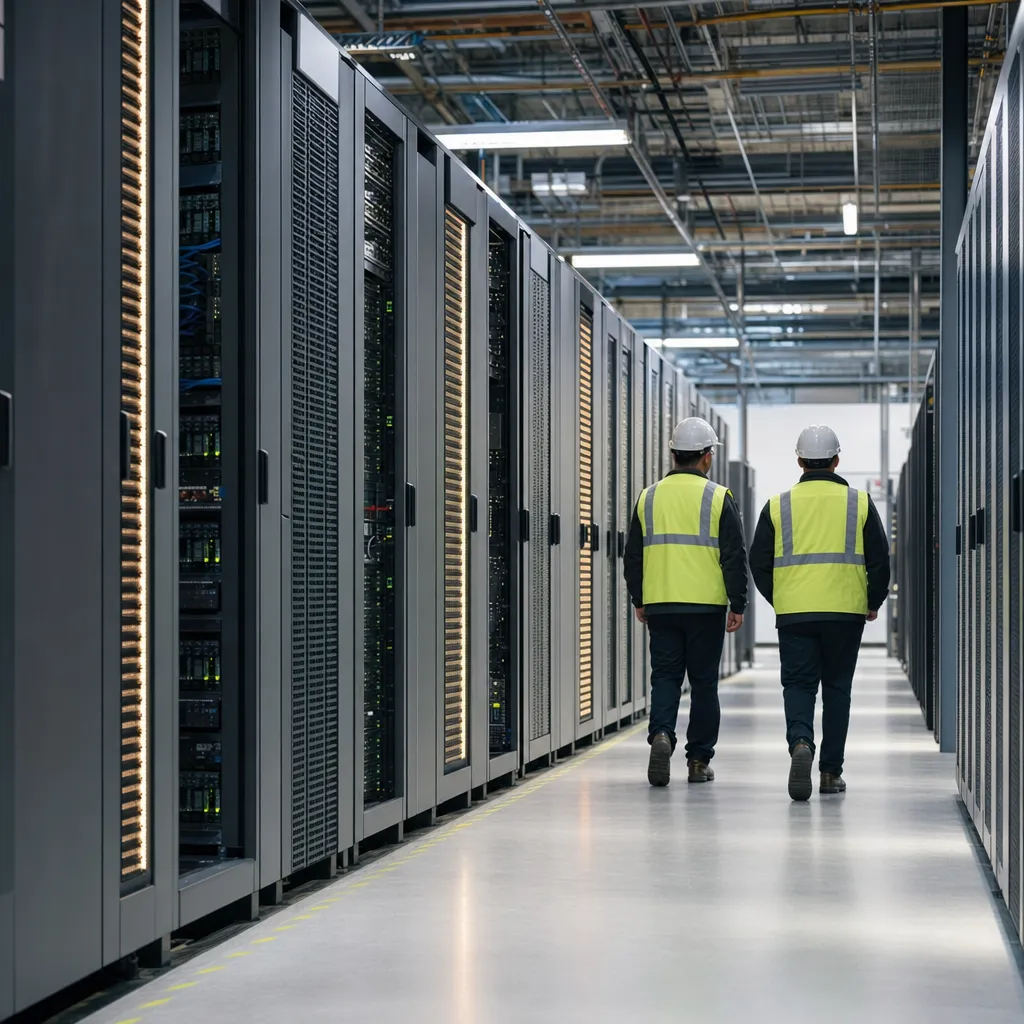
Nvidia posted $115.8 billion in Q3 FY2027 revenue — a 103% year-over-year jump — with Data Center revenue hitting $107.6 billion, up 110% annually.
Nvidia posted $115.8 billion in Q3 FY2027 revenue, a 103% jump from the same quarter a year ago — the clearest signal yet that AI infrastructure spending shows no sign of plateauing. The numbers confirm what the company's customers have been signaling for months: demand for AI compute continues to outpace supply.
The results, reported November 2026, beat Wall Street expectations and pushed Nvidia's quarterly revenue above $100 billion for the first time in company history.
The Numbers
Nvidia's Q3 FY2027 performance breaks down as follows:
- Total revenue: $115.8 billion, up 103% year-over-year and 20% quarter-over-quarter
- Data Center revenue: $107.6 billion — the core of the business — up 110% annually
- Q4 guidance: $130 billion, implying continued acceleration
Data Center is Nvidia's business now. At $107.6 billion, the segment accounts for 93% of total revenue. The GPU maker that once sold primarily to gamers and researchers now derives almost all of its income from hyperscalers, enterprise AI labs, and sovereign AI programs buying Blackwell and Hopper chips by the rack.
Context
Nvidia's growth rate is extraordinary by any measure, but the past year has established a pattern: every quarter the company reports results that look unsustainable, and every subsequent quarter it beats them.
Get this in your inbox.
Daily AI intelligence. Free. No spam.
The year-ago period (Q3 FY2026) itself showed significant growth. Doubling that in a single year — crossing $100 billion in a single quarter — reflects just how much capital has flowed into AI infrastructure since large language models became commercially viable.
Jensen Huang, the CEO who built Nvidia from a gaming-chip company into the backbone of the AI economy, is in the final stretch of a transition period after announcing plans to eventually step down. His dealmaking and long-term bets on CUDA software ecosystem and tensor processing are widely credited with Nvidia's ability to monetize this wave faster than any competitor.
What It Means for the Industry
For businesses watching AI infrastructure spending, the Nvidia earnings are a proxy for the entire buildout:
- Hyperscalers are still buying. Microsoft, Google, Amazon, and Meta have each signaled multi-year capital expenditure plans in the hundreds of billions. Nvidia's results confirm those commitments are translating into actual chip purchases, not just announced intentions.
- Sovereign AI is a real revenue line. Governments in the Middle East, Europe, and Southeast Asia are building national AI infrastructure. Nvidia has explicitly called out sovereign customers as a growing share of Data Center revenue.
- Competition remains limited. AMD's MI-series and custom silicon from Google (TPUs) and Amazon (Trainium) are in production, but none has dented Nvidia's market position in a meaningful way at the revenue level.
For companies building AI products and services, Nvidia's pricing power is a structural cost — one that feeds directly into the economics of running inference at scale. When Nvidia guides to $130 billion next quarter, it is also signaling that the cost of AI compute will remain elevated.
What to Watch
Nvidia's Q4 guidance of $130 billion assumes continued execution on Blackwell supply and no major disruption to export controls. The U.S. government's ongoing restrictions on high-end chip sales to China remain a wildcard — Nvidia has navigated them through product modifications, but any tightening could affect the guidance.
The outgoing CEO transition timeline will also draw scrutiny. Investors and enterprise customers want continuity in Nvidia's roadmap strategy, and any uncertainty around leadership succession will be a recurring question on analyst calls.
Did this help you understand AI better?
Your feedback helps us write more useful content.
Get tomorrow's AI briefing
Join readers who start their day with NexChron. Free, daily, no spam.