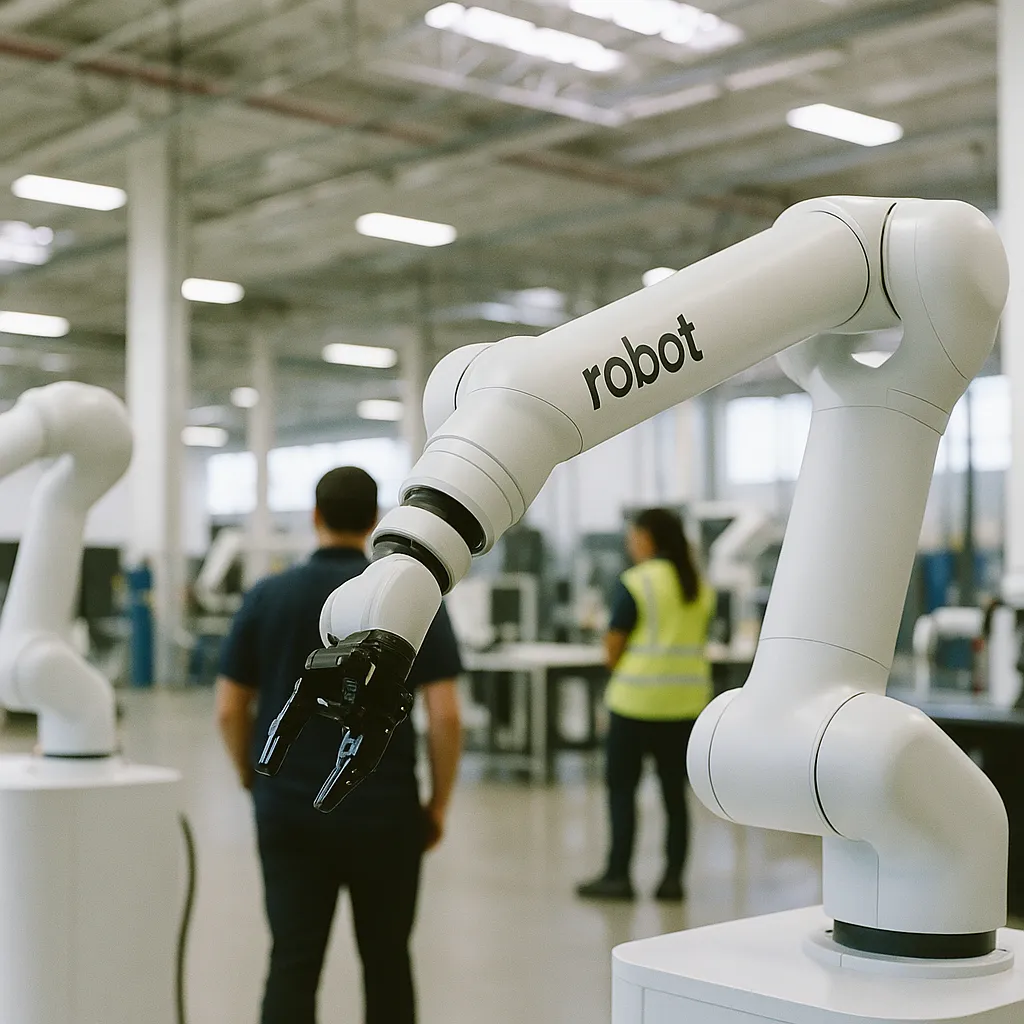
NVIDIA Drops Three Robotics AI Model Families During National Robotics Week
NVIDIA released new models across Nemotron (agentic AI), Cosmos (physical world simulation), and Isaac GR00T (robotics foundation) during National Robotics Week — a coordinated push to establish its stack as the software foundation for industrial and service robotics.
Why this matters
NVIDIA released new models across Nemotron (agentic AI), Cosmos (physical world simulation), and Isaac GR00T (robotics foundation) during National Robotics Week — a coordinated push to establish its stack as the software foundation for industrial and service robotics.
NVIDIA Drops Three Robotics AI Model Families During National Robotics Week
By Hector Herrera | April 16, 2026 | Science
NVIDIA used National Robotics Week to release new open models across three of its physical AI platforms — Nemotron for agentic reasoning, Cosmos for physical world simulation, and Isaac GR00T for humanoid and industrial robotics. The releases are not incremental updates. They represent NVIDIA's coordinated push to establish its model stack as the software foundation for the next wave of real-world AI deployment, from hospital automation to warehouse logistics.
The distinction between these models and what most people think of as "AI" is fundamental: these are systems designed to understand and act in the physical world, not just process text.
The Three Model Families
Nemotron — Agentic AI
Nemotron is NVIDIA's family of language and reasoning models tuned for agentic tasks — situations where an AI system needs to plan a sequence of actions, use tools, and complete multi-step goals without human guidance at each step. The National Robotics Week releases extend Nemotron's capabilities specifically toward embodied agent scenarios: AI that needs to coordinate between perception (what is happening in the environment) and action (what to do about it).
For physical AI applications, this matters because robots need to make decisions, not just follow scripts. A warehouse robot encountering an unexpected obstacle needs to reason about what to do next — reroute, flag for human intervention, attempt a different approach. Nemotron's agentic architecture is designed to handle that kind of decision loop.
Cosmos — Physical World Simulation
Cosmos is NVIDIA's platform for generating and reasoning about physical world data. Its core function is serving as a world model — an AI that can simulate how the physical environment behaves, enabling robots and autonomous systems to reason about actions before taking them.
World models have emerged as one of the key architectural ideas in physical AI research. Rather than training robots purely through real-world trial and error (expensive and dangerous) or scripted simulations (limited fidelity), world models allow AI systems to develop intuitions about physics, object interactions, and spatial reasoning in a more generalizable way.
Get this in your inbox.
Daily AI intelligence. Free. No spam.
The Cosmos releases extend the platform with new model variants specifically trained on robotics and autonomous vehicle data, improving its fidelity for the kinds of manipulation and navigation tasks that industrial and service robotics require.
Isaac GR00T — Humanoid and Industrial Robotics Foundation Model
Isaac GR00T is NVIDIA's foundation model for robot learning — a pre-trained model that robotics companies can fine-tune for their specific hardware and tasks, rather than training from scratch. According to NVIDIA's Robotics Week announcement, the new releases expand GR00T's supported robot morphologies (body configurations) and add capabilities for more complex manipulation tasks.
Foundation models have transformed software AI by providing pre-trained starting points that dramatically reduce the data and compute required to develop capable systems. GR00T attempts to bring the same dynamic to robotics: a base model that understands robot motion, manipulation physics, and task planning, which individual companies can adapt to their specific hardware without building from zero.
Why These Three Together
The Nemotron-Cosmos-GR00T stack is not coincidental. It represents a full-stack approach to physical AI:
GR00T handles the robot's low-level motion and manipulation intelligence
Cosmos provides the physical world model that enables simulation and physical reasoning
Nemotron handles the higher-level task planning and agentic decision-making
Stack them together and you have the software architecture for a robot that can understand its environment (Cosmos), reason about what to do (Nemotron), and execute physical actions (GR00T). The hardware that runs this stack is, naturally, NVIDIA silicon.
The Market Context
Amazon, Google, and major manufacturers are accelerating hardware investment in robotics infrastructure. Amazon's fulfillment network automation, Google's DeepMind robotics research, and manufacturing investments across automotive and electronics are converging on a common requirement: AI that can work reliably in unstructured physical environments.
NVIDIA's position in this market is strategically important. In the software AI market, NVIDIA's GPUs are the dominant training hardware but the inference market is more competitive. In physical AI, NVIDIA is attempting to establish its full stack — chips (Jetson, Thor), simulation (Isaac Sim), and now foundation models (GR00T, Cosmos, Nemotron) — as the platform that robotics companies build on, creating a more durable competitive moat than chip hardware alone.
The open model strategy: Releasing these models as open (or open-access) is deliberate. Open models attract developers, researchers, and companies who build on the platform, expanding the ecosystem without requiring NVIDIA to capture all value at the model layer. The value accrues at the hardware level — the companies building on GR00T will run their robots on Jetson and Thor chips.
What to Watch
The robotics deployment curve follows a pattern that has already played out in software AI: a period of rapid foundational model development, followed by a wave of enterprise adoption once the models are capable enough for real-world tasks. For physical AI, that capability threshold is higher — physical reliability requirements exceed software reliability requirements because mistakes have physical consequences.
Watch adoption rates among robotics startups building on the GR00T foundation specifically. The number of companies integrating GR00T into their development pipeline is the leading indicator of whether NVIDIA's foundation model bet pays off. Amazon's warehouse robotics program and hospital automation pilots will be the first large-scale production tests.
Hector Herrera is the founder of Hex AI Systems and editor of NexChron.
Key Takeaways
✓By Hector Herrera | April 16, 2026 | Science
✓Cosmos — Physical World Simulation
✓Isaac GR00T — Humanoid and Industrial Robotics Foundation Model
Hector Herrera is an AI systems architect and the founder of Hex AI Systems. He designs and runs AI systems in production and writes daily about how AI is reshaping business, government and everyday life. 20+ years building for the web. Houston, TX.