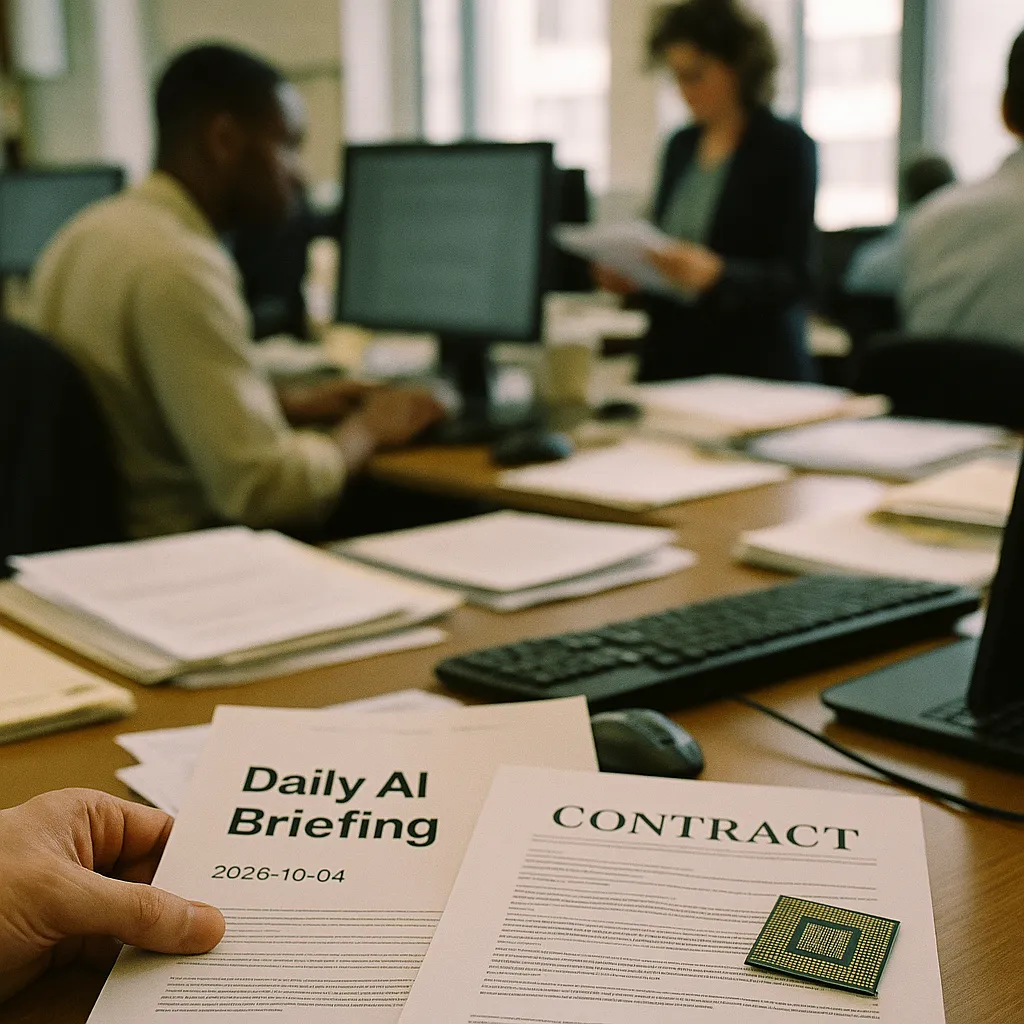
Your daily AI intelligence for October 04, 2026.
Good morning. Here's your AI intelligence for Sunday, October 04, 2026.
Law, Policy, and Governance
California became the first state in the country to ban attorneys from delegating legal work to AI. The new law — effective January 1, 2027 — prohibits using confidential client data with AI tools and requires human verification of every AI-generated citation. It's the strictest state-level restriction on legal AI yet, and bar associations in at least five other states are already reviewing whether to follow.
The General Services Administration moved on federal AI procurement this week without waiting for formal rulemaking. Its new policy mandates AI requirements in all new federal contracts starting October 19 — bypassing standard notice-and-comment procedures in a move that signals urgency at the top. Vendors have roughly two weeks to get into compliance. It's a significant shift: AI governance is now baked into the federal acquisition baseline, not treated as optional.
Silicon and Infrastructure
OpenAI made its clearest move into vertical AI with the launch of GPT-Synopsys, a specialized model built with semiconductor EDA leader Synopsys and trained specifically on chip design workflows. The partnership is notable less for its scope than for what it signals: OpenAI is moving deliberately into high-stakes domains where the cost of error is enormous and domain expertise is scarce. Chip design is one of the most complex engineering disciplines on the planet. Automating pieces of it matters.
Major telecom operators aren't adapting their networks to AI — they're rebuilding them around it. Orange, SK Telecom, and Optus are redesigning fiber, data centers, and radio access networks from the ground up on AI-native architectures. Deutsche Telekom's preliminary 5G tests show 65% lower energy consumption in early deployments. When energy savings at that scale are confirmed, the rebuild timeline across the sector accelerates.
Transportation and Logistics
Venti Technologies crossed a threshold the logistics industry has been watching for years. The company deployed North America's first fully autonomous truck fleet inside a live intermodal rail yard — vehicles loading and moving containers without any human operator present. The rail yard environment is one of the harder autonomous use cases: tight quarters, unpredictable workflows, high consequences for error. Venti reports 40–70% logistics cost reductions at the deployment site. That range is wide enough to invite scrutiny, but even at the low end, it's a number that will move capital.
Nordic and European grid operators are now characterizing AI-assisted management as necessary, not optional, to handle the real-time instability generated by intermittent renewable sources. The irony buried in the latest operator data: fossil fuel producers are adopting AI grid tools faster than clean-energy operators. The gap isn't ideological — it's about integration complexity and legacy system maturity. The incumbents have more to protect and, apparently, are moving faster to protect it.
Get this in your inbox.
Daily AI intelligence. Free. No spam.
Finance
The World Economic Forum published its 2026 AI Playbook for Financial Services, establishing board-level accountability standards and risk management frameworks for banks and insurers globally. The playbook arrives at a revealing moment: just 13% of financial services firms are currently on track with their own AI strategies, according to separate survey data released this month. The gap between commitment and execution in financial AI is wide, and the WEF document is trying to give boards a structured way to close it.
Health and Agriculture
A new in-parlor AI camera system is changing the economics of precision livestock management. The system scores every dairy cow's body condition daily after milking — delivering herd health analytics that were previously available only at industrial scale. For small and mid-size operations, it removes a cost barrier that's been in place for a decade. Precision agriculture tools that close the scale gap tend to diffuse quickly once they hit an accessible price point.
Construction and Real Estate
Ironsite AI closed a $30.8 million financing round to deploy vision AI on active construction sites. The differentiation in Ironsite's approach is the data source: training on first-person footage from live construction environments, not simulations. Construction AI has seen uneven investment through 2024–2025, but the round signals renewed conviction in AI-native approaches over retrofitting general-purpose tools to the jobsite.
Education
A new American Chemical Society study found that 67% of college students — and 81% in the U.S. specifically — believe AI tools are making learning too shallow. Faculty are divided on the finding, and universities are moving in opposite directions: some restricting AI use in coursework, others accelerating integration with minimal guardrails. The student data complicates the narrative that AI in education is straightforwardly positive. The concern isn't that AI is present — it's that students feel it's doing their thinking for them.
AI Interfaces
Tavus launched Griffin-Lite, describing it as the world's first Human Interaction Model. The distinction from current video AI systems is full-duplex capability: Griffin-Lite sees, processes, and responds in real-time video without the turn-taking pauses that define most AI conversation interfaces today. That latency gap is a larger barrier to natural AI interaction than it gets credit for. Closing it changes the feel of a conversation more than almost any other single improvement.
Creative and Media
The debate over AI music charts moved into mainstream conversation this week. Kelly Clarkson and other artists are publicly calling for separate chart categories as AI-generated tracks flood streaming platforms. Labels and distributors remain divided on whether separation would protect human artists or simply fragment discovery. The stakes are high: chart placement drives royalties, algorithmic recommendations, and cultural legitimacy. How platforms respond in the next few weeks will set a precedent the industry will be working around for years.
What to Watch Today
California's legal AI ban will generate immediate response from the legal tech sector. Watch for formal guidance from the State Bar, compliance timelines from legal software vendors, and signals from other state bars on whether similar rules are in motion.
GSA's October 19 deadline is now 15 days out. Monday is the first business day since the announcement — expect federal contractors to begin publishing compliance positions and asking for clarification on scope.
The AI music chart debate is accelerating. With major artists now publicly on record, label responses this week will indicate whether the industry is moving toward formal chart separation or preparing to manage it differently. Platform decisions from Spotify and Apple Music, in particular, will be watched closely.
Did this help you understand AI better?
Your feedback helps us write more useful content.
Get tomorrow's AI briefing
Join readers who start their day with NexChron. Free, daily, no spam.