Your daily AI intelligence for June 10, 2026.
Daily AI Briefing — June 10, 2026
Good morning. Here's your AI intelligence for Wednesday, June 10, 2026.
Healthcare: The Training Gap
AI tools are saving clinicians the equivalent of 16 working days per year — but 70% of healthcare workers say their organizations are failing to adequately train them on the tools they're already using, according to a new Philips Health Index. That gap isn't a technology problem. It's a deployment and management failure. Hospitals rushing to license AI without budgeting for onboarding, workflow redesign, and ongoing education are creating a population of undertrained users who are either bypassing the tools or using them incorrectly. The productivity gain of 16 days per clinician is real. The question is whether institutions will capture it or squander it.
Legal: Courts Are Struggling to Keep Up
An MIT study of 4.5 million federal civil cases found AI-generated court filings jumped from just 1% of submissions in 2023 to 18% in 2026. Self-filed docket activity has surged 158% over the same period. The concern isn't AI use itself — it's quality control. Hallucinated citations, fabricated legal quotes, and confidently formatted filings that cite nonexistent cases are arriving faster than court rules can catch them. Federal judges don't yet have consistent policies for flagging, sanctioning, or managing AI-assisted filings. That's the gap the MIT data is exposing.
Autonomous Systems: Three Big Deployments
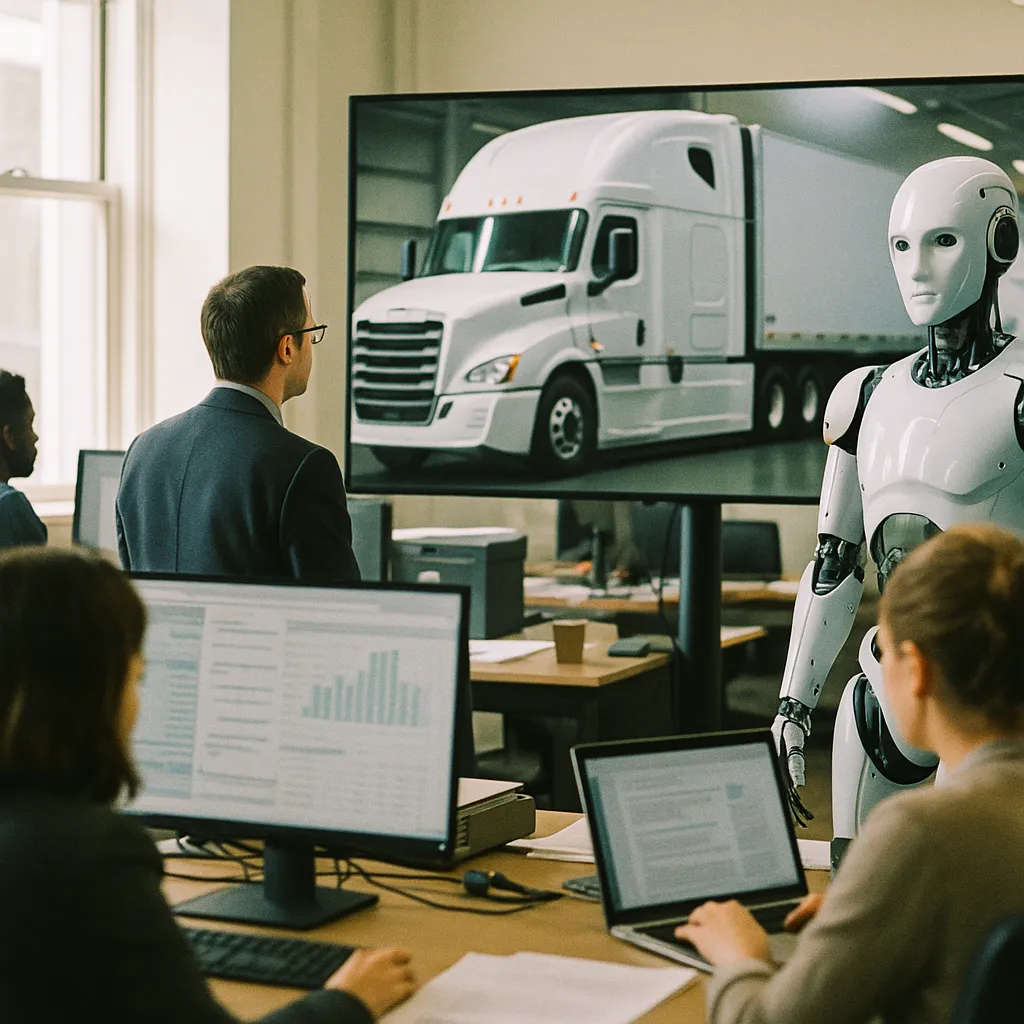
PepsiCo has deployed 41 fully driverless Gatik trucks across Arizona, Texas, and Arkansas to deliver Frito-Lay products to Walmart and Dollar General stores — the largest autonomous commercial delivery fleet in U.S. history. The operation runs without safety drivers. The backing: a $600 million multiyear commitment from PepsiCo. This isn't a research pilot. It's a production logistics deployment at a scale that changes what "commercial readiness" means for autonomous trucking.
Standard Bots closed a $200 million Series C at a $1 billion valuation, making it America's largest manufacturer of AI-native industrial robots. Its customer list — Amazon, Lockheed Martin, the U.S. Army — signals where the demand is coming from: defense, logistics, and heavy manufacturing. As concerns about supply chain dependence on overseas manufacturers grow, American-built AI robotics is becoming a strategic purchasing category, not just a preference.
Nvidia and Hyundai announced a $5.9 billion AI and robotics co-development hub in South Korea powered by 50,000 Blackwell GPUs. The significance is in the relationship change: Nvidia transitions from chip supplier to joint development partner, embedding itself in how Hyundai designs its next-generation manufacturing systems and autonomous mobility platforms.
Get this in your inbox.
Daily AI intelligence. Free. No spam.
Infrastructure: Data Centers, Grids, and Neighbors
Nvidia and startup Emerald AI have partnered with six major U.S. utilities — AES, Constellation, Invenergy, NextEra, Nscale, and Vistra — to operate AI data centers as dispatchable grid resources. The system uses real-time load throttling to let data centers absorb or shed power in response to grid conditions. The pitch to utilities: AI infrastructure isn't just a demand problem, it's a flexibility asset. Whether that holds in practice — and whether regulators will formalize it — is the next question.
At the same time, AI data center construction spending has reached parity with general office construction in the U.S. That number is getting felt at the local level. In Louisiana, Arizona, Michigan, and Texas, community opposition is intensifying over water consumption, grid burden, and the conversion of agricultural and residential land to industrial use. The infrastructure boom that looked like pure economic development is now producing genuine political friction.
Policy: Washington Makes a Trade, New York Draws Lines
The White House and congressional negotiators are structuring a deal that would federally preempt select state AI regulations in exchange for passing the Kids Online Safety Act and the NO FAKES Act. The structure: states get protections for children online and against AI-generated deepfake likenesses, but give up the ability to enforce certain AI regulations under their own laws. States with active AI legislation — California, Colorado, Texas, Illinois — stand to lose the most regulatory authority. The precise scope of what gets preempted is still being negotiated, and that language will determine whether this is a narrow carve-out or a broad rollback.
New York City's Department of Education is finalizing an AI playbook expected to release this month. The policy prohibits using AI for grading student work, making disciplinary decisions, or developing IEPs — individualized education plans for students with disabilities. The guidance applies across the nation's largest school district, serving more than one million students. No major U.S. district has drawn harder limits on AI in high-stakes student decisions. Other districts will be benchmarked against it.
Finance: Credit Infrastructure Gets an Agentic Layer
Experian launched Agent OS — an AI orchestration system embedded in its credit platform — that lets financial institutions automate lending decisions and fraud detection with built-in governance and audit trails. The product is designed to give lenders agentic automation without sacrificing the compliance documentation regulators require. The strategic significance: Experian isn't building a bolt-on AI add-on. It's embedding agentic capability into the infrastructure that credit markets run on.
What to Watch Today
The federal AI preemption deal is still being negotiated. Watch for state AG responses — particularly from California and Colorado, which have the most developed AI regulatory frameworks — as the contours of what gets preempted become clearer. The exact scope of preemption is the fulcrum this deal turns on.
PepsiCo's autonomous trucking deployment is the clearest proof point yet that commercial-scale driverless logistics is operational in the U.S. Labor and regulatory responses will follow. Watch for statements from the Teamsters and from state transportation agencies in Arizona, Texas, and Arkansas where the trucks are already running.
The NYC DOE AI playbook is due this month. When it publishes, the ed-tech industry's response — and the response of vendors already contracted with the district — will indicate how much political weight the restrictions carry.
Did this help you understand AI better?
Your feedback helps us write more useful content.
Get tomorrow's AI briefing
Join readers who start their day with NexChron. Free, daily, no spam.