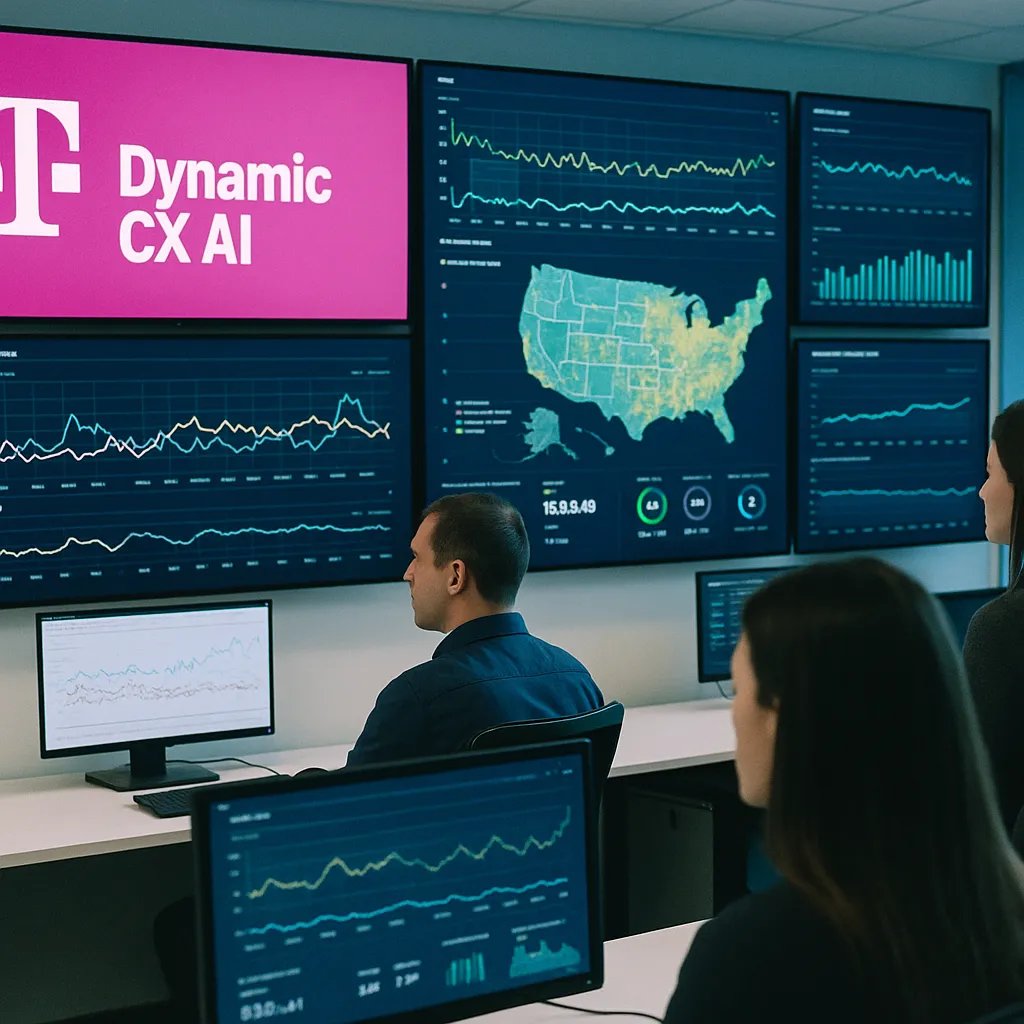
T-Mobile and Ericsson have commercially deployed the world's first AI-native Radio Access Network scheduler, replacing decades-old static algorithms with a continuously learning model that optimizes spectral efficiency in real time.
T-Mobile and Ericsson Just Turned On the World's First AI-Native Cell Network
By Hector Herrera | June 6, 2026 | Telecom · Company News
T-Mobile and Ericsson have commercially deployed the world's first AI-native Radio Access Network (RAN) scheduler — a system that replaces the decades-old static algorithms that tell cell towers how to allocate airwaves with a machine learning model that continuously adapts in real time. The announcement marks the most significant architectural change to cellular network management since the introduction of 4G.
The deployment moves AI from being a peripheral optimization tool in network management — the "intelligent" features that carriers have added incrementally for years — to the core scheduling logic that every wireless transmission passes through. This distinction matters: previous AI network features sat alongside traditional schedulers and influenced decisions at the margins. The AI-native scheduler is the decision-maker.
What a RAN Scheduler Actually Does
If you're not a network engineer, here's the relevant background: the Radio Access Network (RAN) is the infrastructure that connects your phone to the cellular system — the antennas, base stations, and the software that manages them. The scheduler is the algorithm inside a base station that decides, in real time, which of the hundreds of connected devices gets airwave access at each microsecond, and how much bandwidth each device receives.
For 30 years, schedulers have operated on rule-based systems: fixed algorithms that prioritize devices based on signal strength, queue position, and service tier. These rules were written by engineers and updated through manual software releases. They are efficient at average conditions but inflexible at the edges — heavy traffic events, interference spikes, unusual device behavior — exactly the conditions that cause network congestion and call drops.
An AI-native scheduler replaces those static rules with a model that learns continuously. It adapts to interference patterns that weren't present when it was trained, adjusts for device behavior it's never seen before, and optimizes for spectral efficiency — how much data is transmitted per unit of spectrum — across varying real-world conditions.
The Commercial and Technical Significance
Ericsson positioned this deployment as foundational to a fully autonomous network management era converging with the industry's 6G transition. That's a long-horizon claim, but the near-term implications are concrete.
Get this in your inbox.
Daily AI intelligence. Free. No spam.
Spectral efficiency gains translate directly to network capacity without additional spectrum or hardware investment. If the AI-native scheduler delivers measurably better efficiency across T-Mobile's cell sites, the carrier can handle more devices and more data traffic without the capital expenditure of deploying additional infrastructure. For a carrier competing with AT&T and Verizon on both coverage and plan pricing, that's a structural cost advantage.
Continuous learning means the network improves over time without manual software releases. Traditional RAN software updates are managed, tested, and rolled out on quarterly or longer cycles. A continuously learning model updates from operational data in near-real-time — a fundamentally different development and operations model for network infrastructure.
6G readiness is the longer game. 6G specifications under development by bodies including 3GPP explicitly envision AI-native air interfaces — the idea that AI isn't added on top of the communications standard but is embedded in the protocol itself. T-Mobile and Ericsson's commercial deployment creates operational experience with AI-native network management at scale, giving them a head start on the architecture that 6G is expected to require.
What This Means for the Industry
Every major network equipment vendor — Nokia, Huawei, Samsung, ZTE — has AI-in-RAN research programs. Ericsson's claim of a commercial first in a production T-Mobile deployment is a meaningful milestone because it creates a reference point. Enterprise procurement at carriers is intensely benchmarked against competitive deployments; a confirmed commercial first accelerates T-Mobile competitors' timelines to match it.
For other carriers — AT&T, Verizon in the U.S.; Vodafone, Deutsche Telekom in Europe; NTT Docomo and SoftBank in Japan — the relevant question is how quickly they can replicate a comparable deployment with their own network vendors. The answer depends on whether their existing RAN infrastructure is compatible with AI-native scheduling upgrades or requires hardware replacement.
Open RAN (O-RAN) adds a layer of complexity. T-Mobile is a significant O-RAN advocate; O-RAN architecture separates hardware from software and theoretically allows AI-native scheduling software to run on multi-vendor hardware. But AI-native scheduling in a traditional, integrated Ericsson stack is a different technical problem than deploying it in a fully disaggregated O-RAN environment. Carriers running mixed or O-RAN infrastructure will have a different integration path.
What to Watch
Performance benchmarks from the deployment will be closely scrutinized. Ericsson has released the milestone announcement; the specific efficiency gains — percentage improvement in spectral efficiency, reduction in congestion events, throughput increases under load — will be reported in subsequent technical disclosures and potentially in T-Mobile's investor communications.
Regulatory attention is a reasonable expectation. AI systems making real-time decisions about network resource allocation are not currently subject to any specific AI regulatory oversight in the U.S. As AI-native network management scales, questions about algorithmic transparency, network neutrality compliance, and potential for discriminatory traffic prioritization will eventually reach the FCC's agenda.
6G timeline implications should not be overstated. 6G commercial deployment is not expected before 2030 at the earliest. But the race to establish operational AI-native network experience is happening now, and today's announcement gives T-Mobile and Ericsson a head start that network equipment development cycles — which run 3-5 years — make difficult to close quickly.
The AI-native RAN scheduler is a genuine infrastructure inflection point. The static rules that have governed how your cell signal is managed since the 1990s are being replaced, in commercial production, with a model that learns. What that looks like in network performance terms — and in competitive market terms — will become clear over the next 12 months of operational data.
Did this help you understand AI better?
Your feedback helps us write more useful content.
Get tomorrow's AI briefing
Join readers who start their day with NexChron. Free, daily, no spam.