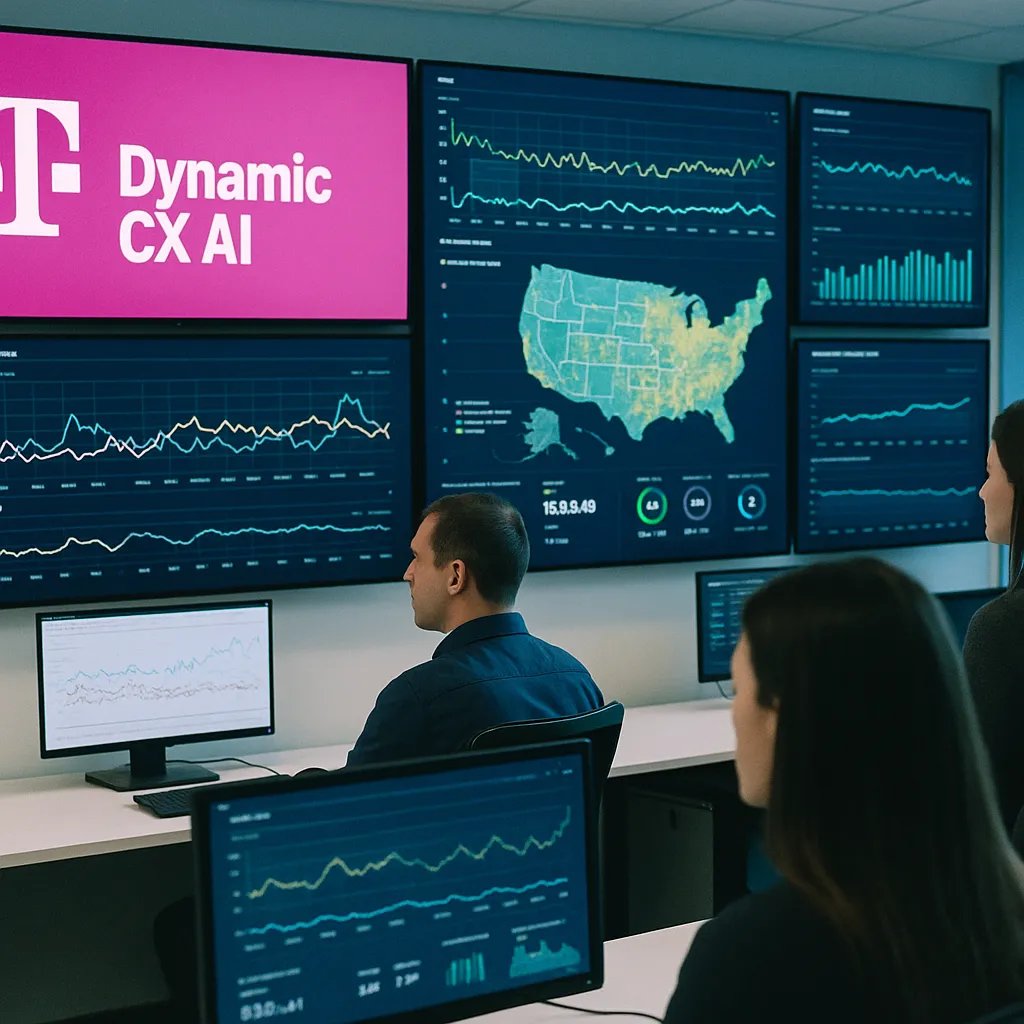
T-Mobile's Dynamic CX uses AI to optimize network performance in real time at crowded events, marking 2026 as the year AI-powered autonomous network operations move from pilot to production for Tier 1 carriers.
T-Mobile Deploys Dynamic CX AI to Optimize Networks in Real Time During Peak Events
T-Mobile launched Dynamic CX in early June 2026, an AI-powered network optimization system that adapts performance in real time during crowd-dense events — concerts, sporting matches, public gatherings — where traditional static configurations fail under concentrated demand. The deployment moves AI from telecom pilots into commercial production operations, and analysts now identify 2026 as the year AI-powered autonomous network management transitions from experimental to commercial standard for Tier 1 carriers.
The significance isn't the technology itself — AI network management has been in trials since 2023. It's the timing. A major U.S. carrier is running it in production, which changes how the whole industry prices the risk of following suit.
What Dynamic CX Actually Does
Traditional wireless networks operate on static capacity allocations. A cell tower serving a stadium has predetermined bandwidth limits per device class, and those limits don't adjust in real time regardless of how many people show up or what they're doing.
Dynamic CX replaces that static model with a continuous AI inference loop. The system monitors real-time demand signals across every connected device in a geographic cluster, predicts congestion points before they materialize using event schedules and historical patterns, reallocates capacity dynamically across frequency bands and towers, and prioritizes traffic types — emergency services, voice calls, critical data — without requiring human operator intervention.
The practical result for consumers at a sold-out venue: fewer dropped calls and more consistent data performance during peak moments. The practical result for T-Mobile: more efficient use of existing spectrum and infrastructure, reducing the capital spend required to serve demand that previously required overbuilding.
The Broader AI-RAN Transition
Dynamic CX is one component of a broader industry shift toward AI-RAN — AI-native radio access networks (RAN refers to the portion of the wireless network connecting devices to the carrier's core infrastructure).
The conventional approach to network management involves human network operations centers staffed around the clock, responding to alerts and manually adjusting configurations. AI-RAN progressively replaces that human monitoring layer with continuous automated response, running faster and at a scale no human team can match.
The full AI-RAN stack being built at Tier 1 carriers covers four layers:
Get this in your inbox.
Daily AI intelligence. Free. No spam.
- Radio access — dynamic spectrum allocation and beamforming optimization
- Core network — traffic routing, enterprise network slices, fraud detection
- Edge compute — latency-sensitive processing pushed closer to the device
- Operations — predictive maintenance, automated fault isolation, zero-touch service delivery
Dynamic CX sits primarily at the RAN and operations layers. The architecture supports expansion to core and edge functions as the AI model accumulates more operational data and T-Mobile builds confidence in autonomous decision-making at greater scope.
What This Means for the Business Model
The capital efficiency angle matters more than it might initially appear. Wireless carriers spent 2019–2024 in an expensive 5G buildout cycle — spectrum auctions, tower densification, mid-band coverage expansion. That cycle is largely complete for T-Mobile, AT&T, and Verizon. The next growth phase is not about adding infrastructure; it's about extracting more value from the infrastructure that already exists.
AI network optimization directly enables that model. If Dynamic CX serves an additional fraction of peak event demand using existing towers and spectrum — without adding hardware — the return on AI investment compounds quickly and the cost per served subscriber declines.
For enterprise clients, AI-native networks enable a new product category: guaranteed network performance slices. A stadium operator or event promoter can purchase contractually guaranteed minimum performance levels for their venue — a commitment a static network can't reliably price but an AI-optimized network can fulfill and verify. That's a new revenue stream for carriers, layered on top of existing connectivity contracts.
Vendors Behind the Shift
T-Mobile has not disclosed its full Dynamic CX vendor stack. The commercial AI-RAN market is concentrated around Ericsson and Nokia — whose hardware underpins most major carrier networks globally — both of which are moving aggressively toward AI-native software products running on their existing installed base.
Both companies face a strategic imperative. Hardware margins on 5G equipment are compressing as the buildout phase ends. AI network software and managed services are their primary growth story for the next five years. T-Mobile's production deployment creates the reference case their enterprise sales teams need.
A secondary market of AI-RAN software startups — including companies integrating with O-RAN open architecture standards — is also active, though none have the installed base access that Ericsson and Nokia hold.
What to Watch
Ericsson and Nokia AI-RAN contract announcements in the second half of 2026 will indicate whether T-Mobile's deployment is the leading edge of rapid industry adoption or an isolated early mover.
Regulatory treatment of autonomous network decisions is an emerging policy question. If an AI system autonomously deprioritizes certain traffic types during congestion, what are the net neutrality implications? The FCC has not issued guidance on AI-managed network prioritization, and that gap will need to be addressed as autonomous operations expand in scope and visibility.
The near-term watch item is scale. Dynamic CX running at specific venues is a contained, bounded deployment. The next phase — AI-autonomous management of the full national network, handling decisions that today require human NOC operators — is on T-Mobile's roadmap. That transition will happen in the 2027–2028 window if current deployments perform as expected. When it does, the economics of running a wireless carrier change materially.
By Hector Herrera
Did this help you understand AI better?
Your feedback helps us write more useful content.
Get tomorrow's AI briefing
Join readers who start their day with NexChron. Free, daily, no spam.