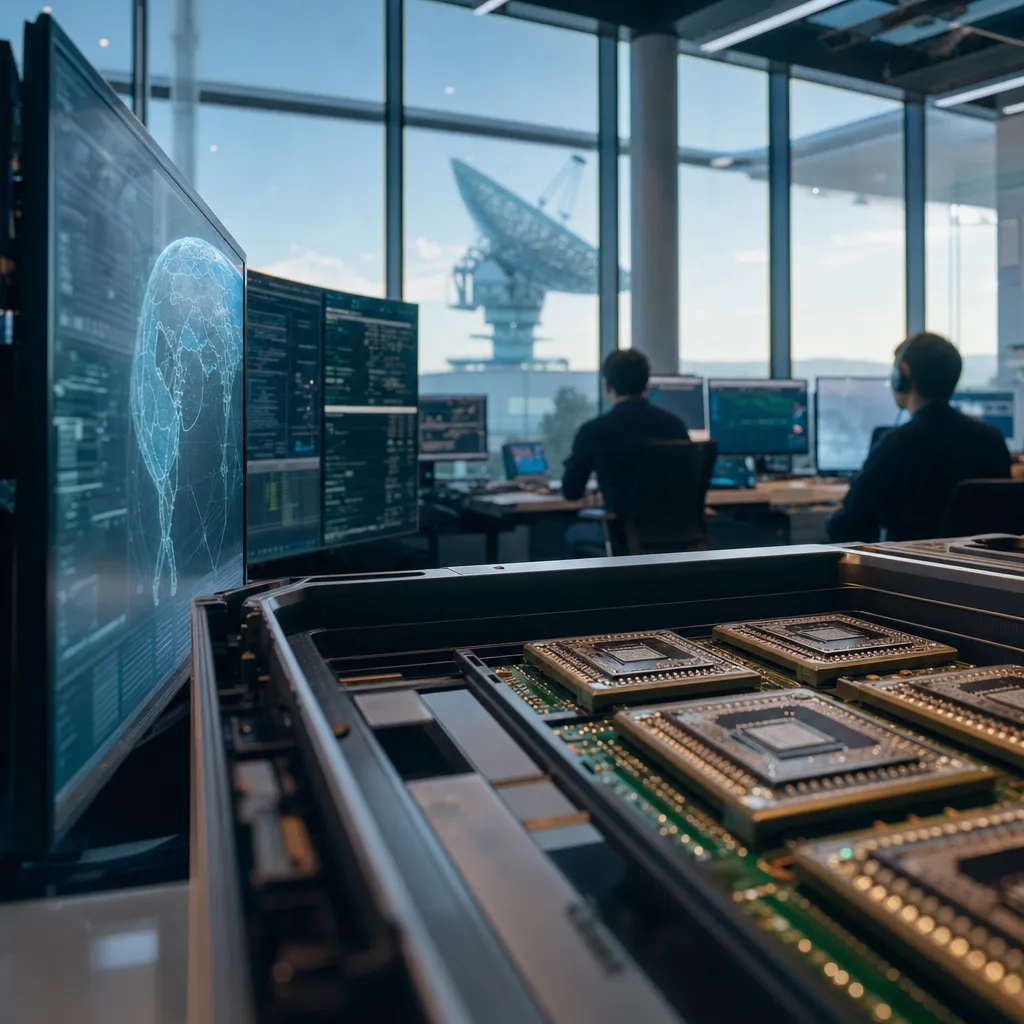
Ericsson CEO Per Narvinger says proprietary AI-optimized RAN chips — not off-the-shelf NVIDIA or Qualcomm silicon — will decide who wins the 6G era, as open-network architecture and SpaceX's planned 5G network threaten the existing duopoly.
Ericsson CEO Bets on Proprietary AI Chips as 6G and Satellite Competition Threaten the Telecom Equipment Duopoly
By Hector Herrera | November 11, 2026 | Telecom
Ericsson CEO Per Narvinger said on November 10 that the company is betting its competitive future on in-house AI-optimized radio access network (RAN) chips — purpose-built silicon for processing wireless signals, not repurposed from general AI chip designs. The argument: off-the-shelf components from NVIDIA or Qualcomm cannot match what proprietary silicon delivers for the physics of 5G and 6G radio processing. It's a direct response to the pressure Ericsson faces from two directions: open-network architectures that commoditize its hardware and satellite-based 5G networks that threaten to bypass ground-based equipment entirely.
The Duopoly Under Pressure
Ericsson and Nokia have shared near-total dominance of the Western telecom equipment market since Huawei was effectively shut out in 2019–2020. That position looked stable — until two forces began converging.
Open RAN (O-RAN) architecture allows mobile network operators to build their networks using standardized, interoperable hardware from multiple vendors instead of proprietary end-to-end systems from a single provider. If a Verizon or Deutsche Telekom can mix baseband processors from one vendor with radios from another, Ericsson's integration advantage evaporates. The O-RAN Alliance has 300+ member companies, and while full commercial deployments remain limited, operator interest is real.
Satellite-based RAN is the longer-term threat. SpaceX's planned fourth U.S. 5G network — expected to begin commercial operation in 2027 — and Amazon's Project Kuiper are both building coverage economics that could undercut traditional terrestrial RAN in certain markets, particularly rural coverage and international deployments. If significant traffic migrates to satellites, the addressable market for ground-based RAN equipment shrinks.
The Silicon Strategy
Digitimes reported that Narvinger's argument rests on a specific technical claim: radio signal processing for cellular networks has extremely demanding real-time latency requirements — sub-millisecond — and highly predictable workload profiles that differ fundamentally from the variable, batch-oriented workloads GPU architectures are optimized for. Ericsson's proprietary baseband chips are designed around those constraints from first principles.
Get this in your inbox.
Daily AI intelligence. Free. No spam.
The company says its silicon delivers measurably better energy efficiency (critical as operators face rising power costs and sustainability pressure) and latency performance (critical for 6G's target use cases, including industrial automation and augmented reality) compared to equipment built on commodity processors.
Ericsson is also rolling out AI-native network automation tools — software that uses machine learning to optimize network configurations in real time. The company's argument is that this software performs better when running on hardware designed for it, reinforcing the proprietary stack.
What Operators Actually Care About
For mobile network operators — Verizon, AT&T, Deutsche Telekom, NTT Docomo, Vodafone — the chip strategy question is whether Ericsson's performance claims justify staying on a proprietary stack instead of pursuing O-RAN flexibility. The operators who have been most aggressive about O-RAN exploration (Dish in the U.S., Rakuten in Japan) tend to be newer entrants or operators trying to differentiate on cost. The largest, most conservative operators have been slower to move.
Ericsson's bet is that the performance gap between proprietary and commodity silicon remains wide enough — particularly at the 6G air interface (the radio signal processing layer) — that large operators will choose performance over flexibility when it matters. The 6G standardization process is expected to reach its first technical specification milestones in 2027–2028, giving Ericsson a narrow window to establish silicon leadership before the standard locks in and competitors converge on the same architecture.
What to Watch
SpaceX's terrestrial 5G network is the most significant near-term disruption risk. If it launches on schedule in 2027 and proves economically competitive with traditional RAN in coverage economics, the total addressable market for ground-based equipment shrinks, making the O-RAN vs. proprietary debate less important at the margins.
6G standardization milestones in 2027–2028 are the medium-term checkpoint. Watch for Ericsson to publish comparison data showing energy and latency performance differentials between its silicon and O-RAN-based alternatives. If the data is compelling, it will attract operators who care more about network performance than vendor diversity. If it isn't, the O-RAN momentum will accelerate.
Ericsson's next earnings call will signal whether large operator customers are committing to its next-generation silicon roadmap — or hedging with O-RAN trials.
Source: Digitimes
Did this help you understand AI better?
Your feedback helps us write more useful content.
Get tomorrow's AI briefing
Join readers who start their day with NexChron. Free, daily, no spam.