Why this matters
A comprehensive, plain-language guide to AI — what it is, how it works, where it is used, and what it means for your business and daily life.
What Is Artificial Intelligence? The Complete Guide
By Hector Herrera | April 12, 2026 | 13-minute read
TL;DR: Artificial intelligence is software that learns patterns from data to make decisions, generate content, or take actions — without being explicitly programmed for every scenario. Today's AI is dominated by large language models and neural networks trained on massive datasets. It is a general-purpose technology, not a single product. It is already embedded in medicine, law, manufacturing, finance, and daily consumer life. It is also narrow, brittle in new situations, prone to error, and subject to the biases in its training data. This guide explains all of it.
What AI Actually Is (The Plain-Language Definition)
Artificial intelligence is a field of computer science and a category of software systems that can perform tasks which, until recently, required human judgment. That includes recognizing images, translating languages, writing text, diagnosing medical conditions, routing traffic, and hundreds of other jobs.
The key word in every useful definition of AI is learn. Traditional software follows explicit rules a programmer writes: if this condition, then that action. AI systems instead learn rules from examples. You show a system ten million labeled photos of cats and dogs, and it builds its own internal rules for distinguishing them — rules no human ever wrote down.
That shift — from hand-coded logic to learned patterns — is what makes AI powerful and, at the same time, what makes it unpredictable. The system knows what the training data taught it. No more, no less.
AI is not one thing. The term covers a broad family of techniques:
Machine learning (ML): Systems that improve at a task by processing data.
Deep learning: A subset of ML using layered neural networks to find patterns in complex data like images and language.
Generative AI: Systems trained to produce new content — text, images, code, audio, video — rather than just classify or predict.
Reinforcement learning: Systems that learn by trial and error, receiving rewards for good outcomes.
These are not competing definitions. A modern AI product often combines several of them.
A Brief History: From Theory to Utility
The intellectual foundations of AI stretch back to the 1940s, when mathematicians began asking whether machines could think. Alan Turing proposed his famous test in 1950. The term "artificial intelligence" was coined at a Dartmouth workshop in 1956, where researchers were optimistic they would have human-level machines within a decade.
That optimism proved premature. The field went through two major "AI winters" — funding droughts in the 1970s and late 1980s — when progress stalled and promises outran results.
The modern era of useful AI begins in 2012, when a deep learning model called AlexNet dramatically outperformed all previous approaches on a standard image recognition benchmark. The key ingredients had finally converged: large labeled datasets, cheap parallel computing via GPUs, and refined neural network architectures.
What followed was rapid progress across domains: speech recognition, machine translation, game-playing, protein structure prediction. Then, in 2017, researchers at Google published "Attention Is All You Need," introducing the transformer architecture. That paper, more than any other single development, explains why AI is where it is today.
How Modern AI Works: Neural Networks and Transformers
Neural Networks
A neural network is a mathematical structure loosely inspired by the brain. It consists of layers of nodes (neurons), where each node takes inputs, multiplies them by learned weights, applies a mathematical function, and passes the result forward. The network learns by comparing its outputs to correct answers and adjusting weights — a process called backpropagation — thousands or millions of times over a training dataset.
The word "deep" in deep learning refers to networks with many layers. A shallow network might have two or three. A modern large language model has dozens or hundreds of layers, with billions of parameters — individual numerical weights — that the training process has tuned.
What a trained network actually contains is not a list of facts or rules. It is a high-dimensional geometric arrangement of weights that, when you present an input, produces a useful output. This is why neural networks are hard to interpret: the "knowledge" is distributed across billions of numbers with no obvious human-readable meaning.
The Transformer Architecture
The transformer is the architecture underlying virtually every major language model today — GPT-4, Claude, Gemini, Llama, Mistral, and hundreds of others. Its key innovation is the attention mechanism: a way for the model to weigh the relevance of every word (or token) in a sequence against every other word when producing a prediction.
Before transformers, language models processed text sequentially — word by word, left to right — and struggled to connect distant parts of a sentence. The transformer reads the entire sequence at once, computing relationships between all parts simultaneously. That is why it scales so well: more data and more compute produce dramatically better results, a property called scaling laws.
A large language model (LLM) is a transformer trained on enormous text corpora — essentially large portions of the public internet, digitized books, and code repositories — to predict the next token in a sequence. Prediction sounds modest. But a model trained to predict text at massive scale, over long enough training runs, develops representations of grammar, facts, reasoning patterns, and world knowledge as byproducts. The result is a system that can answer questions, write code, summarize documents, and translate languages — not because it was explicitly programmed to do those things, but because doing them accurately requires good next-token prediction.
Types of AI: Narrow, General, and Everything In Between
Narrow AI (What We Have Now)
Every AI system deployed commercially today is narrow AI — also called weak AI or applied AI. It is extremely good at specific tasks it was trained for and brittle outside that domain.
A radiology AI that identifies tumors in chest X-rays with 95% accuracy cannot look at a photograph of a dog and tell you what breed it is. A language model that writes elegant prose will confidently produce plausible-sounding but factually wrong information on topics underrepresented in its training data. These are not bugs to be patched — they are inherent to how narrow AI works.
Narrow AI systems range from simple linear models and decision trees (used in fraud detection and credit scoring) to the large foundation models that power today's most visible applications. What unites them is that each system was optimized for a specific distribution of inputs and tasks.
Artificial General Intelligence (Not Here Yet)
Artificial general intelligence (AGI) refers to a hypothetical system with human-level reasoning across arbitrary domains — one that could learn a new task the way a person does, with minimal examples and broad transfer of prior knowledge. No such system exists.
The AI field debates whether current architectures are on a path toward AGI or whether fundamentally different approaches are required. Some researchers believe large enough transformers will eventually exhibit general reasoning. Others argue that language modeling is fundamentally limited and that embodied experience, causal reasoning, or entirely new architectures are necessary.
What is not debated: the systems deploying today are not AGI, and no credible researcher believes AGI will arrive on a precise schedule.
Agentic AI (The Current Frontier)
Between narrow task performance and AGI sits an emerging category: AI agents. An agent is an AI system that can take sequences of actions toward a goal, use tools (web search, code execution, APIs), and adapt its approach based on results.
Get this in your inbox.
Daily AI intelligence. Free. No spam.
Current agents are still narrow — they fail in new situations and require careful task design — but they represent a meaningful step beyond simple input-output models. Systems like computer-use agents can navigate software interfaces. Coding agents can write, run, and debug code in multi-step loops. Research agents can search, synthesize, and draft reports with minimal human intervention.
The Current State: LLMs, Image Generation, and What's Actually Deployed
Large Language Models in 2026
As of 2026, large language models are production infrastructure. They are embedded in customer service platforms, legal document review software, enterprise search, software development environments, healthcare triage systems, and consumer applications used by hundreds of millions of people daily.
The leading models — from Anthropic, OpenAI, Google, Meta, and a growing cohort of open-weight developers — are measured in hundreds of billions of parameters and trained on datasets that represent much of digitized human knowledge. Capabilities that were impressive demonstrations two years ago (summarization, basic question answering, code completion) are now table stakes. The competitive frontier has moved to reasoning, long-context retention, tool use, and multimodal understanding.
Open-weight models — where the trained weights are publicly released — have significantly narrowed the gap with proprietary frontier systems, making enterprise deployment without API dependencies practical for the first time.
Generative Image, Video, and Audio
Diffusion models and related architectures can now generate photorealistic images, coherent short videos, and cloned or synthesized voices from text prompts. The same underlying techniques enable image editing, style transfer, and video interpolation.
Practical commercial applications include product visualization, advertising creative, architectural rendering, and entertainment production. The risks — synthetic media for fraud, disinformation, and non-consensual content — are equally real and the subject of active regulatory effort across multiple jurisdictions.
AI Agents and Automation
Agentic systems are moving from experimental to operational. Software engineering agents handle pull requests and bug fixes. Data analysis agents query databases, write visualizations, and produce reports. Customer-facing agents handle multi-turn service interactions without human escalation for a growing share of cases.
The limiting factors remain reliability and trust: agents fail in unexpected ways, and many tasks require accountability that cannot be delegated to a system that cannot explain its reasoning auditably.
AI Across Industries: Where It Is Being Applied
AI's impact is not uniform. The industries where data is abundant, tasks are well-defined, and error tolerance is higher have moved fastest. Industries with regulatory complexity, physical requirements, or high-stakes decisions are moving more carefully — but moving.
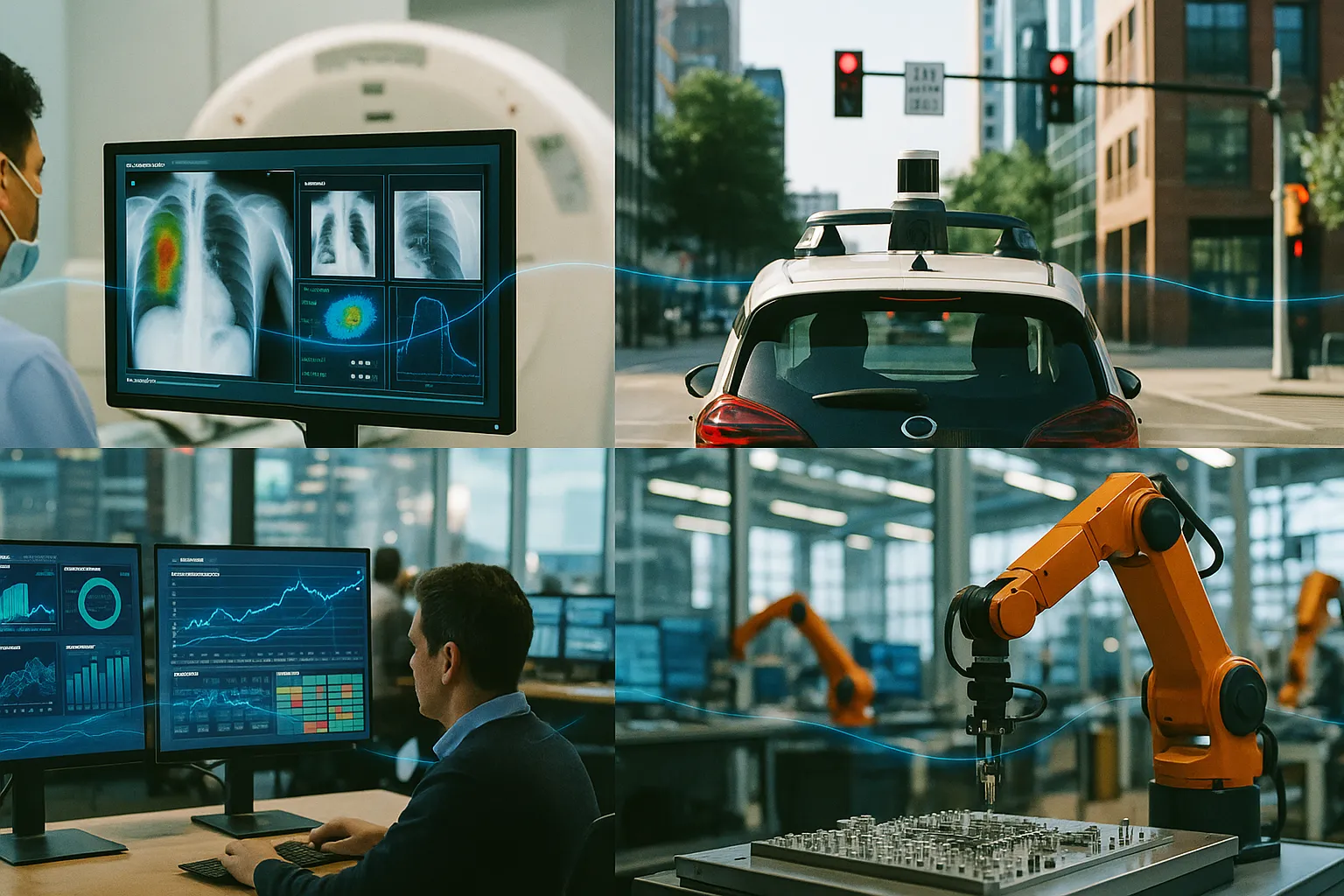
Healthcare: Diagnostic imaging AI is FDA-cleared for several radiology and pathology applications. Drug discovery pipelines use AI to screen molecular candidates. Clinical documentation tools reduce physician administrative burden. The caution is proportionate to stakes: AI errors in medicine have different consequences than AI errors in marketing copy. See NexChron's coverage of AI in healthcare.
Finance: Fraud detection, credit underwriting, algorithmic trading, and regulatory compliance screening all rely heavily on machine learning — much of it pre-dating the current LLM wave. Generative AI is being applied to client-facing advisory tools, financial document analysis, and internal research synthesis. See AI in finance.
Education: Personalized tutoring systems, automated essay feedback, and AI-assisted curriculum design are live in school districts and universities. The pedagogical questions — whether AI assistance aids or undermines learning — are genuinely unresolved. See AI in education.
Transportation: Autonomous vehicle development continues across passenger cars, trucking, and last-mile delivery robotics. Fully autonomous passenger vehicles remain geographically restricted; highway trucking and warehouse logistics are further ahead. See AI in transportation.
Energy: Grid optimization, predictive maintenance on infrastructure, and materials discovery for battery chemistry are active application areas. Energy demand from AI training and inference is itself a growing factor in grid planning. See AI in energy.
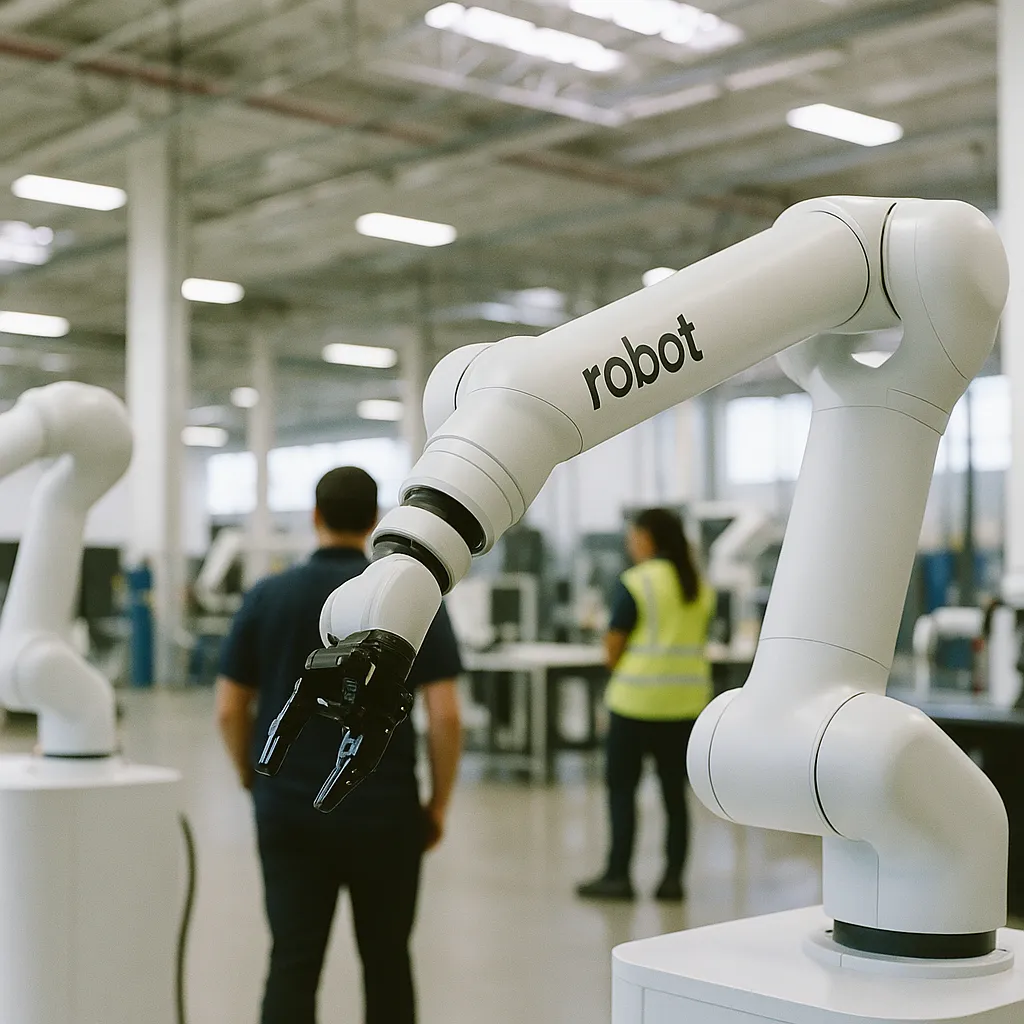
Manufacturing: Quality inspection via computer vision, predictive maintenance, and supply chain optimization are mature applications. Robotics with improved manipulation and vision is expanding AI's physical footprint on the factory floor. See AI in manufacturing.
Legal: Contract review, due diligence document analysis, and legal research tools are deployed at major firms. AI does not practice law, but it processes documents faster than humans can, at a fraction of the cost. See AI in law.
Agriculture: Crop monitoring via satellite and drone imagery, yield prediction, precision application of inputs, and early disease detection are reducing waste and increasing output per acre. See AI in agriculture.
Creative industries: Music composition tools, image and video generation, screenwriting assistance, and game asset production are live in commercial workflows. The economic and copyright questions are unresolved at law and at practice. See AI in creative industries.
Security: Threat detection in network traffic, malware classification, and automated vulnerability scanning are standard. Adversarial use — AI-generated phishing, deepfake fraud, automated attack generation — is the other side of the same coin. See AI in security.
Risks, Limitations, and Things AI Gets Wrong
No honest account of AI omits its failure modes. These are not hypothetical — they are documented in production systems.
Hallucination
Large language models generate text that is fluent and confident regardless of whether it is accurate. When a model lacks reliable training signal on a topic, it fills the gap with plausible-sounding content. This phenomenon — called hallucination — means LLM outputs require verification before acting on them in consequential contexts. The rate and type of hallucination varies by model and task; it has not been eliminated.
Bias and Representational Harms
AI systems trained on data generated by humans inherit the patterns in that data, including historical disparities in hiring, lending, policing, and representation. A resume screening model trained on past hiring decisions may encode preferences that disadvantage candidates from underrepresented groups. An image generation model trained on stock photography may systematically misrepresent professions by race or gender. These are not hypothetical risks — they have been documented in deployed systems.
Brittleness and Distribution Shift
A model trained on data from one distribution — say, chest X-rays from urban hospitals in wealthy countries — may perform significantly worse on data from different settings. The model has learned the patterns in its training data, not the underlying physical reality. When the world differs from the training distribution, performance degrades, sometimes catastrophically.
Security and Adversarial Attacks
AI systems can be manipulated. Image classifiers can be fooled by small perturbations invisible to humans. Language models can be induced to ignore their safety constraints through carefully crafted prompts (prompt injection). AI agents given access to tools can be hijacked by malicious content in their context. These are active research and engineering problems without complete solutions.
Concentration and Access
The most capable AI systems are expensive to train and are controlled by a small number of organizations. Access to frontier capabilities is mediated by commercial APIs with pricing, terms, and availability determined by those organizations. This creates dependency risks for businesses and raises questions about what happens to capabilities, pricing, and access over time.
What AI Cannot Do
The limitations are as important as the capabilities for anyone making decisions about AI deployment.
Current AI systems cannot:
Reliably reason about novel situations outside their training distribution
Understand causality — they find correlations, not causes
Know what they don't know (reliable uncertainty quantification remains an open problem)
Act in the physical world without robotic hardware (and current manipulation capabilities are limited)
Guarantee factual accuracy on any given output
These are not complaints about today's models that will be solved next quarter. Some are fundamental to the current paradigm; others are areas of active research with uncertain timelines.
The Future Outlook: What Is Likely, What Is Uncertain
What Is Likely
Capability will continue to improve. The scaling trend — more compute, more data, better performance — has not plateaued in a way that suggests it has ended, though the rate of improvement per dollar is subject to debate. Inference will get cheaper. Capable models will become accessible on consumer hardware. Agentic systems will handle longer-horizon, more complex tasks.
Integration will deepen. AI will become infrastructure in the same way databases, cloud storage, and APIs are infrastructure — present everywhere, rarely the point of the product itself.
Regulation will increase. The EU AI Act is in effect. The US, UK, China, and other major economies are developing governance frameworks. Compliance requirements for high-risk applications will increase deployment complexity.
What Is Uncertain
Whether current architectures lead to systems with substantially better reasoning — not just more fluent outputs — is genuinely unknown. Whether AI agents will be reliable enough for fully autonomous high-stakes tasks within five years is unknown. The economic effects on labor markets are debated among serious economists with access to the same evidence.
The appropriate level of skepticism is: believe demonstrated capabilities, not roadmap promises. AI has a long history of forecasts that missed timelines by years or decades in both directions.
Glossary Quick Reference
Key terms used throughout NexChron AI coverage, with dedicated entries in the NexChron Glossary:
Hector Herrera builds AI systems and writes about how AI intersects with every industry and institution. Finance articles include a financial disclaimer. Health articles include a medical disclaimer. About NexChron.
Hector Herrera is an AI systems architect and the founder of Hex AI Systems. He designs and runs AI systems in production and writes daily about how AI is reshaping business, government and everyday life. 20+ years building for the web. Houston, TX.