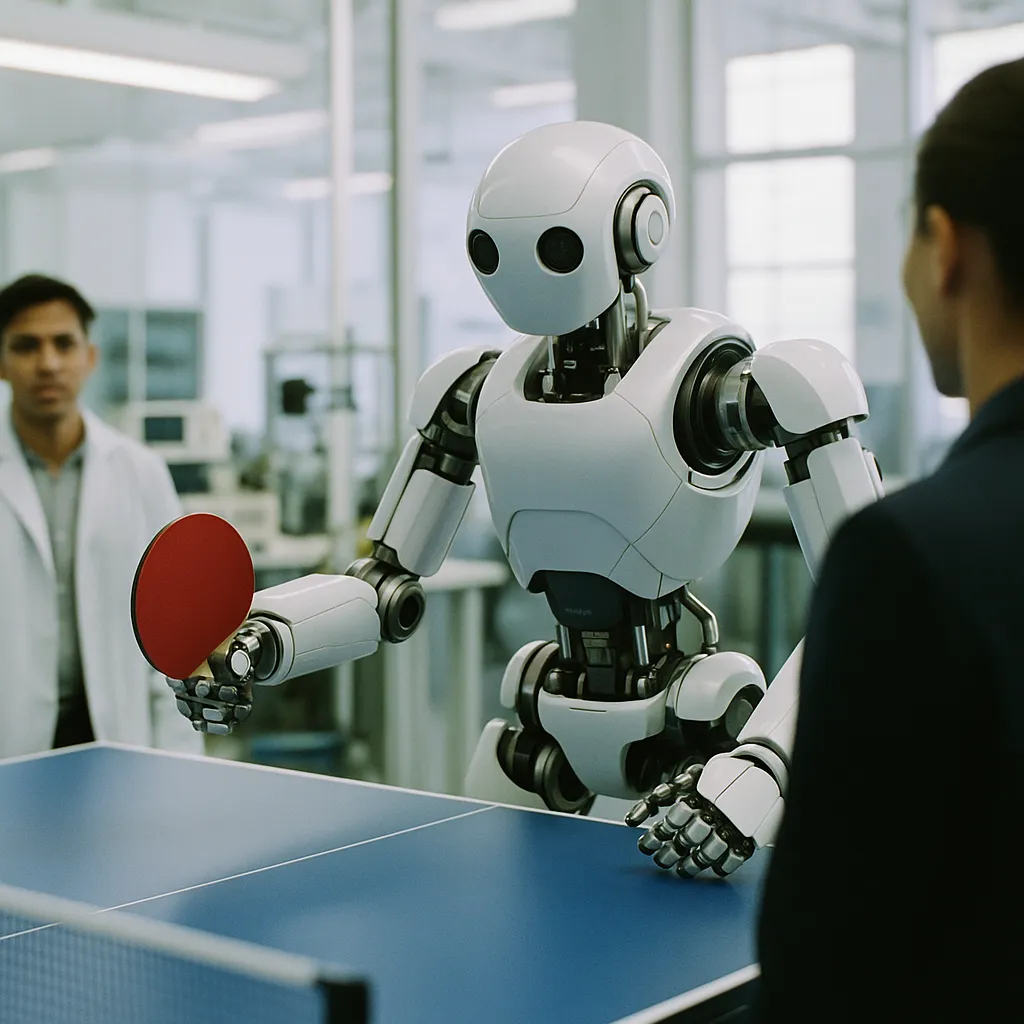
Sony AI's Project Ace built a robot that defeats elite human table tennis players under real-world conditions — published on the cover of Nature. The manufacturing implications reach far beyond sports.
Sony AI Robot Beats Elite Table Tennis Players — and the Real Story Is What It Means for Factories
By Hector Herrera | April 27, 2026
Sony AI built a robot that can beat elite, professional-level human table tennis players under real-world conditions — and published the result on the cover of Nature. The headline is impressive; the implications for manufacturing robotics and autonomous logistics are more important.
Background
Table tennis is one of the hardest physical challenges for a robot. A ball travels at speeds exceeding 100 kilometers per hour, spins in three axes simultaneously, bounces unpredictably off the table, and requires a response in milliseconds. Human players read spin from subtle paddle angles that change in fractions of a second. For decades, robotic systems could compete only against beginners or in heavily constrained lab conditions.
Project Ace, Sony AI's research initiative, published its results in Nature after demonstrating the system against elite and professional players — not amateurs, not constrained environments. The distinction matters because controlled lab performance has repeatedly failed to translate to real-world deployment in robotics.
Get this in your inbox.
Daily AI intelligence. Free. No spam.
What the System Does
- Project Ace combines real-time visual processing, physics modeling of ball spin, and motor control to react to shots that arrive within a 50–100ms window.
- The system performs at a level competitive with elite and professional human players — a tier that represents roughly the top fraction of a percent of all table tennis players globally.
- The result was peer-reviewed and published on the cover of Nature, indicating the methodology withstood scientific scrutiny, not just in-house benchmarks.
- The key technical advance is real-time processing of fast-moving, unpredictable physical environments — the system isn't executing scripted responses but reasoning about each shot as it arrives.
Why This Matters Beyond Sports
The challenge table tennis poses to a robot overlaps significantly with challenges in high-speed manufacturing and logistics:
- Variable objects at high speed — analogous to parts arriving on a conveyor at inconsistent orientations
- Real-time physics reasoning — the same capability needed to catch, sort, or place irregular components without pre-programming each scenario
- Adaptation to human partners — in collaborative manufacturing settings, robots need to respond to what a human co-worker does, not just execute a fixed routine
Sony AI explicitly frames Project Ace as a platform for embodied AI — AI systems that reason about the physical world in real time rather than processing text or images on a server. The table tennis result is the proof-of-concept. The downstream applications Sony is pointing toward include manufacturing robotics and autonomous logistics handling.
The Embodied AI Moment
Project Ace lands in the middle of a broader shift in how the robotics industry thinks about robot intelligence. Until recently, most industrial robots were programmed for specific, repeatable tasks — they were precise but brittle. Add an unexpected variable and they stop or fail.
What Sony demonstrated is a robot that handles unexpected variables in real time, at speeds that outpace human reaction time in some dimensions. That's the fundamental requirement for robots that can operate in unstructured environments — which describes most real factories, warehouses, and logistics facilities better than the idealized conditions most robots are tested in.
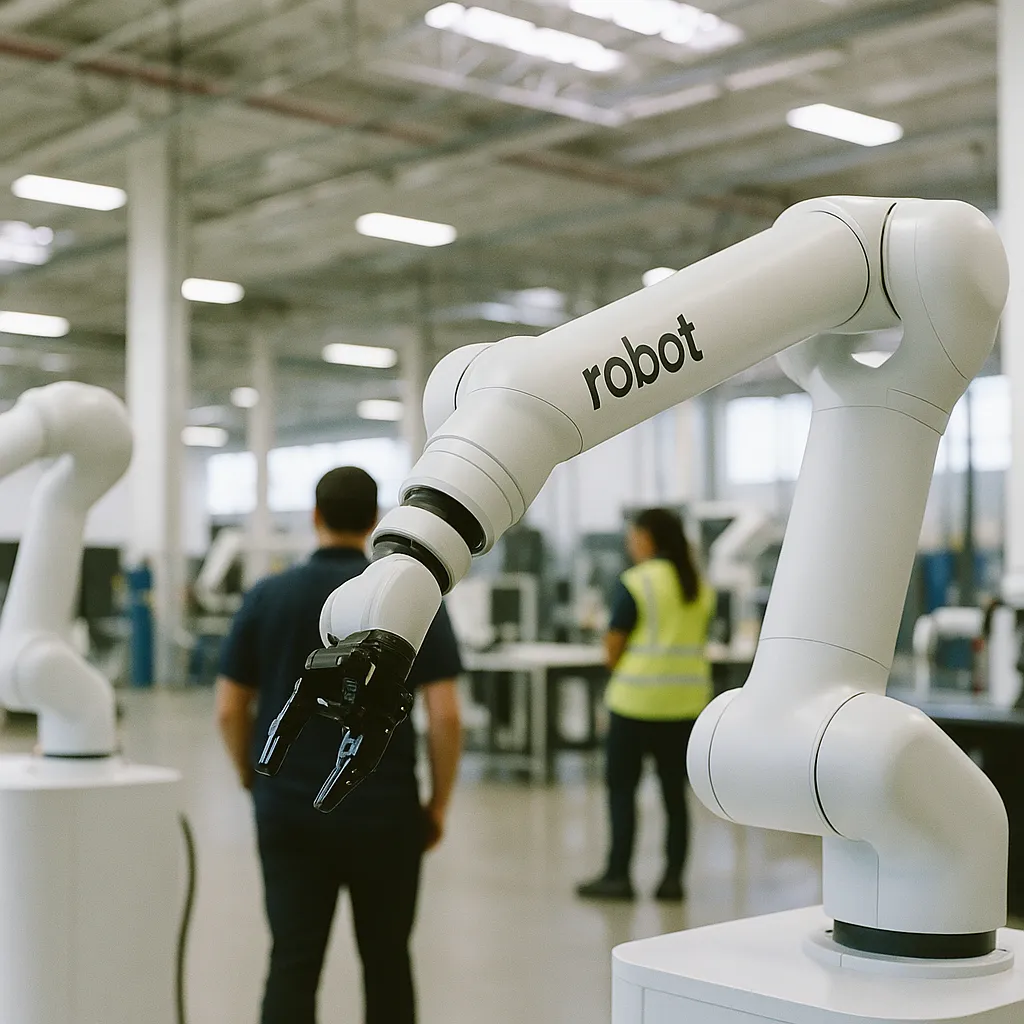
For manufacturers, this is the capability gap that's kept full automation out of reach in flexible production environments. A robot that can reason about a part it hasn't seen before, or adapt to a co-worker's movement, or handle an item that arrives in a non-standard orientation — that's what the industry needs to take automation past the bolt-tightening and welding operations where it already excels.
What to Watch
Sony hasn't announced a commercial timeline for Project Ace derivatives, and the gap from a research breakthrough to a deployed factory system is real. But watch for Sony's industrial robotics partners to move quickly on licensing the underlying perception and control architecture — and for this result to show up in competitive evaluations from Boston Dynamics, ABB, and Fanuc within the next 18 months. The Nature publication gives Sony something rare in robotics: a defensible, peer-reviewed performance benchmark that competitors have to beat to claim equivalence.
Did this help you understand AI better?
Your feedback helps us write more useful content.
Get tomorrow's AI briefing
Join readers who start their day with NexChron. Free, daily, no spam.