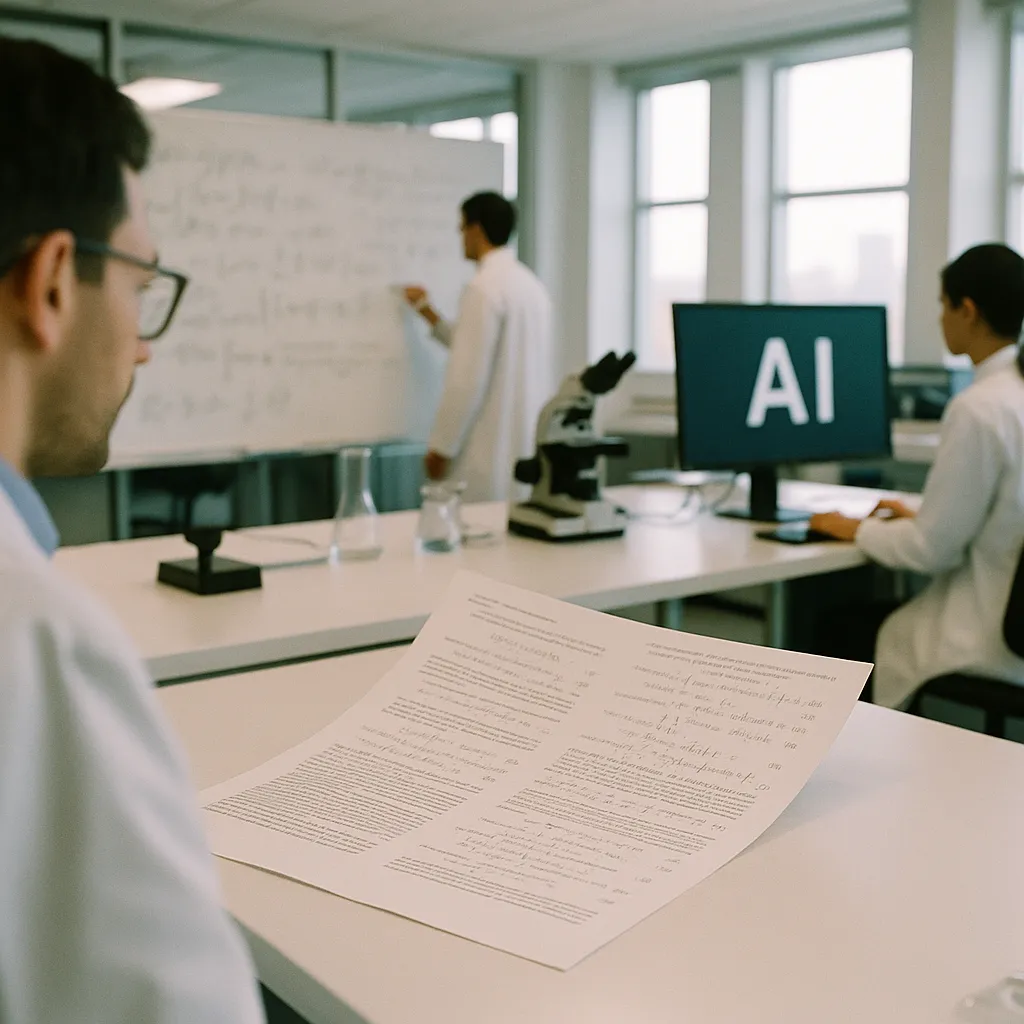
OpenAI published 722 mathematics manuscripts from an unnamed internal frontier model — including work touching the Riemann hypothesis and two other unsolved Millennium Prize Problems.
OpenAI published 722 mathematics manuscripts to a public GitHub repository on October 7, 2026 — work it attributes to an unreleased internal frontier model that the company has not yet named. The release is significant because three of the five remaining Millennium Prize Problems — including the Riemann hypothesis — are among the targets the model appears to have addressed.
The Millennium Prize Problems are seven unsolved mathematics challenges identified by the Clay Mathematics Institute in 2000, each carrying a $1 million award. Only one has been solved by a human: Grigori Perelman's proof of the Poincaré Conjecture in 2003. The remaining five — including the Riemann hypothesis, P vs NP, and the Navier-Stokes equations — have resisted every human attempt for decades. If any of the three the OpenAI model has "touched" holds up to peer review, it would be among the most consequential events in the history of mathematics.
What OpenAI Released
According to QZ's reporting on the GitHub release, the repository — openai/math — contains:
- 722 individual manuscripts organized into 372 families of results
- Coverage spanning pure mathematics, theoretical computer science, and mathematical physics
- Results touching three of the five remaining Millennium Prize Problems, including the Riemann hypothesis
- Cost per result: approximately three hours of ChatGPT Pro compute
The manuscripts are attributed to an unnamed "internal frontier model" that OpenAI has not publicly announced. The company provided no accompanying model card, technical report, or timeline for release.
Why This Is Different From Prior AI Math Claims
AI systems have made progress on mathematics benchmarks before — most notably Google DeepMind's AlphaProof, which in 2024 solved four of six problems from the International Mathematical Olympiad. But Olympiad problems, however difficult, are solved competition exercises with known answers. The Millennium Prize Problems are open research questions that have never been solved. "Touching" them — producing plausible partial results, conjectures with supporting derivations, or novel approaches — is a different category of claim.
OpenAI's framing is carefully hedged. The company did not announce proofs. It published manuscripts and invited scrutiny. Whether the results are correct, novel, or merely computational restatements of known approaches is a question that will take weeks or months of peer review to answer.
Get this in your inbox.
Daily AI intelligence. Free. No spam.
The Riemann hypothesis — which concerns the distribution of prime numbers and has implications across number theory, cryptography, and physics — is widely considered the most important open problem in mathematics. A confirmed proof or disproof would cascade through a hundred downstream fields.
What It Costs to Produce This Work
The three-hours-of-Pro-compute figure per result is notable. At current ChatGPT Pro pricing of $200/month with no hard per-session cap, that suggests the 722 manuscripts represent hundreds of thousands of dollars in inference compute — not the kind of expenditure any individual researcher could replicate, but well within reach for a major institution or well-funded lab.
The cost asymmetry matters: if AI systems can produce credible mathematical work at this scale for a few hundred dollars per manuscript, the economics of theoretical research change permanently. Graduate programs, national labs, and independent researchers will eventually have access to similar tools. OpenAI got there first, but the capability is not proprietary forever.
What This Means
For mathematics: Peer review will be the bottleneck. The mathematical community will need to work through 722 manuscripts to separate genuine advances from plausible-looking errors. That process takes time — but the raw material is now public.
For AI development: This is OpenAI's clearest signal yet that its next unreleased model operates at a fundamentally different capability level than GPT-4o or even o3. The company is using mathematics — the most verifiable of all knowledge domains — to demonstrate that gap before releasing the model commercially.
For research institutions: Universities and national labs that have been debating whether to integrate AI into theoretical research now have a harder question: can they afford not to, given what a commercial system just produced overnight?
What to Watch
The immediate question is peer review. Mathematicians at the Clay Mathematics Institute and leading university departments will begin examining the manuscripts; the first credible independent assessments should surface within weeks. Watch for OpenAI to announce the frontier model publicly — likely with a commercial launch tied to the research credibility this release establishes.
Sources: QZ / OpenAI GitHub, Clay Mathematics Institute Millennium Problems
Did this help you understand AI better?
Your feedback helps us write more useful content.
Get tomorrow's AI briefing
Join readers who start their day with NexChron. Free, daily, no spam.