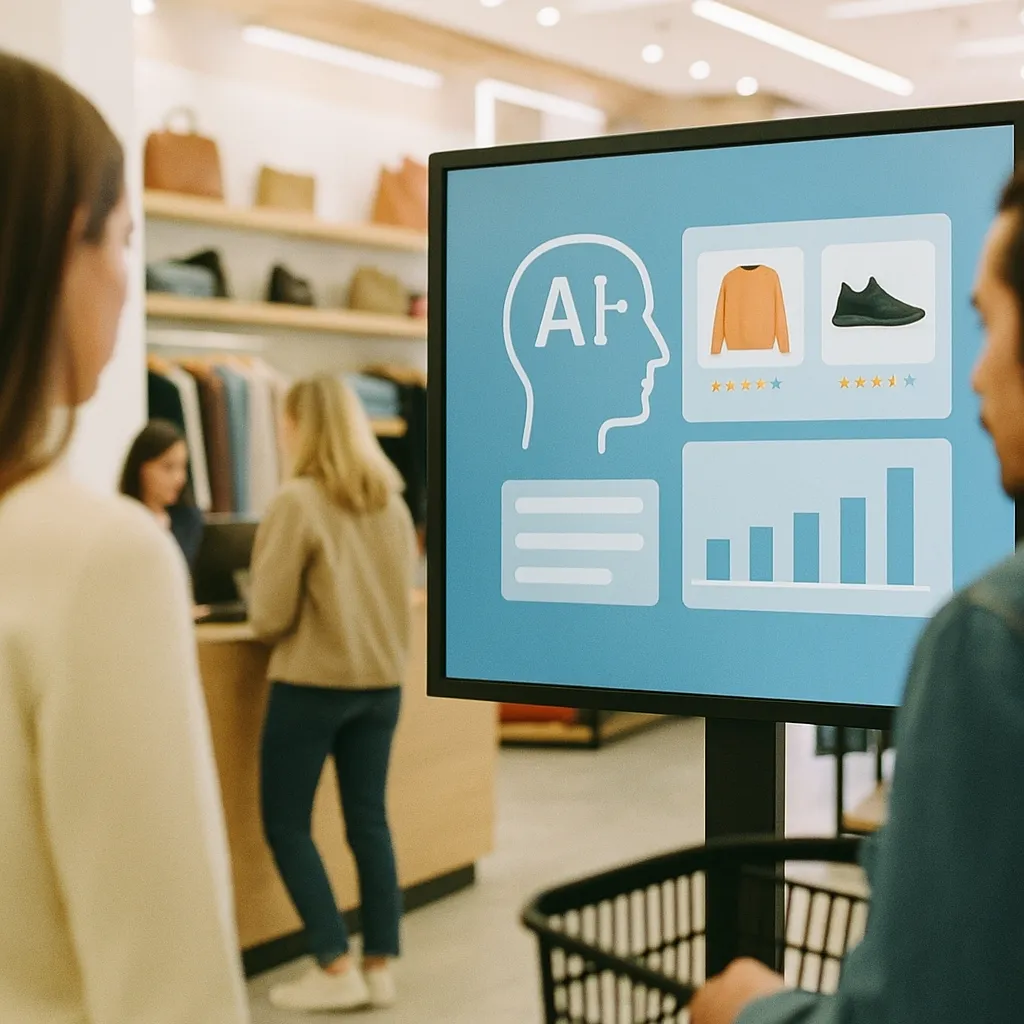
AI-powered recommendations now give brands a 2-to-1 purchase advantage, and U.S. ecommerce driven through AI platforms is projected to hit $20 billion in 2026, according to Similarweb's State of Ecommerce 2026 report.
AI Is Rewiring How Americans Shop Online — and $20 Billion in 2026 Sales Already Prove It
AI-powered buying recommendations now give recommended brands a 2-to-1 purchase advantage over non-recommended competitors — a finding from Similarweb's State of Ecommerce 2026 report that signals AI has moved from search optimization experiment to the controlling layer of how Americans discover and buy online.
U.S. ecommerce sales flowing through AI-powered platforms are projected to exceed $20 billion in 2026, according to eMarketer data cited in the Similarweb report. That figure is expected to reach $144 billion by 2029 — a seven-fold increase in three years driven almost entirely by AI becoming the default interface for product discovery, comparison, and conversion.
The Numbers Behind the Shift
The Similarweb data captures a structural change in consumer behavior, not a marginal one:
- 2:1 purchase advantage. When an AI system recommends a brand, that brand converts at roughly double the rate of competitors the AI doesn't surface. This is not a visibility play — it's a dominance play.
- Compressed research cycles. AI is collapsing the time between product awareness and purchase decision. Merchants that had historically finalized holiday campaigns in Q3 are now completing product selection and creative work months earlier to position for AI recommendation indexing.
- $20B in 2026, $144B by 2029. The trajectory embedded in the Similarweb report suggests AI-mediated ecommerce is not a niche channel. It's on course to become a primary distribution layer within this decade.
What AI Is Replacing — and Building
The traditional online shopper journey ran like this: search engine → results page → product page → cart. That funnel hasn't disappeared, but it's being disrupted at the discovery step. AI-powered shopping interfaces — whether embedded in ChatGPT, Google's AI Overviews, Amazon's Rufus, or emerging third-party recommendation engines — are increasingly handling product discovery before consumers ever reach a brand's own search or website.
For brands, this creates a new optimization problem. Traditional SEO targeted search engine crawlers. AI recommendation optimization works differently: it depends on how AI systems read, summarize, and rank product attributes, reviews, and brand signals across the web. A brand that ranks well in Google's organic results may not perform well in AI-mediated discovery if its structured data and product descriptions aren't legible to large language models.
The businesses already winning in this environment are the ones treating AI recommendation positioning as a channel — with its own budget, tracking metrics, and optimization workflows — rather than an extension of existing SEO.
Get this in your inbox.
Daily AI intelligence. Free. No spam.
The Amazon Effect
The scale of AI's ecommerce influence is partly a function of Amazon's market position. Amazon's Rufus AI [shopping assistant](/retail/amazon-rufus-ai-250-million-shoppers-prime-day-2026) is already serving 250 million shoppers, having launched as a core experience during Prime Day 2026. When an AI that recommends products is integrated into a platform where 250 million people shop, the 2:1 recommendation advantage isn't hypothetical — it's expressed on hundreds of millions of purchase decisions per year.
The same dynamic is developing on Google Shopping, where AI Overviews increasingly surface product recommendations before users reach organic listings. Google's broader [agentic commerce](/retail/agentic-ecommerce-393-percent-surge-2026) push is designed to go further, enabling AI agents to complete purchases autonomously on behalf of users — removing the human decision step from the funnel entirely in some use cases.
What This Means for Merchants
For brands selling through Amazon, Google Shopping, or other AI-integrated retail channels:
- Audit your structured data. Product descriptions, specifications, and reviews need to be machine-readable and accurate. AI recommendation systems degrade quickly on ambiguous or incomplete product information. An incomplete spec sheet that confused a human shopper is invisible to an AI shopper.
- Treat recommendation positioning as its own channel. If a 2:1 purchase conversion advantage is real at scale, AI recommendation share deserves its own measurement framework — separate from paid search, organic SEO, and display advertising.
- Move your planning calendar earlier. If holiday campaign infrastructure needs to be in place before AI systems establish their recommendation patterns for Q4, waiting until September is already too late.
For smaller brands and independent merchants: the AI recommendation advantage flows primarily to brands with comprehensive, high-quality product data and strong review signals. Catch-up investment in product data quality will matter more over the next three years than advertising spend as AI recommendation share grows.
The Bigger Picture
The Similarweb projections — $20B in 2026 growing to $144B by 2029 — imply that AI-mediated ecommerce must displace a significant portion of current search-mediated and social-mediated commerce to hit those numbers. That displacement is already happening at the discovery layer. The question for the next 18 months is whether it extends to the conversion layer: AI agents that don't just recommend products but complete purchases autonomously.
McKinsey's 2026 [agentic commerce](/retail/agentic-commerce-mckinsey-1-trillion-retail-2026) analysis puts the potential value of AI-driven commerce automation at $1 trillion in retail efficiency gains. The Similarweb data suggests that the underlying consumer behavior change needed to unlock that value is already underway — faster than most merchants have adjusted to capture it.
What to Watch
Regulatory attention is beginning to follow the money. The EU is already requiring disclosure on AI-generated content; AI-mediated purchase recommendations may be next on the transparency agenda. In the U.S., the FTC's interest in algorithmic consumer targeting is growing. Whether AI recommendation systems face disclosure requirements — "this brand was suggested by AI" — could materially change conversion dynamics if consumers respond differently to disclosed AI recommendations versus organic search results. That question will likely reach a regulatory decision point within the 2026–2027 window.
By Hector Herrera
Did this help you understand AI better?
Your feedback helps us write more useful content.
Get tomorrow's AI briefing
Join readers who start their day with NexChron. Free, daily, no spam.