Google released an open standard for AI agents to browse and buy across retailer inventory — a structural bid to become the connective layer of agentic commerce.
Google Launches Universal Commerce Protocol to Power the Agentic Shopping Era
By Hector Herrera | May 25, 2026 | Retail
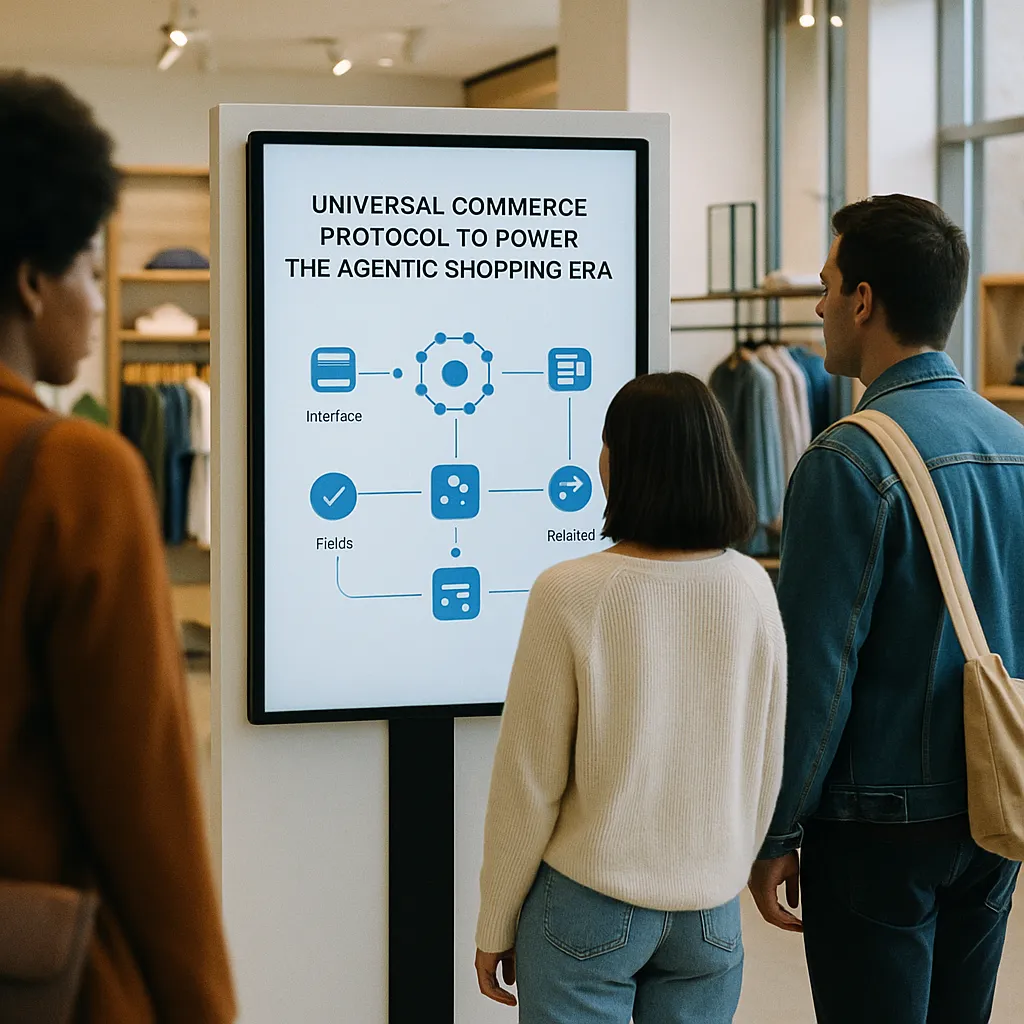
Google has released the Universal Commerce Protocol (UCP), an open standard designed to make retailer inventory and offer data readable by AI agents acting on behalf of consumers — a structural bid to become the connective layer between product databases and the next generation of AI-driven shopping. The protocol arrives as agentic commerce — where AI agents browse, compare, and complete purchases autonomously — is moving from concept to commercial reality.
The significance is not the individual tools Google announced. It is the architectural position Google is staking out: if AI agents are going to shop, Google intends to be the protocol they shop through.
What Google Announced
According to Google's official blog, the Universal Commerce Protocol package has three core components:
1. The Universal Commerce Protocol (UCP) itself — An open standard that allows retailers to structure their product data, inventory status, and pricing in a format that AI shopping agents can read and act on. Think of it as a structured API layer between retailer backends and AI agents, standardizing the handoff that currently happens inconsistently or not at all.
2. Business Agent in Search — A new interface allowing brands to engage in conversational discovery directly within Google Search. When a user (or their AI agent) queries Google, brands can respond dynamically rather than through static product listings.
3. Direct Offers in Google Ads — A new ad format that surfaces exclusive, real-time discounts to specific users or segments at the moment of purchase consideration. The discounts are not static; they respond to signals like cart abandonment, user history, and competitive pricing.
Get this in your inbox.
Daily AI intelligence. Free. No spam.
The package also includes new Merchant Center data attributes — structured fields retailers can populate to make their products more discoverable and purchasable by AI agents doing comparison shopping autonomously.
Why Agentic Commerce Is a Different Game
Most people think of AI shopping as a chatbot that helps you find a product. That is not what the industry is moving toward.
Agentic commerce means AI systems — acting with persistent preferences, purchase history, and delegated authority — browse independently, evaluate options across multiple retailers, and complete transactions without the user involved in each step. A user tells their AI agent "reorder my skincare routine when any product runs below 20% and find alternatives if something is more than 10% cheaper." The agent does the rest.
This is already happening at the high end: enterprise procurement tools, AI-driven subscription management, and some consumer finance apps have limited agentic purchasing capability today. The Universal Commerce Protocol is designed to make this mainstream.
For retailers, the implication is significant: the customer may no longer be a person browsing your storefront. The customer may be an AI agent with specific optimization criteria and no brand loyalty. If your product data is not structured in a format agentic systems can parse, you may not be considered at all — not because a human scrolled past you, but because your data did not conform to the protocol the agent was using.
Google's Strategic Position
Google is not a neutral infrastructure player here. UCP is open — but it is Google's open standard, built to route agentic commerce through Google's infrastructure, ad systems, and data layer.
The move has several strategic dimensions:
- Defending search revenue in a world where AI agents bypass traditional search pages. If agents use UCP to query Google's Commerce Graph directly, Google remains in the transaction flow even when no human visits google.com.
- Monetizing agentic intent through Direct Offers — a new ad format specifically designed for AI-mediated purchase decisions, not human browsing.
- Setting the standard before Amazon does. Amazon has its own agentic commerce push (Amazon's "Buy for Me" agent and its Alexa+ shopping integrations). Google launching UCP now is partly a land grab to define the protocol before any single platform monopolizes it.
What Retailers Need to Do
For retailers evaluating this, the immediate actions are straightforward:
- Audit your Merchant Center data completeness. The new UCP attributes require structured data fields that many retailers have not populated — real-time inventory status, attribute-level product specifications, and dynamic pricing signals.
- Evaluate the Direct Offers format for high-intent categories where real-time discount signals could convert comparison-shopping agents.
- Watch for Amazon and Shopify responses. Neither company will cede this layer without a counter-move. Shopify has existing infrastructure that could be adapted for agentic commerce; Amazon controls both the agent (Alexa) and the marketplace.
What to Watch
The Universal Commerce Protocol's actual adoption rate among retailers will determine whether it becomes the standard or one of many competing approaches. Google has the distribution advantage — Merchant Center already connects to millions of retailers — but UCP's openness means rivals can implement compatible data structures without routing through Google. Watch whether Shopify, WooCommerce, or Salesforce Commerce Cloud adopt UCP natively in their platforms over the next two quarters.
Hector Herrera is the founder of Hex AI Systems and the author of NexChron.
Did this help you understand AI better?
Your feedback helps us write more useful content.
Get tomorrow's AI briefing
Join readers who start their day with NexChron. Free, daily, no spam.