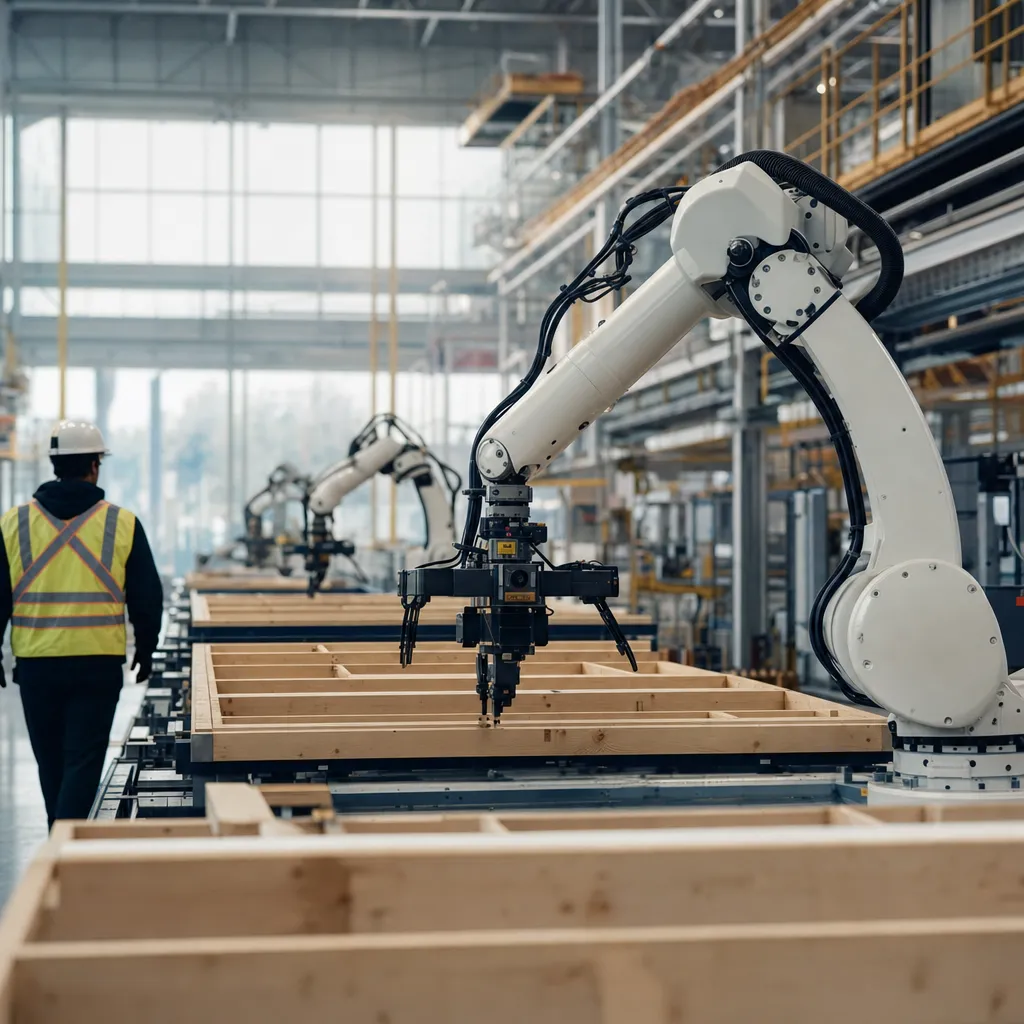
Promise Robotics closed a C$40 million Series B to expand AI-driven factory homebuilding, where robots fabricate complete panels from standard blueprints for 50% faster on-site assembly — with 2,500 homes under contract and a deal with D.R. Horton.
Promise Robotics closed a C$40 million Series B this week to expand AI-driven factory homebuilding — a construction model where robots fabricate wall, floor, and ceiling panels (complete to HVAC and plumbing rough-ins) from standard blueprints for rapid on-site assembly. The Toronto-based company already has 2,500 homes under contract and a multi-year deal with D.R. Horton, the largest U.S. homebuilder by volume.
Factory-built construction is not a new concept, but Promise's approach is distinct from traditional manufactured housing. The company builds to the same code as site-built homes from the buyer's existing blueprints — no proprietary floor plans required. Robots handle the fabrication, reducing labor demand on the factory floor and cutting on-site assembly time by roughly 50% compared to conventional stick-frame construction.
The Raise and What It Funds
The C$40 million Series B was led by White Star Capital. Promise plans to use the capital to open its first U.S. manufacturing plant in Phoenix — a market where housing supply pressure and construction labor shortages are acute.
Key metrics at the time of the raise:
- 2,500+ homes under contract across existing builder relationships
- Multi-year agreement with D.R. Horton — the U.S.'s largest homebuilder by units closed annually
- 50% faster on-site assembly versus conventional construction
- Fabrication scope: wall, floor, and ceiling panels delivered complete to HVAC rough-ins and plumbing stubs
The Phoenix plant will be Promise's first U.S. facility. Canada remains the company's primary operating base, but the D.R. Horton relationship implies significant U.S. volume as the Phoenix facility comes online.
Get this in your inbox.
Daily AI intelligence. Free. No spam.
Why D.R. Horton Matters
D.R. Horton closed approximately 90,000 homes in its most recent fiscal year. It does not sign multi-year supply agreements with pre-revenue startups — the company has operating discipline and procurement scale that require real production capability before a deal is inked. The existence of that agreement is the strongest signal available that Promise's production economics are within range of large-volume residential development.
For the broader housing affordability question, the implication is significant. D.R. Horton builds entry-level and move-up homes at national scale. If factory fabrication lowers per-unit construction costs by even 10-15%, the volume of homes that pencil at an accessible price point increases substantially.
The Structural Problem Promise Is Solving
U.S. housing construction faces two compounding constraints:
- Labor shortage: The construction workforce has aged and hasn't been replaced. Skilled framers, plumbers, and electricians are increasingly scarce in high-growth markets.
- Cost escalation: Construction costs have outpaced wage growth in most U.S. metros, pushing affordable housing out of reach at current build rates.
Factory fabrication addresses both. Robots do not commute, do not require overtime pay in adverse weather, and produce consistent tolerances that reduce on-site rework. Controlled factory environments also allow year-round production regardless of weather — a significant advantage in Phoenix's summer heat and northern Canada's winters.
What to Watch
The Phoenix plant's commissioning timeline and actual unit economics at scale will determine how quickly Promise can expand beyond D.R. Horton to other volume builders. If the first U.S. plant hits its production targets, expect competing builders — Lennar, NVR, PulteGroup — to evaluate similar partnerships or build competing capabilities.
The other variable is regulatory: manufactured and modular housing is subject to a patchwork of state and local codes. Promise's ability to certify its panel systems across multiple states will shape how rapidly the Phoenix plant can serve builders in diverse markets.
Sources: BetaKit — Promise Robotics Series B
Did this help you understand AI better?
Your feedback helps us write more useful content.
Get tomorrow's AI briefing
Join readers who start their day with NexChron. Free, daily, no spam.