New research estimates AI productivity gains could expand US commercial real estate demand by 12% — but the outcome depends entirely on whether AI grows economic activity or concentrates it among fewer workers.
AI Could Add 330 Million Square Feet to US Commercial Real Estate — But Only If It Grows the Economy
New research estimates that AI-driven productivity growth could expand occupied US commercial real estate by 12% over the next decade — roughly 330 million square feet — as companies scale operations to capture AI-enabled output. The finding, published by AllWork.Space, directly challenges the dominant narrative in commercial real estate that AI would primarily shrink office footprints by automating workers out of jobs. The counterintuitive result comes with a significant condition: it only holds if AI expands economic activity rather than concentrating existing output among fewer, more productive workers.
That condition is the entire debate.
The Core Argument
The expansion scenario rests on a mechanism that technology waves have followed before: when AI makes workers substantially more productive, companies that compete for AI-augmented output will hire more people and expand operations, not fewer. More workers means more office space, more warehouse square footage, more logistics infrastructure.
Mainframes didn't eliminate office space — they enabled the growth of enterprises that needed more of it. Personal computers created new categories of knowledge work. The internet expanded the number of companies competing in markets, driving demand for commercial space rather than contracting it.
The question for AI is whether the same dynamic holds, or whether this wave differs qualitatively because AI automates cognitive work — the primary activity performed in offices — rather than just automating physical or mechanical work.
The Asset Class Hierarchy
Not all commercial real estate is moving at the same speed or in the same direction. The research identifies a clear gradient:
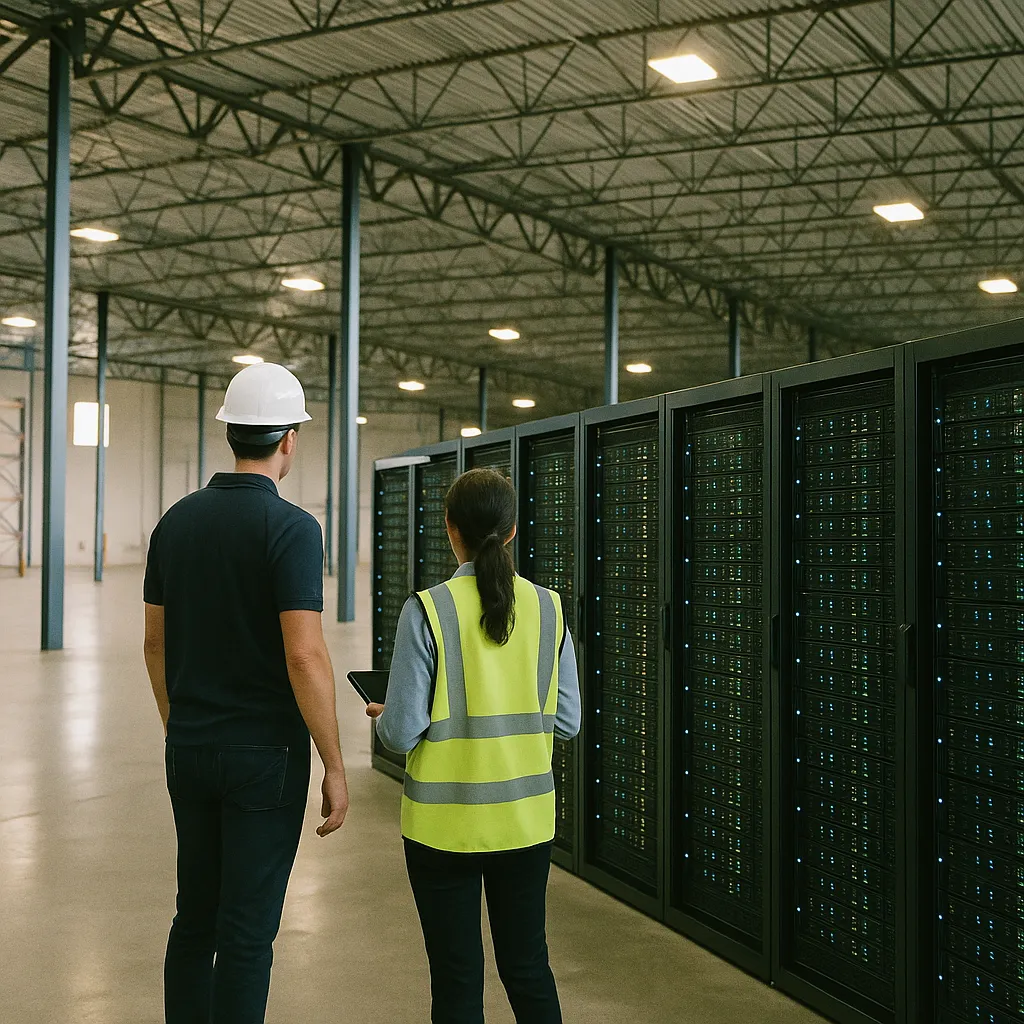
Data centers are 18-24 months ahead of every other asset class on AI-driven demand. The buildout is structural and already priced into real estate markets. In Northern Virginia, Phoenix, and Dallas, data center development has compressed available land and raised construction costs for competing uses. This is not a forecast — it is the current market reality, and it is driving returns that bear no resemblance to the rest of the commercial property market.
Get this in your inbox.
Daily AI intelligence. Free. No spam.
Industrial and logistics are second. AI-optimized warehouses and last-mile fulfillment centers are driving demand for larger, taller, better-connected facilities in suburban markets near major population centers. The e-commerce and supply chain optimization that AI enables requires physical infrastructure — automated sorting centers, robotics-compatible floor plans, high-power electrical capacity.
Office is where the forecast diverges most sharply from current market sentiment. Office demand recovery is described in the research as conditional on which version of AI's economic impact plays out. The 12% expansion thesis requires AI to expand economic activity broadly. If AI concentrates output among fewer workers instead, office demand falls.
The Concentration Risk
A law firm that deploys AI document review tools and uses the increased capacity to grow its client base adds office demand. A law firm that deploys the same tools, maintains revenue, and reduces junior headcount shrinks it. The aggregate effect on commercial real estate depends on which behavior is more common across the economy.
Early data is ambiguous. Legal services firms are in both camps. Accounting and financial services are showing point reductions in junior positions. Technology companies — where AI adoption is most advanced — have shown mixed signals on net hiring, with some firms growing headcount alongside AI investment and others reducing it.
The research is explicit that the office demand recovery scenario is the most uncertain element of its forecast, and that the 12% figure should be understood as the upside scenario, not the base case.
The Data Center Divergence as a Calibration Tool
The data center case is useful precisely because it has already played out. The AI-driven real estate demand that is certain — data center and industrial space — has been priced into markets. The demand that is uncertain — office — has not, which is why office valuations remain under pressure in most major markets despite evidence of post-pandemic occupancy recovery.
For real estate investors, this creates a useful frame: certain AI demand is already in the price; uncertain AI demand is not. Whether you believe the 12% expansion thesis or the contraction scenario determines how you think about office exposure.
What to Watch
The employment data in AI-intensive sectors over the next 18 months will start to reveal which scenario is materializing. Track net headcount in technology, legal, finance, and healthcare — the sectors where AI adoption is most advanced and where the expansion-versus-concentration question will be answered first.
If headcount in those sectors grows alongside AI adoption, the 12% expansion thesis gains empirical support. If headcount flattens or falls while revenue and output grow, the contraction scenario becomes the more likely outcome for office demand. Either way, the data center and industrial thesis needs no further validation — it is already fact.
By Hector Herrera
Did this help you understand AI better?
Your feedback helps us write more useful content.
Get tomorrow's AI briefing
Join readers who start their day with NexChron. Free, daily, no spam.