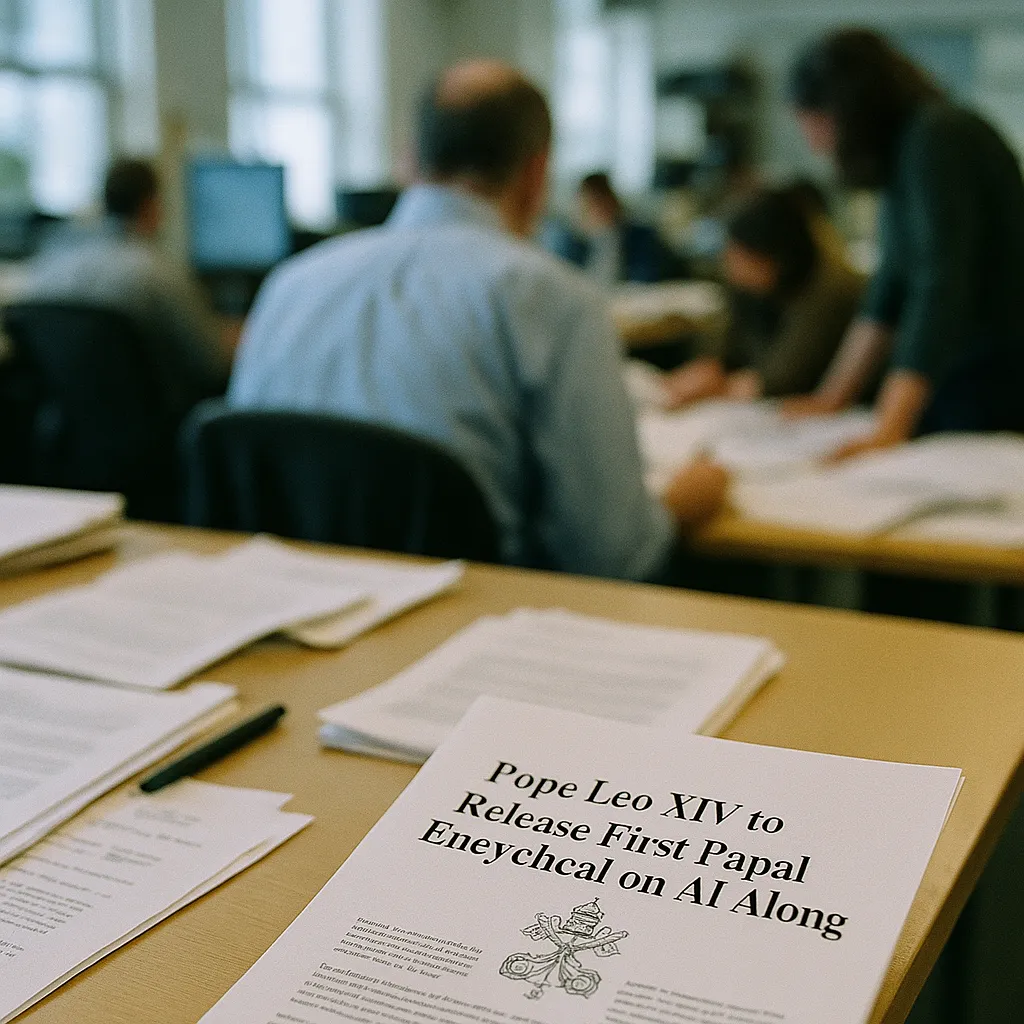
Pope Leo XIV will publish Magnifica humanitas, the first papal encyclical devoted to artificial intelligence, on May 25—co-presented at the Vatican with Anthropic co-founder Christopher Olah.
Pope Leo XIV to Release First Papal Encyclical on AI Alongside Anthropic Co-Founder on May 25
By Hector Herrera | May 21, 2026 | News
Pope Leo XIV will publish the first papal encyclical in history devoted to artificial intelligence on May 25, co-presenting the document at the Vatican alongside Christopher Olah, Anthropic's co-founder and head of interpretability research. The pairing signals that AI's ethical stakes have reached the highest levels of global moral authority — and that one of the world's most watched AI safety researchers is willing to stand beside the papacy to make that case.
The encyclical, titled Magnifica humanitas ("The magnificent humanity"), is signed on the 135th anniversary of Rerum novarum, the 1891 document that defined the Catholic Church's framework for labor rights and economic justice during the Industrial Revolution. The anniversary is not a coincidence. The Vatican is explicitly framing AI's rise as a moral test comparable to industrialization — one that demands the same scale of institutional response.
What the document covers
According to PBS NewsHour, Magnifica humanitas situates AI within the Church's longstanding tradition of Catholic social teaching — the body of doctrine covering human dignity, labor rights, peace, and distributive justice. The encyclical argues that AI presents challenges to each of those domains simultaneously, making it uniquely demanding of a coordinated moral response.
Christopher Olah's presence at the Vatican launch is significant beyond symbolism. Olah pioneered mechanistic interpretability — the research field aimed at understanding what is actually happening inside neural networks — and is among the most respected technical voices on AI safety globally. His appearance alongside the Pope suggests Magnifica humanitas engages seriously with AI's technical realities rather than offering abstract moral guidance from a distance.
Get this in your inbox.
Daily AI intelligence. Free. No spam.
Why this moment, why this document
The Catholic Church has addressed AI before. In 2024, the Vatican's Pontifical Academy for Life published a call for an international AI treaty. But an encyclical carries far greater doctrinal weight. It is the highest form of papal teaching, addressed to every Catholic bishop worldwide and traditionally to "all people of goodwill." No encyclical has ever focused on a single emerging technology.
The timing is equally deliberate. The EU AI Act's high-risk provisions take effect in August 2026. The United States has no federal AI framework. China and the U.S. are racing to advance AI capabilities with minimal coordination. Into that policy vacuum, the Catholic Church — with 1.4 billion members in nearly every country on Earth — is asserting its authority to frame the moral terms of the debate.
What the Rerum novarum parallel means
The anniversary framing matters because it invokes a track record. The 1891 document helped establish the philosophical foundations for minimum wage laws, labor unions, and worker protections that became global standards over the following century. The Church is signaling that it intends Magnifica humanitas to perform similar work for AI governance — to provide a moral vocabulary and set of principles that outlast any single political administration or regulatory cycle.
Whether secular governments and technology companies engage substantively with the encyclical will be the first test. The second is whether the document addresses specific AI applications — autonomous weapons, surveillance systems, medical AI, agentic economic systems — or remains at the level of principle.
Impact
For the AI industry, a papal encyclical on AI is not a regulatory event but a reputational and cultural one. Companies like Anthropic, Google, and OpenAI operate in societies where public trust is a competitive asset. A document from global moral authority at the scale of the papacy, positioning AI as a test of whether humanity honors its own dignity, shapes the environment in which those companies operate — regardless of whether any government cites it.
For policymakers, Magnifica humanitas provides a framework that crosses ideological lines. Catholic social teaching draws on both progressive concerns about inequality and conservative concerns about human dignity and institutional family structures, making it one of the few intellectual traditions that can speak across political divides on AI.
What to watch
The May 25 release positions the encyclical just ahead of the G7 summit, where AI governance is expected to be on the agenda. Leo XIV has already demonstrated willingness to engage contemporary debates directly. Magnifica humanitas will reveal how far that engagement extends into technical and policy specifics — and whether Olah's involvement produces a document that AI researchers recognize as technically informed rather than theologically generic.
Did this help you understand AI better?
Your feedback helps us write more useful content.
Get tomorrow's AI briefing
Join readers who start their day with NexChron. Free, daily, no spam.