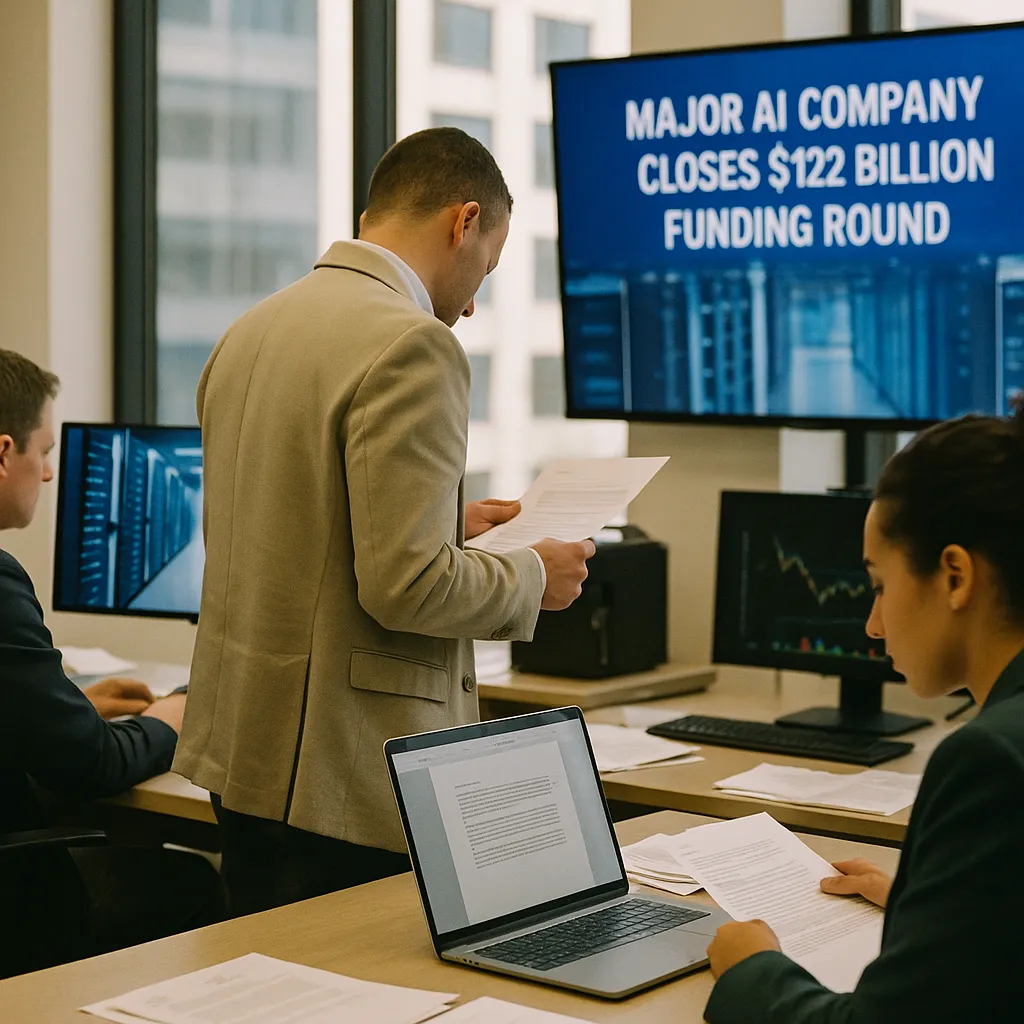
OpenAI has closed a $122 billion funding round—one of the largest private fundraises in the history of technology—to fuel compute infrastructure buildout, model development, and an expanding enterprise product suite.
OpenAI has closed a $122 billion funding round, one of the largest private fundraises in the history of technology, to fund compute infrastructure buildout, next-generation model development, and an expanding enterprise product suite. The raise signals that institutional capital remains fully committed to the frontier AI build-out—even as competition from Anthropic, Google, and open-source challengers like DeepSeek intensifies.
Why This Round Is Different
OpenAI has raised at every stage of its growth, but $122 billion is categorically different in scale. Microsoft's roughly $10 billion structured investment across 2023–2024 was the previous headline number. This round is more than twelve times that, closed in a single tranche. At this scale, OpenAI joins a short list of private technology companies whose valuations rival publicly traded giants.
The structural change that made this possible: OpenAI spent much of 2024 restructuring its governance from a nonprofit-controlled model to a public benefit corporation, clearing the legal path for conventional venture and private equity funds to hold equity. Without that restructuring, a round of this size would have been difficult to close under the original nonprofit constraints.
Where the Capital Goes
According to OpenAI, the funding is allocated to three priorities:
- Compute infrastructure — Training frontier AI models requires billions in GPU clusters, data centers, and long-term energy contracts. OpenAI's current models run on some of the largest compute clusters ever assembled, and the next generation will require more.
- Model development — Continued research and training of next-generation systems, including multimodal, reasoning-optimized, and agentic models.
- Enterprise product expansion — Scaling ChatGPT Enterprise and the OpenAI API to compete directly with cloud-native AI from Microsoft Azure AI, Google Vertex, and Amazon Bedrock.
The Competitive Pressure Behind the Raise
The timing is not coincidental. OpenAI's competitive position in 2026 is more contested than at any point since its founding.
Get this in your inbox.
Daily AI intelligence. Free. No spam.
Anthropic has steadily narrowed the capability gap with its Claude model family and is growing its enterprise footprint in financial services, healthcare, and legal. Google DeepMind has Gemini embedded across Google Workspace, Cloud, and Search—distribution advantages that money cannot simply replicate. Meta's Llama and DeepSeek's open-source releases have demonstrated that closed frontier models no longer hold a monopoly on high-capability benchmark performance.
Against that backdrop, $122 billion in fresh capital is partly a competitive signal. It tells enterprise procurement teams, recruiting targets, and potential acquisition candidates where the financial leverage is concentrated—and it makes OpenAI a harder competitor to ignore.
What This Means for Enterprise Buyers
If you are evaluating AI infrastructure for your organization, this raise changes your calculus in concrete ways:
OpenAI's capacity to offer aggressive commercial terms expands. A well-capitalized sales organization can offer deeper service level agreements, more favorable pricing, and longer-term contract structures than competitors facing tighter cash positions.
The OpenAI ecosystem deepens. When one player raises $122 billion, third-party developers building on its APIs have stronger incentives to stay on that platform. Expect the developer ecosystem—fine-tuning providers, wrapper tools, enterprise integrations—to grow and become stickier.
Switching costs will increase over time. OpenAI will use this capital to tighten integrations with Microsoft 365, build proprietary enterprise tooling, and develop model versions tailored to regulated industry needs. The longer an organization builds on OpenAI infrastructure, the more expensive migration becomes.
What to Watch
The terms of the round—valuation, lead investors, governance provisions—matter as much as the headline number. Watch in particular whether any conditions are attached around the completion timeline of OpenAI's nonprofit restructuring, a process that has moved slowly and attracted scrutiny from California's attorney general.
The next major disclosure test: whether OpenAI files for an initial public offering in 2026 or 2027. A $122 billion private round at this scale creates investor return expectations that are difficult to satisfy indefinitely without public market liquidity. If OpenAI delays an IPO, expect secondary market activity in OpenAI shares to accelerate as early investors seek exits.
Did this help you understand AI better?
Your feedback helps us write more useful content.
Get tomorrow's AI briefing
Join readers who start their day with NexChron. Free, daily, no spam.