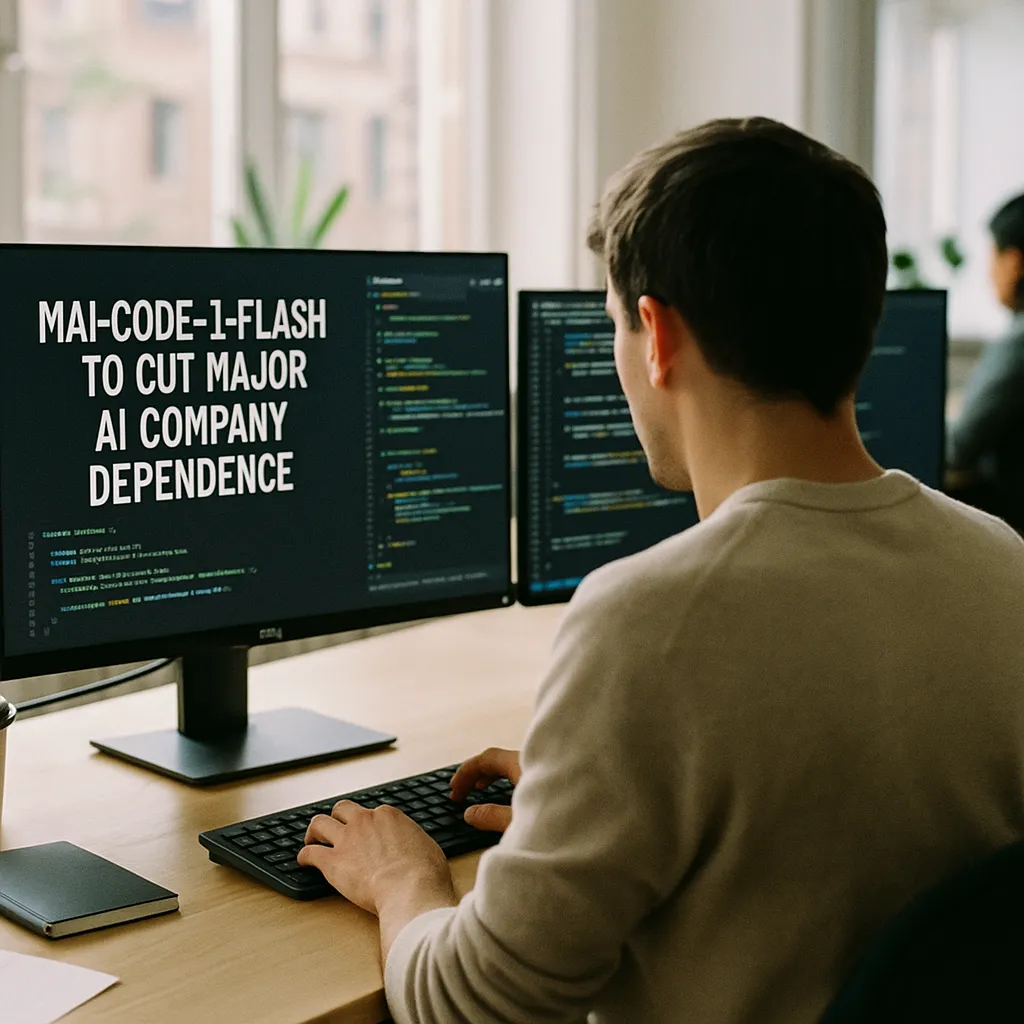
Microsoft unveiled MAI-Code-1-Flash at Build 2026, a model that converts written descriptions into working application code — the clearest sign yet that it is building around OpenAI, not through it.
Microsoft unveiled MAI-Code-1-Flash at its Build 2026 developer conference on June 2 — a coding model that converts written descriptions directly into working application code. The launch is Microsoft's clearest signal yet that it is building around its OpenAI partnership rather than depending on it, and that the cost structure of AI development on Azure is about to change.
Background
Microsoft has been OpenAI's exclusive cloud partner since its landmark 2019 investment, with the relationship deepening through a reported $13 billion total commitment. That arrangement gave Microsoft early access to GPT models powering Copilot products across Office, Azure, and GitHub — but it also created a structural problem. Every developer query that routes through GPT-4o generates revenue for OpenAI and margin pressure for Microsoft.
MAI — Microsoft AI — is the company's internal answer. The team has been building proprietary models for months. MAI-Code-1-Flash is the first to be publicly unveiled at a flagship developer event, targeting the specific workload where the cost asymmetry hurts most: high-volume code generation.
What Microsoft Announced at Build 2026
According to CNBC's coverage, MAI-Code-1-Flash is built to:
- Convert plain-language descriptions into deployable application code, reducing the manual scaffolding developers currently write by hand
- Lower per-query costs for developers building on Azure by offering a Microsoft-native alternative to OpenAI's API pricing
- Integrate with Visual Studio and Azure's toolchain without requiring third-party API calls
The "Flash" designation mirrors nomenclature used across the industry — Google's Gemini 1.5 Flash, Anthropic's Claude Haiku — to signal a fast, cost-optimized model rather than maximum-capability frontier performance. The positioning is deliberate: Microsoft isn't claiming to beat GPT-4o. It's claiming to be good enough for the majority of developer tasks at a fraction of the cost.
Get this in your inbox.
Daily AI intelligence. Free. No spam.
The OpenAI Partnership, Reframed
Microsoft and OpenAI modified their partnership agreement earlier in 2026, reducing OpenAI's exclusivity on Microsoft's cloud infrastructure. Today's MAI launch is the public expression of that restructuring. The relationship remains commercially important for both sides — OpenAI still depends on Azure for compute, and Microsoft continues distributing OpenAI models across enterprise products — but the balance of dependency is shifting.
The practical effect for developers: for the first time, Azure customers can route coding workloads to a Microsoft-native model without touching OpenAI's API. That choice didn't exist 90 days ago.
For high-volume, cost-sensitive use cases — automated code review pipelines, CI/CD integrations, internal developer tools generating thousands of queries per day — the per-token economics of that choice are significant. A team running 10 million tokens per week through GPT-4o pays materially more than the same team running equivalent workloads through a cheaper Microsoft-native alternative, assuming comparable output quality.
What Developers Get Now
MAI-Code-1-Flash targets practical coding workflows:
- Generating boilerplate, scaffolding, and application structure from English specs
- Refactoring and debugging existing code in Azure-integrated environments
- Completing multi-step development tasks within Visual Studio and GitHub Copilot workflows
Microsoft has not released a standalone benchmark comparison against GPT-4o, Claude 3.5 Sonnet, or Google's Gemini 2.5 Pro. Real-world developer feedback will be the actual benchmark — and that will emerge quickly given the size of Microsoft's developer ecosystem.
What to Watch
MAI-Code-1-Flash is almost certainly the first in a broader MAI portfolio. Expect variants covering reasoning, multimodal, and enterprise productivity to follow as Microsoft builds the model stack needed to run its AI products without defaulting to OpenAI for every use case.
The more consequential question: how quickly does Microsoft begin routing default Copilot and GitHub workloads to MAI models, and what does that shift do to OpenAI's annualized revenue from the partnership? That number isn't public — but the structural logic of today's launch points in one direction.
By Hector Herrera
Did this help you understand AI better?
Your feedback helps us write more useful content.
Get tomorrow's AI briefing
Join readers who start their day with NexChron. Free, daily, no spam.