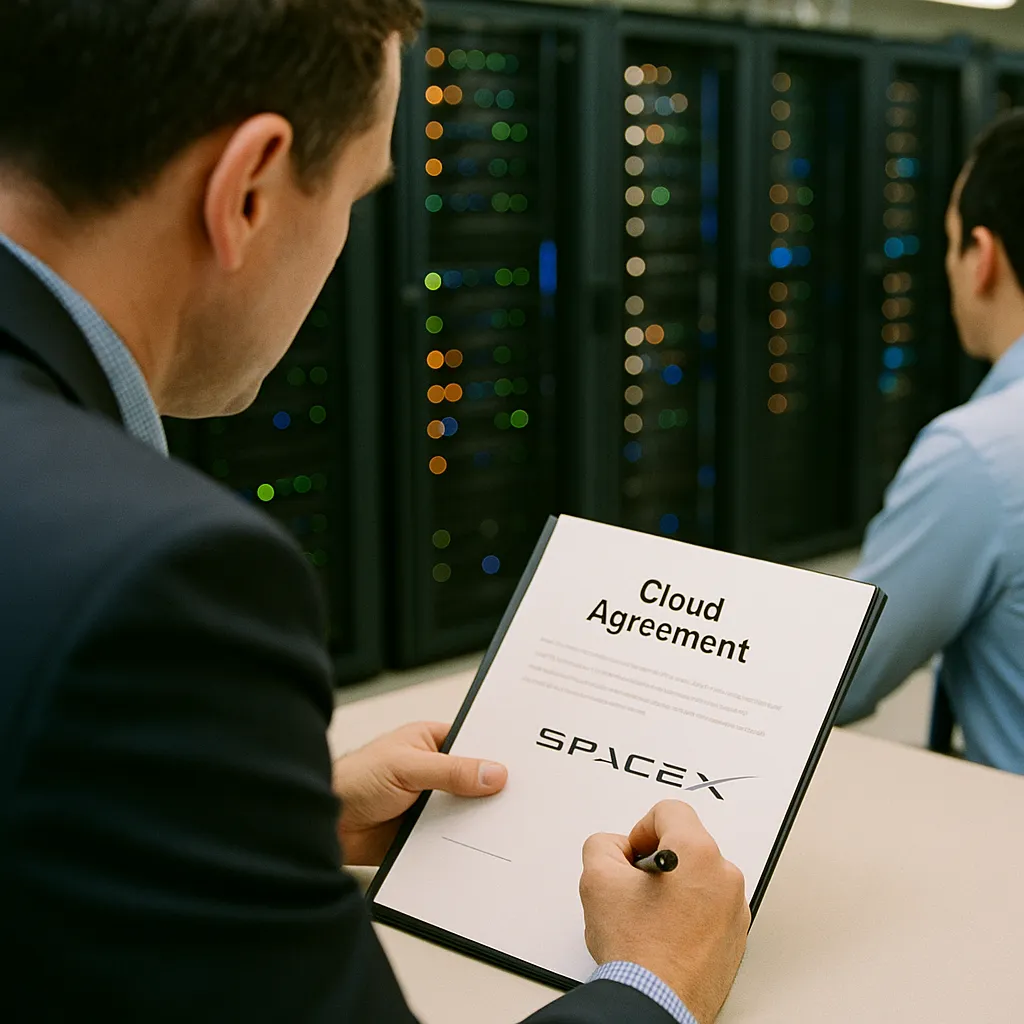
Google has contracted with SpaceX for access to roughly 110,000 NVIDIA GPUs — one of the largest inter-company compute deals of 2026, signaling hyperscalers are willing to source external capacity amid supply constraints.
Google Signs Cloud Agreement with SpaceX for Access to 110,000-GPU NVIDIA Compute Capacity
By Hector Herrera | June 9, 2026 | News
Google has signed a cloud services agreement with SpaceX granting access to AI compute capacity tied to roughly 110,000 NVIDIA GPUs — making it one of the largest inter-company GPU access deals of 2026. The deal signals a significant strategic shift: hyperscalers are now willing to contract externally for compute to bridge gaps in their own infrastructure buildout, rather than waiting for their own data center pipeline to catch up with demand.
The GPU supply crunch — driven by sustained AI training and inference demand outpacing NVIDIA's manufacturing capacity — has not resolved in 2026. Google, like other major cloud providers, has billions of dollars committed to new data center construction, but those facilities are not online yet. SpaceX's compute capacity, sourced through its own AI infrastructure buildout for Starlink and Grok-related workloads at xAI, is available to contract out.
What the Deal Covers
The agreement gives Google cloud workload access to SpaceX-managed compute infrastructure equipped with approximately 110,000 NVIDIA GPUs, according to reporting cited by Build Fast With AI. The specific GPU models have not been publicly disclosed, though the scale suggests a combination of H100 and H200 series hardware, which are the primary training and inference chips deployed at this scale in 2026.
The deal structure appears to be a capacity-access agreement, not a data center acquisition or ownership transfer. Google is paying for compute access, not buying SpaceX infrastructure. That distinction matters: it keeps the arrangement flexible but also means Google does not gain strategic ownership of the assets.
Get this in your inbox.
Daily AI intelligence. Free. No spam.
Why This Is Notable
The GPU supply situation has forced every major AI company to make uncomfortable capacity tradeoffs. When internal infrastructure cannot keep up with model training schedules and inference demand, the alternatives are: delay products, reduce model quality, or source external compute.
Google's deal with SpaceX represents the third option — and at 110,000 GPUs, it is large enough to matter for product timelines. That is not a small bridge contract; it is a significant percentage of any company's deployed compute in a single agreement.
The deal also illustrates a structural change in how AI compute is being treated as an asset class. SpaceX, a launch and satellite company, has accumulated GPU infrastructure at a scale that makes it a credible third-party compute provider to a company like Google. The line between "AI company" and "compute provider" is dissolving.
Impact on the AI Infrastructure Market
For enterprise AI buyers, the Google-SpaceX deal has several downstream implications:
- GPU spot market pricing will tighten further. When hyperscalers absorb large blocks of available capacity through bilateral deals, less inventory flows to the spot market that smaller companies depend on for burst workloads.
- Compute-as-a-service is becoming a commodity layer. Any organization with substantial GPU inventory — not just traditional cloud providers — can now monetize it. Expect more non-traditional compute providers to emerge.
- Build timelines remain the constraint. Google is not doing this deal because it wants to — it is doing it because its own construction pipeline cannot meet current demand. That constraint will ease as new data centers come online, but not until late 2026 or 2027.
What to Watch
Whether Microsoft, Amazon, or Meta announce similar bilateral compute agreements in the coming months will indicate whether this is a one-off opportunistic deal or the beginning of a broader market pattern for hyperscaler compute sourcing. Also watch for any regulatory review: a deal where a major cloud provider contracts compute from a defense-adjacent company like SpaceX may attract national security scrutiny, particularly given current U.S.-China AI competition dynamics.
Sources: Build Fast With AI — AI News June 8, 2026
Did this help you understand AI better?
Your feedback helps us write more useful content.
Get tomorrow's AI briefing
Join readers who start their day with NexChron. Free, daily, no spam.