DeepSeek released V4 Flash and V4 Pro on April 24 with top-tier coding benchmarks and a 1-million-token context window—open-source, again, at a moment when Silicon Valley assumed the gap was widening.
DeepSeek Drops V4 Pro and Flash—A Year After Upending Silicon Valley
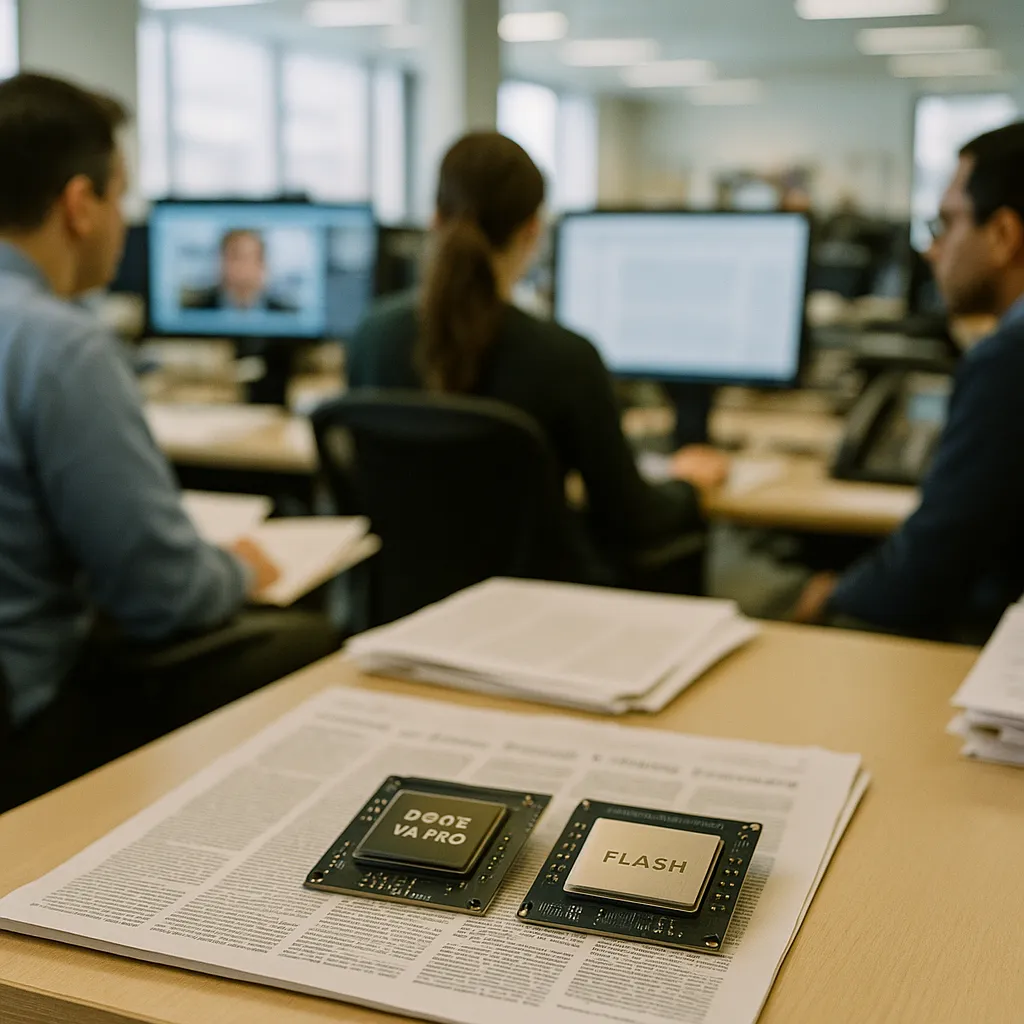
China's DeepSeek released two new models on April 24—V4 Flash and V4 Pro—claiming top-tier performance on coding benchmarks and introducing a 1-million-token context window powered by what the company calls a Hybrid Attention Architecture. Both models are open-source. A year after DeepSeek R1 shocked the AI industry by matching frontier performance at a fraction of the cost, the company has done it again.
According to Bloomberg, V4 Pro is positioned as the flagship, targeting the same enterprise and research workloads as OpenAI's GPT-5.5 and Anthropic's Claude Opus 4.6. V4 Flash is the speed-optimized, cost-efficient variant—aimed squarely at applications that need fast inference at scale.
What's New in V4
The two architectural claims worth taking seriously:
Hybrid Attention Architecture. Standard transformer attention—the mechanism that lets a model relate any word to any other word in its context—scales quadratically with sequence length. That makes very long contexts expensive. DeepSeek's Hybrid Attention Architecture reportedly mixes different attention patterns to reduce that cost, enabling the claimed 1-million-token context. A million tokens is roughly 750,000 words—the length of about seven novels. Whether real-world performance holds at that scale requires independent testing.
Coding benchmark leadership. DeepSeek is claiming top scores on major coding evaluations. This is consistent with the company's history—DeepSeek Coder models have repeatedly outperformed peers on HumanEval and similar benchmarks. Independent verification from third-party researchers is needed before accepting any self-reported benchmark.
Why DeepSeek Keeps Mattering
The first DeepSeek moment, in early 2025, was jarring to Silicon Valley because it demonstrated that frontier AI performance didn't require frontier compute budgets. DeepSeek R1 was trained for a fraction of what GPT-4 cost, and it performed comparably on many tasks.
Get this in your inbox.
Daily AI intelligence. Free. No spam.
V4 arrives with the same structural threat: open-source weights that developers can download, fine-tune, and deploy without paying OpenAI or Anthropic per token. For companies building AI products, that's not just a cost question—it's a control question. Running your own model means your data never leaves your infrastructure.
The geopolitical dimension is harder to ignore now than it was a year ago. U.S. export controls on advanced chips to China have continued to tighten in 2026. DeepSeek's ability to produce frontier-competitive models under those constraints—if their efficiency claims hold—is a significant data point in the debate over whether export controls are actually slowing Chinese AI development.
Who It Pressures Most
OpenAI and Anthropic face the recurring commoditization argument: if comparable capability is available free and open-source, why pay for API access? Their answers—reliability, safety tuning, enterprise support, fine-tuning controls—remain valid for many buyers, but the case requires more active selling with each DeepSeek release.
Enterprise AI buyers get more leverage. The existence of a competitive open-source alternative gives procurement teams a credible negotiating position against proprietary API pricing.
Infrastructure providers (AWS, Azure, Google Cloud) who monetize AI workloads have reason to watch: a significant shift toward self-hosted open-source models would reduce the inference revenue flowing through their managed AI services.
What to Watch
The most important near-term question is independent benchmark verification. DeepSeek's self-reported numbers have historically held up—but the 1-million-token context performance and coding claims need third-party replication to mean anything operationally.
Watch also for the U.S. policy response. Congress has been debating additional restrictions on AI model weights from Chinese labs. If V4 Pro's capabilities are as strong as claimed, it will intensify that debate.
By Hector Herrera | April 25, 2026
Did this help you understand AI better?
Your feedback helps us write more useful content.
Get tomorrow's AI briefing
Join readers who start their day with NexChron. Free, daily, no spam.