Frontier AI models now solve real software engineering tasks with near-perfect accuracy — but the same report finds leading AI systems are disclosing less about how they work than ever before.
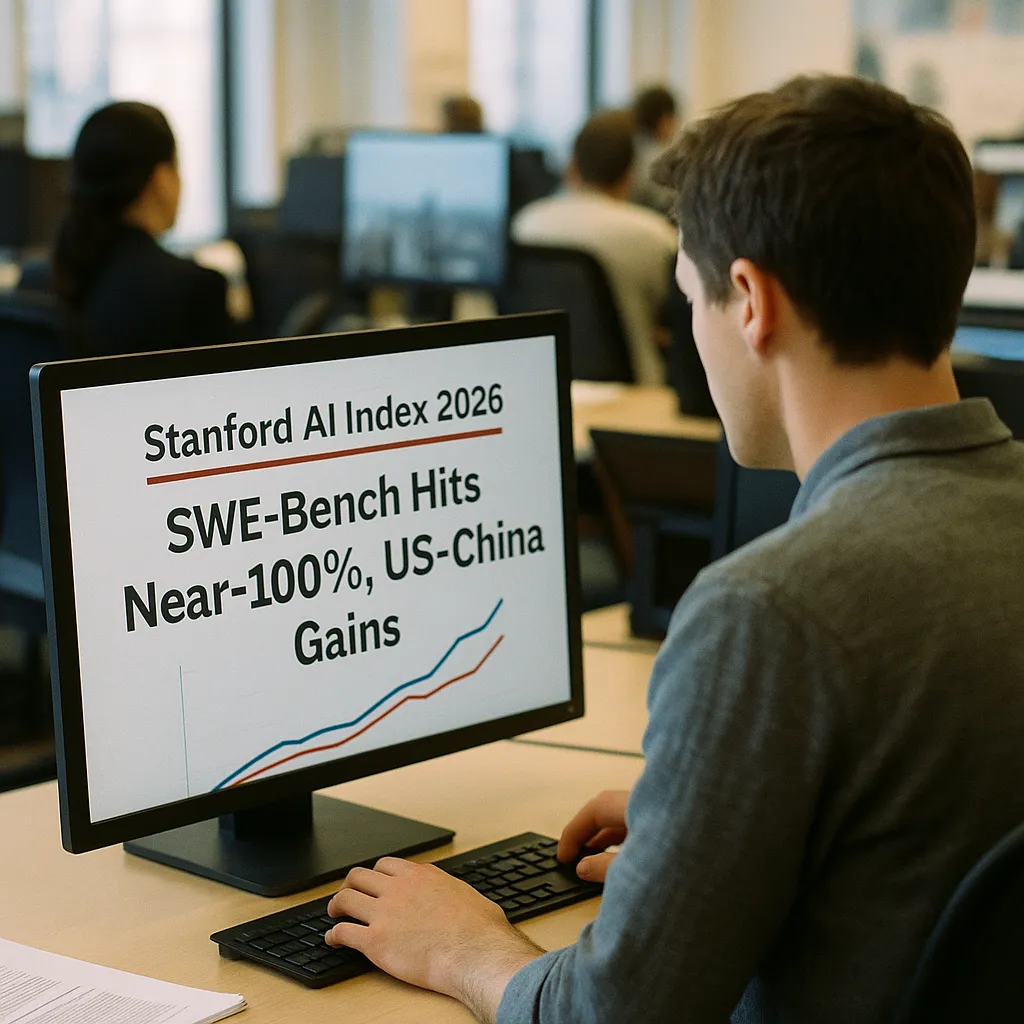
Stanford AI Index 2026: SWE-Bench Hits Near-100%, US-China Gap Closes, AI Transparency Drops
By Hector Herrera | April 24, 2026 | News
Frontier AI models can now solve real-world software engineering tasks with near-perfect accuracy — and the same systems are simultaneously disclosing less about how they work than at any point in the past three years. That's the central tension in Stanford's 2026 AI Index, published this week by the university's Human-Centered AI Institute.
The report is the most comprehensive annual benchmark of AI progress published anywhere, tracking capability gains, economic trends, geopolitical competition, and governance across the full previous year. This year's edition contains findings that should concern anyone building or deploying AI systems at scale.
The Benchmark Headlines
SWE-bench Verified, the industry's standard measure of whether AI can complete real software engineering tasks — fixing bugs, implementing features, writing tests in actual open-source codebases — now sees frontier models scoring near 100%. One year ago, the same benchmark topped out around 60%. That's not an incremental improvement. That's a qualitative shift: AI systems can now handle a substantial share of junior software engineering work without human oversight on defined, scoped tasks.
The US-China performance gap has closed. Top models from both countries are now trading the global leaderboard lead. For two years, US frontier models held a meaningful capability advantage. That gap no longer exists in any statistically significant way, according to Stanford's measurements.
The Transparency Collapse
Here's the number that deserves more attention than it's getting: the Foundation Model Transparency Index (FMTI) — which measures how much AI developers disclose about training data, evaluation methods, model behavior, and deployment practices — dropped from an average score of 58 to 40 across leading models.
To be direct: as AI systems have gotten dramatically more powerful, the companies building them have gotten dramatically less forthcoming about how those systems work.
Get this in your inbox.
Daily AI intelligence. Free. No spam.
This matters for concrete reasons:
- Regulators can't write enforceable rules for systems they can't audit
- Enterprise customers can't properly assess deployment risk in opaque systems
- Researchers can't identify failure modes without published methodology
- Courts are being asked to adjudicate AI-related cases involving systems no one outside the lab fully understands
The EU AI Act's transparency requirements for high-risk AI systems are scheduled to come into full force in 2026. The Stanford data suggests the industry is moving in the opposite direction.
What the Performance Numbers Mean for Hiring
A near-100% SWE-bench score doesn't mean AI replaces senior engineers. The benchmark tests discrete tasks on defined codebases — it doesn't capture system design, architecture decisions, client communication, or the judgment that comes from years of production incidents.
But it does mean the economic case for hiring junior developers to handle routine code tasks — bug fixes, boilerplate, test writing — is weaker than it was twelve months ago. Companies running large engineering organizations will see this reflected in their next headcount planning cycle if they haven't already.
Geopolitical Stakes
The US-China parity finding carries national security implications that go beyond the tech industry. For two years, the assumption in policy circles was that US AI labs maintained a meaningful capability lead over Chinese counterparts. Stanford's data challenges that assumption directly.
Export controls on advanced chips, designed partly to slow Chinese AI development, have not prevented this convergence — or the controls have taken longer to bite than anticipated. Either conclusion has significant policy implications.
What to Watch
The EU AI Act's transparency provisions are the most direct regulatory pressure on the FMTI regression Stanford documented. Watch whether enforcement actions in 2026 produce any movement from the major model providers — and whether the regulation creates meaningful compliance pressure or is treated as a checkbox.
On capability: if SWE-bench is near-saturated, benchmark attention will shift to harder measures — long-horizon software projects, multi-system architecture, tasks requiring genuine reasoning over weeks rather than minutes.
On geopolitics: expect congressional hearings on the US-China parity finding and potential export control updates before year end.
Hector Herrera covers AI developments for NexChron.
Did this help you understand AI better?
Your feedback helps us write more useful content.
Get tomorrow's AI briefing
Join readers who start their day with NexChron. Free, daily, no spam.