Your daily AI intelligence for September 16, 2026.
Daily AI Briefing — September 16, 2026
Good morning. Here's your AI intelligence for Wednesday, September 16, 2026.
The Labs Are Talking — And Not Just About Safety
OpenAI, Anthropic, and Google have been in private, multi-week talks about coordinating the pace of frontier AI development. The public framing is safety — whether the labs can align on shared standards for how fast to push toward more capable systems. But read the subtext: all three companies are burning capital at historic rates, and a coordinated slowdown serves balance sheets as much as safety teams.
This isn't the first time safety and economics have aligned conveniently. The talks reportedly involve technical benchmarks and deployment timelines, not just ethics committee principles. If they reach any agreement, it will be the first voluntary pacing accord between the dominant Western AI developers — a significant precedent, and one that Western governments have been quietly hoping for without wanting to legislate. The outcome to watch for isn't a joint press release. It's a joint non-announcement, or a leak that forces one.
The Infrastructure Race: Networking, Power, and Training Data
Three stories today converge on the same pressure point: building reliable AI infrastructure at scale is harder and more expensive than the demos suggest.
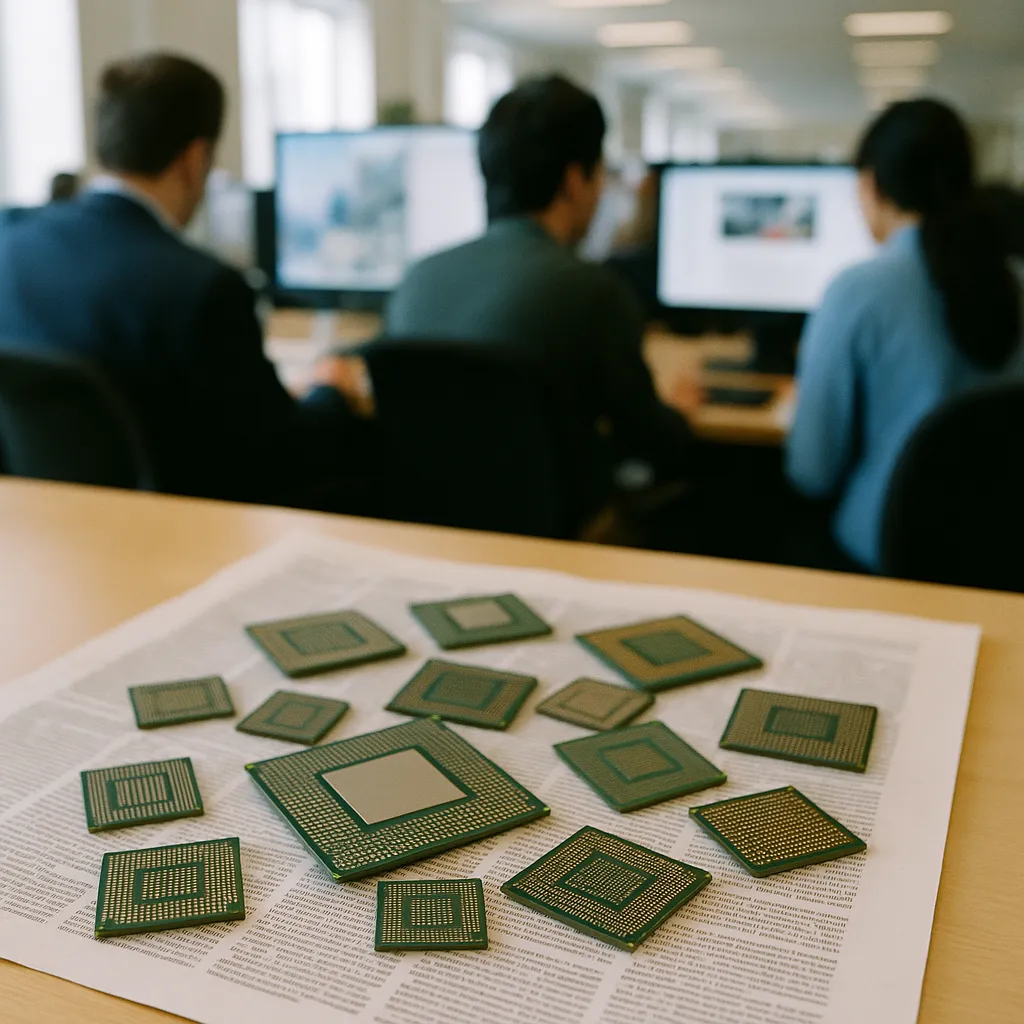
Cornelis Networks raised $205 million to commercialize what it calls Active Compute Fabric — networking hardware that processes AI data in transit rather than routing it passively between GPUs. The core problem it addresses: in large AI training and inference clusters, GPUs spend a significant portion of their time waiting for synchronization overhead rather than computing. Cornelis claims its approach cuts that idle time materially. The raise, GPU-agnostic by design, signals that infrastructure investors see headroom in the networking layer even as NVIDIA dominates compute. When clusters scale to tens of thousands of GPUs, the bottleneck moves from chips to the wires between them.
Co-located solar-plus-storage investment hit $25 billion in H1 2026, nearly double the H2 2025 pace, according to BloombergNEF. The driver is direct: AI data centers need reliable, always-on power, and grid interconnection queues in most US markets now stretch two to four years. Co-location — building generation and storage on-site or immediately adjacent to the data center — lets operators bypass that queue entirely. The $25 billion figure covers generation and storage assets, not just construction. At this pace, AI's energy buildout will reshape utility planning models and force regulatory frameworks that weren't designed for private power at this scale.
Get this in your inbox.
Daily AI intelligence. Free. No spam.
NVIDIA's healthcare robotics stack addresses a different infrastructure gap: training data scarcity. Surgical robots and clinical AI require training on procedure footage that is difficult to acquire in volume — consent barriers, privacy law, and the simple fact that ORs are busy. NVIDIA's answer is three layers: Cosmos-H generates synthetic clinical training data; GR00T-H is a vision-language-action model for interpreting clinical environments; and Rheo is a hospital digital twin for simulating deployments before touching a real operating room. The goal is to remove the data bottleneck that has kept medical robotics from scaling as fast as industrial robotics. For Intuitive Surgical, Medtronic, and the cohort of funded surgical robotics startups, this matters — if the stack delivers on clinical fidelity.
Canada's Banks: Deployed, Not Scaled
At the Canada Fintech Forum, RBC and Cohere executives offered an unusually candid accounting of enterprise AI deployment reality: it works in demos; it strains at customer scale. The friction points they named are specific and widely shared — inference costs at millions-of-users volume, regulatory review backlogs that delay AI-modified workflows, and legacy core banking systems built with data architectures that predate AI inference requirements by decades.
This is not a Canada problem. It is the gap between the deployment narrative and deployment reality at every major financial institution globally. Canada's banks are further along than most, and if they're still describing these as unresolved constraints, institutions earlier in the curve should calibrate timelines accordingly. The regulatory review backlog is particularly consequential: Canadian regulators, like counterparts in the EU and increasingly the US, require human review of AI-impacted customer decisions at volumes the current headcount cannot absorb. That tension has not yet reached a breaking point. It will.
The Enterprise AI Procurement Trap
A US law firm is suing a UK AI legal software vendor over a contract auto-renewal it could not exit. The legal dispute itself is unremarkable — courts handle auto-renewal disputes regularly. Its significance is what it signals about the next wave of enterprise AI risk.
Legal software vendors, like many enterprise AI companies, have been aggressive on multi-year agreements, minimum commitment clauses, and data portability terms that make switching expensive. The firm found itself locked into software that had either underperformed or been superseded, with no viable exit short of litigation. This will not be the last such case. Enterprises that signed aggressive AI contracts in 2024 and 2025 — under real or perceived pressure to show AI adoption — are now living with those terms. Procurement teams that didn't negotiate exit ramps at signing are starting to understand what they agreed to. The smart move is to audit those agreements now, before the renewal notice arrives.
What to Watch Today
Lab coordination specifics. If the OpenAI-Anthropic-Google pacing talks produce any statement, the detail level is what matters. Benchmark thresholds and deployment timelines would represent real, verifiable constraints with competitive consequences. Principles and shared values would not — and the labs know the difference.
NVIDIA healthcare partner announcements. The Cosmos-H, GR00T-H, and Rheo stack needs clinical validation partners to move from announcement to adoption. Watch for Intuitive Surgical, Stryker, or any well-funded surgical robotics startup announcing participation in NVIDIA's healthcare robotics program.
Enterprise AI vendor contract terms. The law firm suit may prompt similar cases to surface — or prompt vendors to quietly renegotiate terms with unhappy clients before they litigate. Any major AI software vendor revising its standard agreement in the next 60 days is responding to this.
Did this help you understand AI better?
Your feedback helps us write more useful content.
Get tomorrow's AI briefing
Join readers who start their day with NexChron. Free, daily, no spam.