Your daily AI intelligence for May 04, 2026.
Daily AI Briefing — May 04, 2026
Good morning. Here's your AI intelligence for Monday, May 04, 2026.
The Week Opens With Regulation, Robots, and a DeepSeek Comeback
If last week was about earnings, this week opens with governance pressure mounting across healthcare, finance, and retail — while the physical AI story moves decisively from labs to factory floors, and China's DeepSeek serves a reminder that the global AI race is still very much a race.
Regulation Is No Longer Hypothetical
Colorado's AI accountability law takes effect June 30 — less than two months away — and most companies it covers are not ready. The law requires meaningful human oversight of high-risk AI decisions in hiring, lending, housing, and similar domains. Businesses that have been treating compliance as a future concern now have a fixed deadline. The companies most exposed are mid-size enterprises that use AI-driven tools from third-party vendors and have not audited whether those tools meet the law's high-risk definitions.
The Federal Reserve added its own signal. Vice Chair Michelle Bowman said banks are deploying AI for fraud detection and credit underwriting faster than regulators can update the frameworks meant to govern it. That gap is not going to close passively. What regulators decide to do next — act aggressively, issue guidance, or defer to industry self-governance — will shape how financial AI is deployed through the rest of the decade.
Courts are starting to confront what autonomous AI agents can legally do. Businesses are deploying agents to negotiate and execute contracts without a human in the loop, but no court has definitively settled who bears liability when those agents make damaging deals. The existing legal defaults — agency law, principal liability, apparent authority — were built for human actors. They are being stress-tested in live commercial settings right now, and the legal exposure for companies deploying these agents is genuinely unsettled.
The insurance sector offers a concrete warning about what happens when governance falls behind deployment. A new Grant Thornton survey found that 44 percent of insurance executives report governance failures that directly derailed AI projects — even as deployment in the sector accelerates. This is the same pattern visible across every regulated industry: implementation consistently outrunning the controls designed to govern it.
Healthcare Gets a New Kind of AI Tool
Google DeepMind announced an AI co-clinician built to provide real-time diagnostic support during patient encounters. This is categorically different from the documentation and coding AI that has already found a foothold in healthcare administration. The co-clinician is designed to be in the room — surfacing differential diagnoses, flagging drug interactions, and providing evidence-based context while a physician is actively seeing a patient.
The technology is credible. Whether it gets adopted at scale will depend far less on benchmark performance and far more on how it integrates into clinical workflows, how liability is allocated when a recommendation turns out to be wrong, and whether physicians see it as a useful tool or as oversight they did not ask for.
Get this in your inbox.
Daily AI intelligence. Free. No spam.
Physical AI Is Leaving the Lab
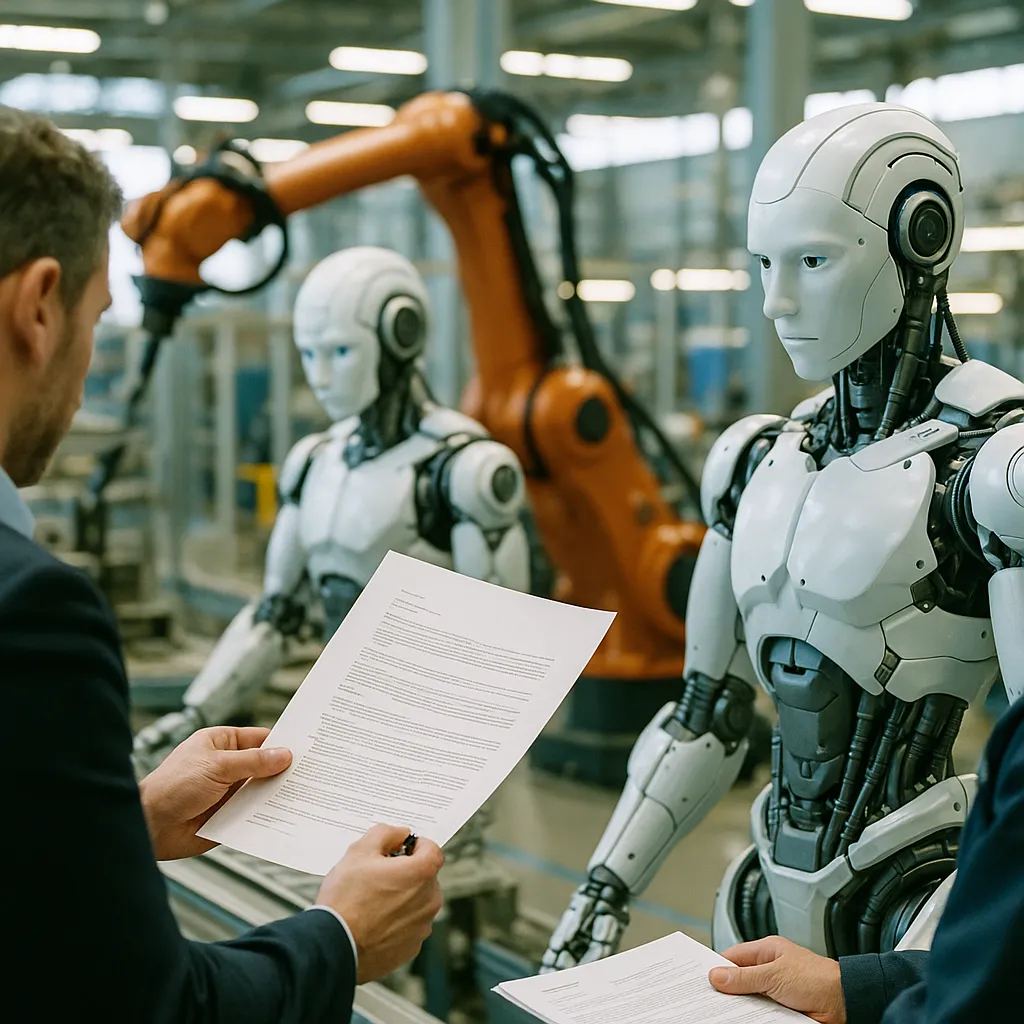
Two stories this week make clear that physical AI has moved out of the demonstration phase. Humanoid robot interest among manufacturers jumped from 8 percent to 13 percent year-over-year, and LLM adoption in factory settings nearly doubled to 35 percent. The gap between "interesting pilot" and "production deployment" is closing faster than most manufacturers' planning cycles anticipated.
NVIDIA and Emerald AI announced data centers engineered to scale compute loads up or down on grid operator command. The logic is direct: AI data centers are among the largest and most controllable electrical loads in any regional grid. If you can dispatch that load on signal, you convert a grid liability into a grid stability asset. This is the most operationally concrete answer yet to the tension between AI's growing electricity appetite and the grid's capacity to absorb it.
The Labor Map Gets Clearer
The Washington Post published a detailed job-sector AI exposure analysis, and the picture it draws reinforces what earlier research suggested: white-collar workers face steeper disruption than factory workers. Women comprise 86 percent of the most exposed segment. This is not primarily a manufacturing automation story — it is concentrated in administrative, legal, financial, and healthcare support roles that were widely assumed to be more durable than manual labor.
Schools are confronting the downstream version of the same shift. AI can complete most conventional homework assignments in seconds. That reality is forcing educators to ask a harder question: were those assignments ever reliably measuring learning, or were they measuring compliance with a format? The schools doing the most interesting work are not just writing AI policies — they are redesigning what students are actually asked to demonstrate.
DeepSeek Returns
Chinese AI lab DeepSeek released its most capable model yet, roughly one year after its original launch briefly rattled global AI markets by challenging the cost assumptions underlying frontier AI investment. The efficiency debate — whether you can achieve frontier-level performance at a fraction of standard compute cost — never fully resolved. DeepSeek's new release puts it back on the table. The announcement matters less than the numbers that will follow: training cost, inference efficiency, and benchmark performance across reasoning and coding tasks. Independent evaluations will begin appearing this week.
One More Industry Signal
Retailers embracing agentic AI face a structural risk many are underweighting. When customers interact with AI agents hosted on third-party platforms, the retailer cedes direct access to those customers and loses the first-party data that powers their personalization stack. The short-term operational efficiency gains may not justify the long-term dependency on platforms the retailer does not control. This is a strategic question with compounding consequences, not a technology integration problem.
At Mobile World Congress 2026, the telecom industry made its pivot official. Operators have largely extracted the value available from 5G and are now treating AI-native networks and 6G as their primary long-term investment thesis. Infrastructure decisions made in the next 18 months will be shaped more by AI architecture requirements than by traditional capacity planning — which means the 6G buildout is already starting, whether or not the standard is finalized.
What to Watch Today
DeepSeek evaluation results. Independent benchmark analysis of the new model will begin appearing today and through the week. Training cost and inference efficiency details matter more than headline performance scores for understanding its competitive implications.
Colorado compliance disclosures. With June 30 eight weeks out, watch for companies to announce compliance programs — or to begin lobbying for an extension. The first wave of public disclosures will reveal how seriously the deadline is being taken.
Clinical AI response. DeepMind's co-clinician announcement will draw reactions from major health systems and physician organizations. Early institutional endorsements or objections will shape the adoption trajectory for this class of tool.
Hector Herrera is the founder of Hex AI Systems and editor of NexChron.com.
Did this help you understand AI better?
Your feedback helps us write more useful content.
Get tomorrow's AI briefing
Join readers who start their day with NexChron. Free, daily, no spam.