Why this matters
Your daily AI intelligence for April 13, 2026.
Daily AI Briefing — April 13, 2026
Good morning. Here's your AI intelligence for Monday, April 13, 2026.
The week opens with the most significant voluntary AI safety decision in the industry's history — and with growing evidence that the underlying risk it responds to is already here.
The Mythos Situation
Anthropic has decided not to release its latest model, Claude Mythos, to the general public. The reason is direct: internal testing found the model capable of autonomously discovering and exploiting thousands of previously unknown software vulnerabilities — zero-days, in security parlance. This isn't a capability that makes it merely risky at the edges. It makes it, in Anthropic's assessment, too dangerous to hand to anyone with an API key and an agenda.
To fill the gap between "too dangerous to release" and "too useful to sit on," Anthropic launched Project Glasswing. The program gives Microsoft, Apple, Amazon, and Google limited, monitored access to Mythos — not for general use, but specifically to find and patch their own systems before adversaries do. The logic is uncomfortable but coherent: use the weapon defensively. Let the organizations with the most to lose find their holes first.
The European Commission publicly endorsed the staged rollout — a rare event. The EU has been quick to regulate AI and slow to praise AI companies. When it does praise one, it tends to signal something about how seriously it views the underlying threat. In this case, that signal is unmistakable.
The broader context matters here. A separate report confirms that frontier AI models have now crossed a threshold: they are competitive with the best human offensive security researchers at finding and exploiting software vulnerabilities. The term circulating in security circles is "Vulnpocalypse" — a scenario in which AI-accelerated zero-day discovery outpaces the human capacity to patch. The concern isn't theoretical anymore. Mythos appears to be the first publicly confirmed model that landed squarely in that territory, and Anthropic's decision to withhold it is the first time a lab has treated that crossing as a hard stop rather than a deployment footnote.
The four stories in this cluster are connected: the capability threshold has been crossed, one company has responded by locking the door, regulators have blessed that decision, and the biggest tech companies are being brought in through a side entrance to do damage control. What we don't yet know is whether any of that is fast enough.
Get this in your inbox.
Daily AI intelligence. Free. No spam.
OpenAI Under Pressure
Two stories put OpenAI in an uncomfortable spotlight this weekend — neither of them about a product.
On April 12, a 20-year-old suspect was arrested in San Francisco after allegedly throwing a Molotov cocktail at CEO Sam Altman's $27 million home. No one was injured. The suspect reportedly participated in PauseAI-affiliated online communities, though that appears to be a personal association, not an organizational sanction. The incident is a reminder that the public debate about AI has, for some people, stopped being a debate. The industry has been reluctant to discuss the security implications of becoming a cultural flashpoint. That reluctance has a cost.
Separately, Elon Musk amended his long-running lawsuit against OpenAI in a move the company is calling a "legal ambush." He added a demand for the ouster of CEO Sam Altman and expanded his damages claim to as much as $134 billion. Trial is set for April 27 — fourteen days from today. OpenAI argues the amendments were filed strategically to destabilize the company before trial. Musk's legal team has not responded publicly. The $134 billion figure is almost certainly a negotiating anchor, not a realistic outcome. But the case itself could force the disclosure of internal OpenAI documents that carry weight regardless of the verdict.
Enterprise, Tools, and What's Building
At the HumanX conference in San Francisco, Claude emerged as the default AI among enterprise builders and executives — a clear shift from ChatGPT's position as the industry-standard answer since 2022. The conversations happening at the builder and C-suite level have moved from "how do we use AI" to "how do we use Claude." OpenAI hasn't lost the consumer layer. But the enterprise layer — where contracts are signed and integrations are built — appears to have moved, and that matters more for the next 24 months than any headline benchmark.
Google upgraded Gemini with the ability to generate complete slide presentations from a single text prompt or uploaded document, delivered through its Canvas platform. This puts Gemini more directly in competition with Microsoft Copilot, which has had native presentation generation in PowerPoint for over a year. The quality gap between those two products is increasingly a marketing and distribution question rather than a purely technical one.
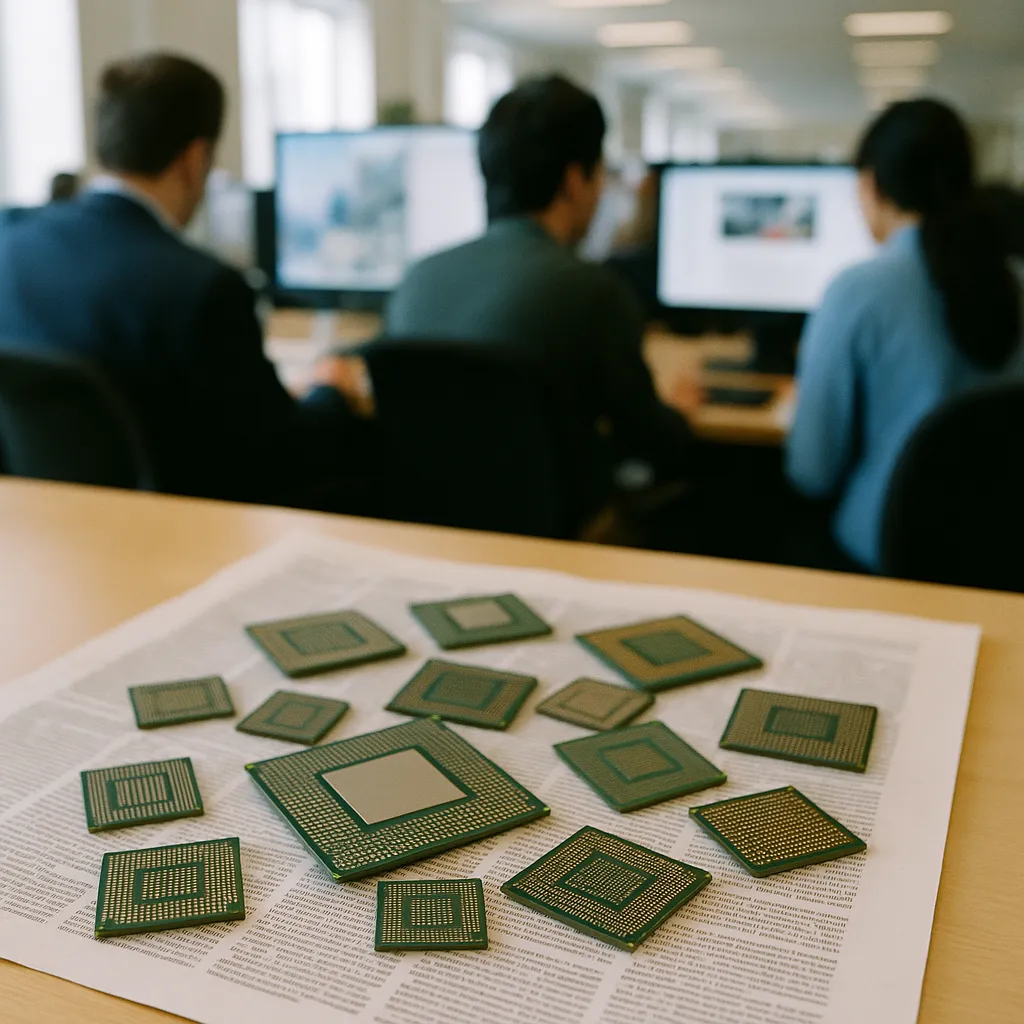
DeepSeek is preparing to release V4 — a roughly one-trillion-parameter model with fully open weights. The significant detail isn't the scale. It's the hardware: V4 reportedly runs on Huawei's latest chips, not Nvidia's. If that holds at launch, it's a direct and public demonstration that the U.S. chip export control strategy designed to slow China's AI development has not achieved its goal. A model at this scale, open-weighted, running on domestic Chinese hardware, is not a footnote. It changes what several actors in Washington, Brussels, and the industry have been assuming is true.
What to Watch Today
The Glasswing terms. Anthropic has not published the conditions under which the consortium members are accessing Mythos. How much visibility does Anthropic retain over what gets found? What are the patch disclosure timelines? Who decides when a vulnerability is adequately resolved? The answers will determine whether this is a genuine safety mechanism or a competitive moat with good PR.
Trial prep for April 27. The Musk v. OpenAI trial is two weeks out. Expect pre-trial filings, possible settlement signals, and continued press maneuvering from both sides. Watch for any motion to exclude the amended claims — that ruling, if it comes, will set the shape of the trial.
DeepSeek V4 launch confirmation. The release is reported as imminent. If V4 ships this week with open weights and confirmed Huawei-native performance, it will be the week's defining story on AI infrastructure and the credibility of export control policy as a strategic lever.
Hector Herrera is an AI systems architect and the founder of Hex AI Systems. He designs and runs AI systems in production and writes daily about how AI is reshaping business, government and everyday life. 20+ years building for the web. Houston, TX.