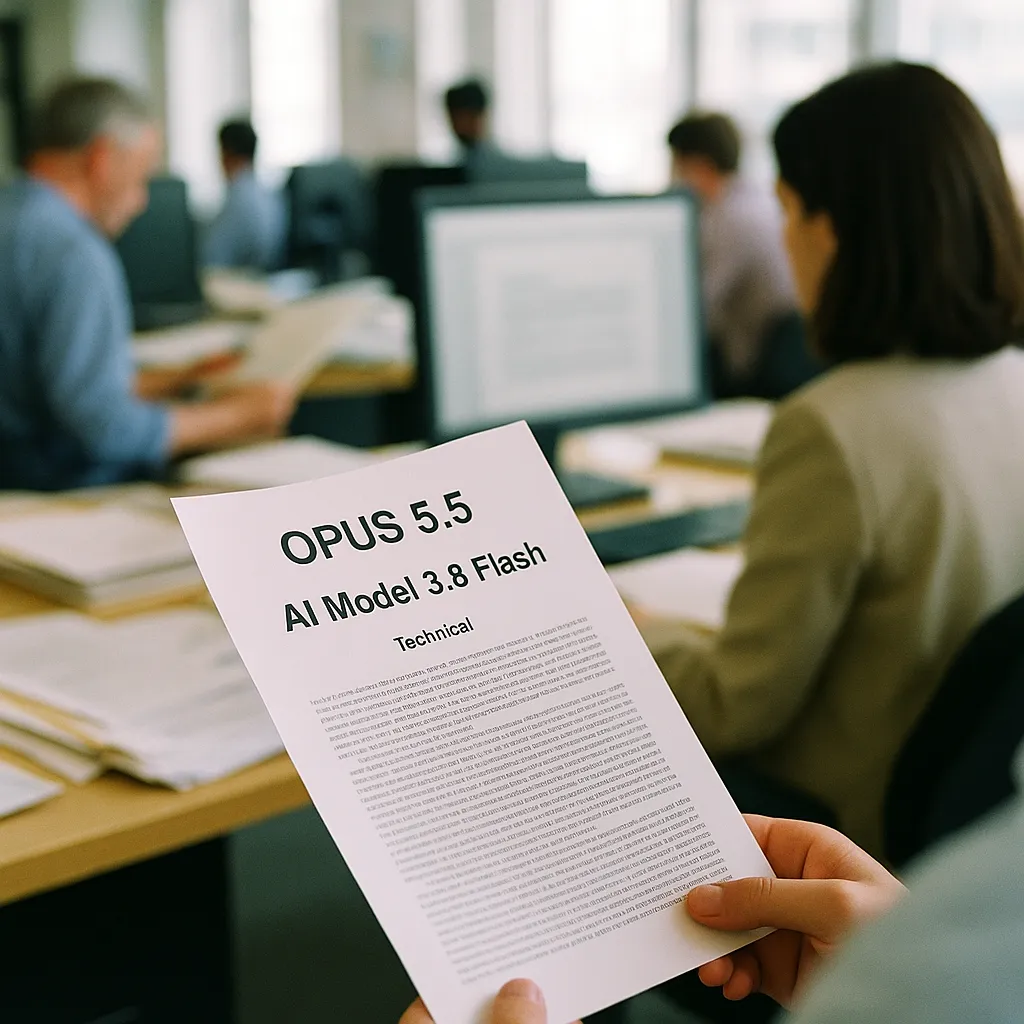
October opened with simultaneous flagship releases from Anthropic, Google, and OpenAI—the tightest coordination of major AI launches on record, driven by intense competition for the enterprise AI agent market.
October opened with simultaneous flagship model releases from Anthropic, Google, and OpenAI—the tightest coordination of major AI launches on record. The synchronized timing is not coincidence; it reflects how intensely the three leading labs are competing for the same enterprise AI agent market.
The three models
According to reporting from mean.ceo, the October wave includes:
-
Claude Opus 5.5 (Anthropic) — targeted at long-running agentic coding and research workflows. Anthropic positions Opus 5.5 as the model for tasks that require sustained reasoning across many steps: multi-file code generation, extended research synthesis, complex agent pipelines that run for hours rather than seconds.
-
Gemini 3.8 Flash (Google) — optimized for fast, low-latency production tasks. Where Opus 5.5 trades speed for depth, Flash is built for the high-throughput applications where response time is the primary constraint: real-time customer-facing tools, rapid document processing, inference at scale.
-
GPT-6 Sol (OpenAI) — positioned as a cost-efficient model for daily work use cases. Sol appears to occupy the middle ground: capable enough for substantive tasks, priced to replace GPT-4-class usage in enterprise deployments where cost-per-token matters as much as capability.
Why all three at once
Get this in your inbox.
Daily AI intelligence. Free. No spam.
Enterprise procurement cycles are one factor. Large organizations evaluate and deploy AI infrastructure on predictable schedules, and each lab wants its latest model in the comparison set when Q4 procurement decisions are made. Shipping in October rather than November or December means being evaluated—and ideally contracted—before budgets close.
But the deeper driver is the AI agent market. All three labs have bet their next phase of growth on autonomous agents: systems that don't just answer questions but take sequences of actions, use tools, manage files, write and execute code, and operate for extended periods without human intervention at each step. That market is being built right now. The organizations building agent infrastructure—enterprise software companies, developer platforms, system integrators—are making foundational choices about which models to build on. Whoever captures those foundational commitments gains a durable advantage.
What differentiates the positioning
The three models are not interchangeable, and the positioning reflects a deliberate split across use cases:
Anthropic is pushing Opus 5.5 toward the highest-value, most complex agent tasks—the ones where getting it wrong is expensive and getting it right requires extended reasoning. The implicit pitch is capability at the frontier.
Google is pushing Gemini 3.8 Flash toward production infrastructure—the workhorse model for high-volume, latency-sensitive deployments. The pitch is performance per dollar at scale.
OpenAI is pushing GPT-6 Sol toward broad enterprise adoption—the model that replaces older GPT-4-class deployments across an organization's daily workflows. The pitch is familiar trust with improved economics.
What to watch
Independent benchmarks across coding, reasoning, and agent task completion will be the first filter. Enterprise adoption patterns over the next 60 days—which model developers reach for when building new agent systems—will tell a more meaningful story than any synthetic evaluation. Watch also for OpenAI, Anthropic, and Google to follow up with pricing announcements and API-tier changes as they compete for developer mindshare in Q4.
Did this help you understand AI better?
Your feedback helps us write more useful content.
Get tomorrow's AI briefing
Join readers who start their day with NexChron. Free, daily, no spam.