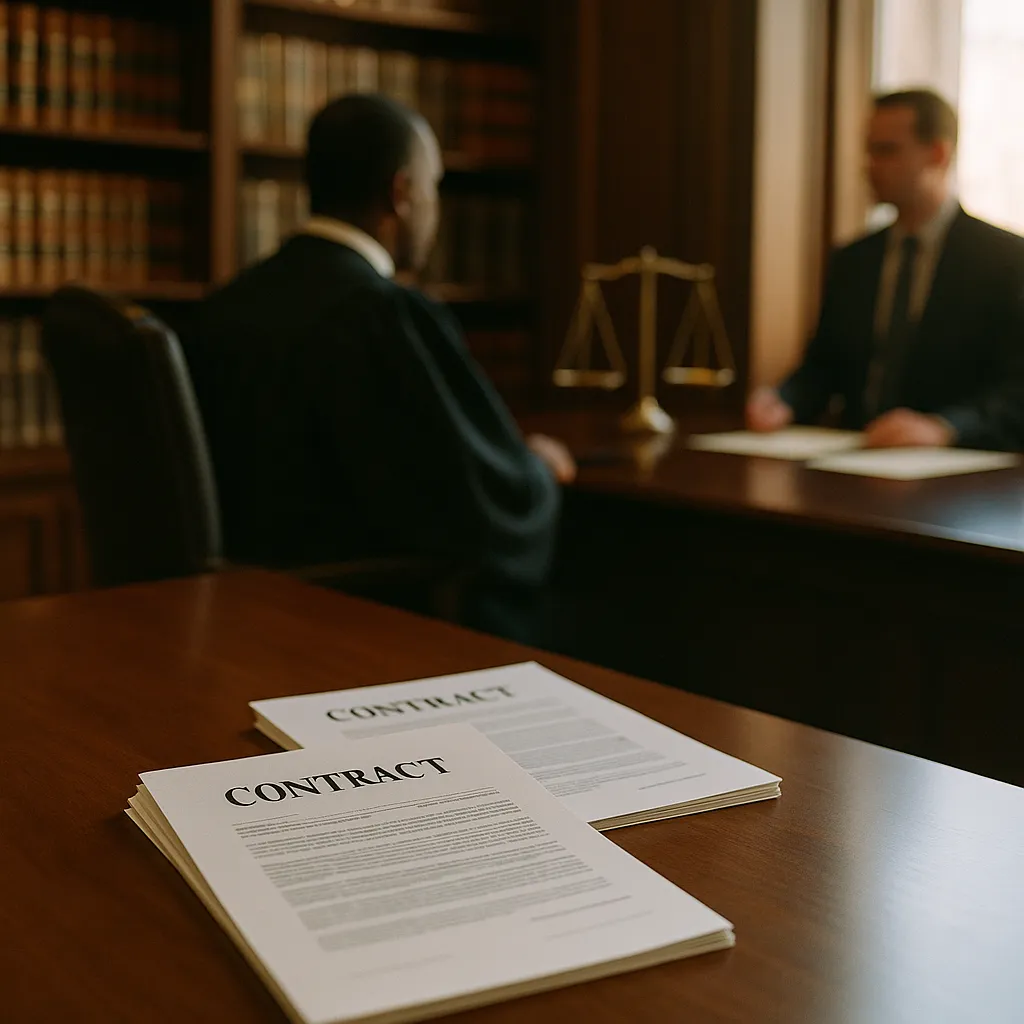
Four federal courts issued AI protective orders in four days, naming specific AI platforms and restricting their use with confidential discovery materials — marking a shift from novelty to standard of care in commercial litigation.
Federal Courts Are Writing AI Restrictions Into Litigation Itself — and Naming Platforms by Name
By Hector Herrera | October 28, 2026 | Legal
At least four federal courts issued or approved AI protective order language in a four-day window in early October, with orders that name specific AI platforms and restrict how attorneys and litigants may use them when handling confidential discovery materials. According to Law and Forensics, legal technology experts say these orders are transitioning from novelties into a new standard of care in complex commercial litigation. Courts are no longer waiting for Congress to set the rules. They are writing them.
What These Orders Actually Say
AI protective orders are case-specific court orders — like existing orders that restrict how parties may use confidential documents exchanged during discovery. The new AI-specific versions go further by explicitly restricting the use of named generative AI platforms when attorneys, paralegals, or parties handle materials designated confidential under the protective order.
The orders typically prohibit or require prior court approval for:
- Uploading confidential discovery documents to consumer or enterprise AI platforms
- Using AI tools to summarize or analyze protected materials if those tools may retain inputs for model training
- Submitting AI-assisted work product without disclosure of which tools were used and how
The platforms being named in these orders include widely used enterprise AI services. The specificity — naming tools rather than writing vague "AI restrictions" — signals that courts are paying attention to the operational details of how law firms actually use AI in 2026, not just the theoretical risks.
Why Courts Are Acting Now
The primary concern driving these orders is confidential data ingestion by AI training pipelines. Discovery in commercial litigation can include trade secrets, personal health and financial information, attorney-client privileged communications, and other materials with significant confidentiality interests.
Get this in your inbox.
Daily AI intelligence. Free. No spam.
When that material is uploaded to an AI service whose terms of service allow training on user inputs — or when the confidentiality of enterprise data handling cannot be independently verified — court-ordered protective orders can be violated without anyone realizing it. The harm may not be detectable for months or years, when training data surfaces in model outputs for unrelated users.
The second concern is verification. Courts are increasingly encountering AI-hallucinated citations in legal filings, as documented in high-profile sanctions cases this year. AI protective orders serve a dual purpose: protecting confidential data from leakage, and establishing accountability for AI-assisted work product so judges can assess its reliability.
A Shift in How Courts Govern Technology
What makes this wave of protective orders structurally significant is not any individual order. It is the pattern: four orders in four days, from different federal circuits, using similar language and naming similar platforms. That does not happen by accident. It reflects a coordinated evolution in legal practice — judges talking to judges, courts signaling to the bar what responsible AI use in litigation looks like.
For context, email and electronic discovery triggered a similar evolution in the 1990s and 2000s. Courts first adapted case-by-case, then the Federal Rules of Civil Procedure were amended to address electronically stored information (ESI) directly. The current AI protective order wave looks like the early-case-by-case phase of that same arc.
The difference this time is speed. ESI rulemaking took roughly a decade. Courts appear to be condensing that cycle significantly — driven by the pace of AI adoption in legal practice, the documented harms from AI hallucinations in filed documents, and the scale of discovery data now flowing through AI tools.
If you are a litigator, general counsel, or legal operations professional, this trend has immediate operational implications.
Actions to take now:
- Audit your AI tool usage against active protective orders. Review every matter where a protective order is in place and verify that your AI tool workflows comply with its terms — including any recently added AI-specific language you may not have noticed.
- Update your firm's AI use policy to distinguish protected from non-protected matter types. Blanket "use AI for everything" policies are incompatible with the protective order environment. You need workflows that enforce different access levels based on material designation.
- Check your AI vendors' data retention and training policies. If a vendor cannot provide written confirmation that client data is not used for training, that vendor should not touch confidential discovery materials — regardless of what a protective order does or does not say.
- Disclose proactively. Courts that have issued AI protective orders are watching for violations. Proactive disclosure of AI tool usage in work product, even where not yet required, builds credibility with judges who are increasingly skeptical of undisclosed AI assistance.
What to Watch
The Judicial Conference of the United States — the policy-making body for the federal court system — is expected to take up AI governance in litigation practice at its next full session. If the conference endorses model AI protective order language for nationwide adoption, the current wave of individual orders will become a floor, not a ceiling. The question is whether the model language will be narrowly targeted at training-pipeline data risks, or whether it will address the broader question of AI-generated work product disclosure — which would reshape how legal arguments are prepared and filed across every federal court.
Did this help you understand AI better?
Your feedback helps us write more useful content.
Get tomorrow's AI briefing
Join readers who start their day with NexChron. Free, daily, no spam.