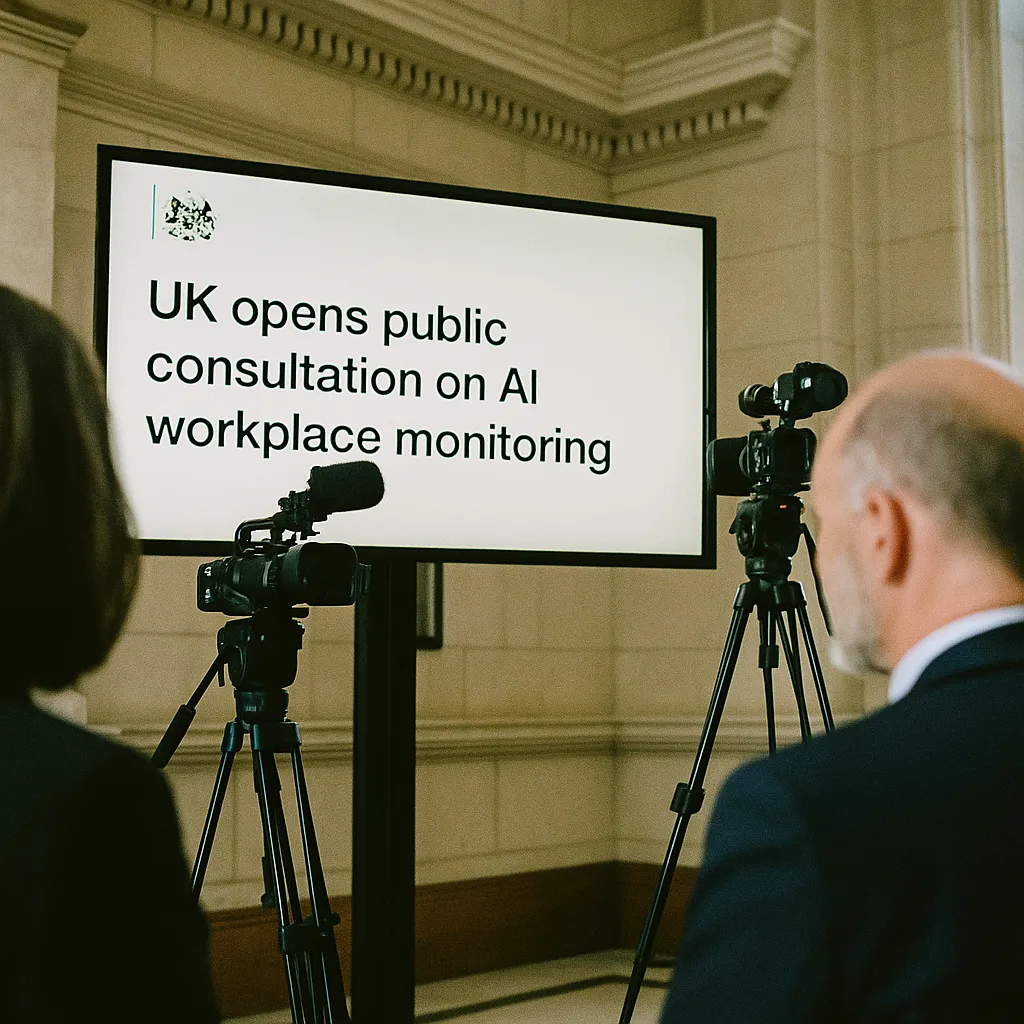
The UK government is seeking input on whether employers should need explicit consent before deploying AI surveillance, biometric tracking, and algorithmic performance management at work.
UK Opens Public Consultation on AI Workplace Monitoring — Responses Due September 30
The UK government is formally seeking input on whether employers should need explicit consent from workers and trade unions before deploying AI surveillance, algorithmic performance management, biometric tracking, and keystroke monitoring at work. The consultation, which launched July 8 and closes September 30, could produce the first binding regulatory framework on AI workplace monitoring in any major economy.
Governments in the EU, US, and Australia are watching the outcome closely as they consider their own approaches.
What the Consultation Covers
The scope is broad and specifically focused on AI-enabled monitoring. The UK's "Make Work Pay" consultation covers:
- AI-powered surveillance tools — monitoring software, computer activity tracking, screen recording
- Algorithmic performance management — automated scoring, productivity metrics, and performance decisions made or influenced by AI systems
- Biometric tracking — facial recognition, fingerprint scanning, and emotion-detection cameras in workplace settings
- Keystroke and input monitoring — detailed activity logs of employee keystrokes, mouse movements, and application usage
- Autonomous decision-making systems — AI that makes hiring, scheduling, disciplinary, or dismissal decisions without human review of individual cases
The consultation sits within the government's broader "Make Work Pay" employment reform agenda, which also includes proposals on zero-hours contracts and flexible working rights. That context matters: workplace AI monitoring is being treated as a labor rights issue, not merely a data protection one.
The Core Policy Question: Consent
The consultation's most significant proposal — and the one most likely to face industry pushback — is the possibility that employers would need explicit consent from workers and, where applicable, union representatives before deploying monitoring technologies. If enacted, this would be a regulatory first for a major economy.
Current UK law, under the Data Protection Act 2018 and UK GDPR, requires employers to inform workers they are being monitored. It does not require consent. The consultation is asking whether that bar is adequate for AI-powered monitoring, which can be far more granular and consequential than traditional CCTV or email audit logs.
Three potential outcomes are on the table:
- Draft legislation — a new statutory requirement for consent or workforce consultation before deploying workplace AI monitoring tools
- A statutory code of practice — a code that employment tribunals and courts would use to assess whether an employer acted reasonably, without creating new criminal liability
- Non-statutory guidance — updated advisory documents with no binding enforcement mechanism
The government has not signaled which outcome it favors. The consultation is designed to surface evidence about current practice, worker experiences, and implementation challenges before ministers decide.
What Employers Are Actually Deploying
The deployment of AI workplace monitoring has accelerated sharply since 2024. Tools now in common commercial use include:
Get this in your inbox.
Daily AI intelligence. Free. No spam.
- Productivity tracking software that scores employee output by measuring time in active applications, keyboard activity, and document production
- Algorithmic management platforms used in logistics and fulfillment that set work pace targets, flag underperformance, and initiate disciplinary workflows with minimal human review
- Computer vision systems in warehouses and factory floors that monitor worker positioning, speed, and compliance with safety protocols
- Customer service AI that scores agent interactions in real time and feeds scores into performance management systems
Several recent UK Employment Tribunal decisions have found against employers who used algorithmic management systems without adequately informing workers how those systems affected their performance assessments or employment status. The tribunal decisions don't yet require consent — but they signal judicial discomfort with opaque AI management.
The Compliance Challenge for Global Employers
Multinational companies operating UK offices alongside EU, US, and Asia-Pacific operations already manage different monitoring rules across jurisdictions. The UK consultation adds a new layer of complexity.
If a consent requirement is enacted:
- UK employees would have a distinct right that employees in most US states and many Asian markets do not currently hold
- Global HR and compliance teams would need to build consent-and-notification workflows specifically for UK operations
- AI monitoring vendors would need to redesign their products to support jurisdiction-specific consent management
The EU comparison is instructive. The EU's AI Act classifies certain workplace AI uses — including systems used in recruitment, performance evaluation, and task allocation — as high-risk, requiring transparency and human oversight. But the EU framework focuses on classification and documentation, not worker consent. The UK is asking a more fundamental question.
Why the International Precedent Matters
No major economy has yet passed a law requiring explicit employer consent before deploying monitoring AI. The UK consultation is notable precisely because it's treating that as an open question rather than a settled one.
Labor advocates in the United States — particularly in states with active AI legislation, including California, Illinois, and New York — are tracking the UK process closely. The EU's works council requirements under the AI Act's high-risk employment provisions create a partial parallel, but one that applies at organizational level rather than requiring individual worker consent.
If the UK enacts a consent requirement, it becomes the reference point for advocates and legislators elsewhere pushing for stronger workplace AI rules. If it opts for non-statutory guidance, the international precedent effect is weaker — but the evidence gathered in the consultation will still feed into future EU and US policy debates.
What to Do Before September 30
If you operate in the UK, the consultation closes in two weeks. Practical steps:
- Audit your current monitoring stack — identify every tool that tracks employee activity, and note whether it incorporates AI scoring or algorithmic decision-making
- Review the legal basis — confirm the data protection lawful basis under which each monitoring activity is conducted, and whether current privacy notices accurately reflect AI components
- Consider submitting a response — the consultation is open to employers, employees, trade unions, and vendors; employer responses will be weighed in the policy decision
The consultation is open at gov.uk/government/consultations/make-work-pay-workplace-monitoring-technologies.
What to Watch
Expect a government response document summarizing findings within three to six months of the September 30 close. Legislation, if it comes, is unlikely before 2027 — but a statutory code of practice could arrive faster and would immediately affect tribunal outcomes.
Watch for: major employer coalitions submitting joint responses; TUC (Trades Union Congress) advocacy for the strongest consent requirements; and any signals from the Department for Business and Trade about which outcome the government is leaning toward.
By Hector Herrera
Did this help you understand AI better?
Your feedback helps us write more useful content.
Get tomorrow's AI briefing
Join readers who start their day with NexChron. Free, daily, no spam.