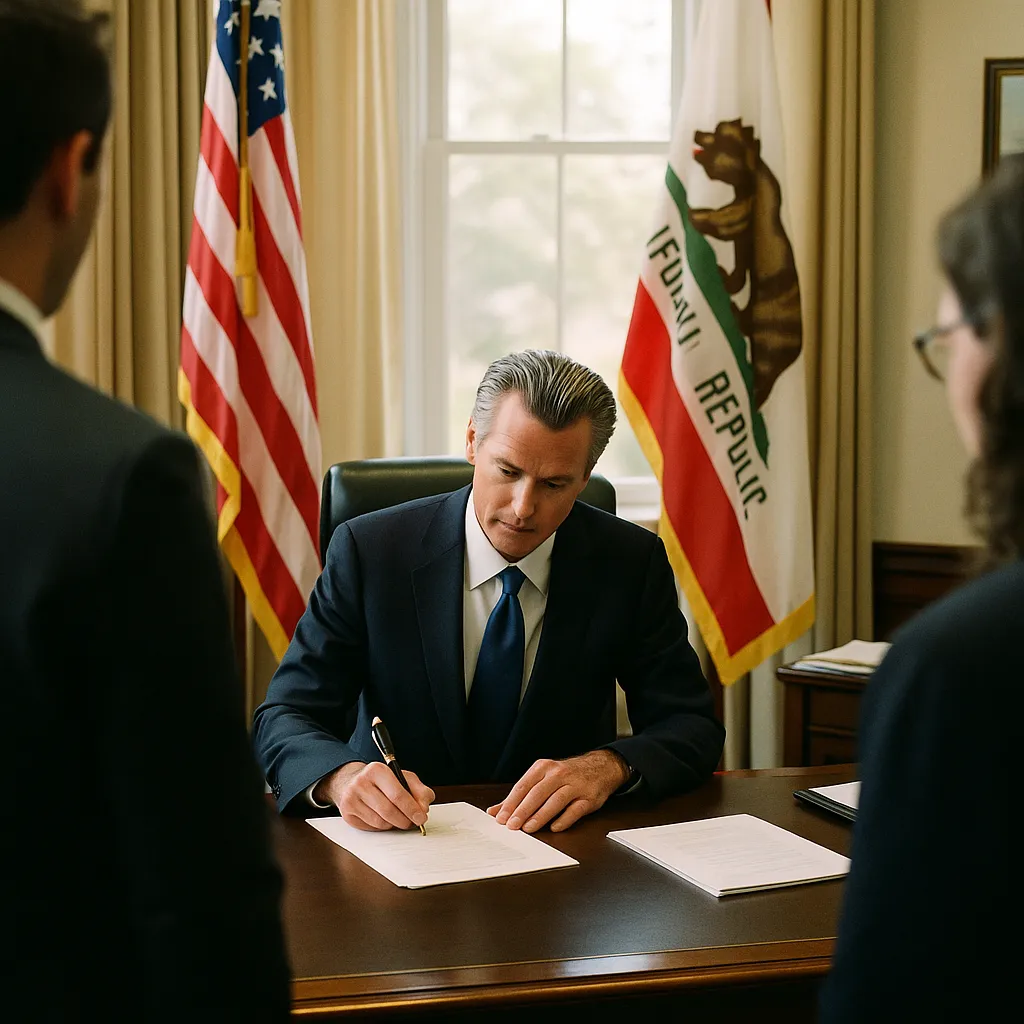
California Governor Gavin Newsom signed SB 53 into law on September 9, establishing the country's first mandatory AI audit requirements and calling on Congress to pass federal legislation.
California Governor Gavin Newsom signed SB 53 into law on September 9, establishing the country's first mandatory independent audit requirements for AI systems and immediately calling on Congress to pass federal AI legislation. The bill is narrower than the 2024 SB 1047 that Newsom vetoed—focusing on audit mechanisms rather than liability mandates—and reflects a deliberate recalibration designed to close accountability gaps without blocking innovation.
Why it matters: California is home to the majority of the world's leading AI developers. Governance rules set in Sacramento carry de facto national weight, regardless of whether other states follow.
From SB 1047 to SB 53: A Deliberate Narrowing
In October 2024, Newsom vetoed SB 1047—a broad AI safety bill that would have imposed sweeping liability requirements on frontier model developers. His core objection: the liability mandates were likely to drive AI development out of California without making AI meaningfully safer. The veto drew immediate industry support and sustained criticism from AI safety advocates.
SB 53 takes a structurally different approach. Rather than assigning liability for outcomes, it requires independent assessments—third-party audits—of AI systems to create transparency and accountability. According to the governor's official announcement, the legislation establishes "first-in-the-nation standards" through this audit framework.
The narrowing is strategic. Audit requirements create accountability without mandating specific outcomes or punishing companies for model behavior that wasn't reasonably foreseeable at the time of deployment.
What SB 53 Requires
The law's core provisions according to the governor's office:
Get this in your inbox.
Daily AI intelligence. Free. No spam.
- Covered AI systems must undergo independent third-party assessments
- Assessments evaluate AI systems against transparency and accountability standards
- No liability mandates—compliance is assessed, not prosecuted for specific AI outputs
- Findings are tied to accountability mechanisms defined in the statute
The audit approach mirrors conformity assessment frameworks in the EU AI Act and aligns with the NIST AI Risk Management Framework's emphasis on third-party evaluation, positioning California within international governance norms rather than ahead of them.
The significant open questions—which AI systems are covered, what qualifies as an independent assessor, and how findings are enforced—will be resolved in implementation rulemaking that follows the bill's signing.
Newsom's Federal Challenge
The signing statement carries as much weight as the statute itself. Newsom explicitly called on Congress to pass federal AI legislation, framing California's action as filling a void that Washington has been unable to fill.
That framing is calculated. A growing patchwork of state AI laws—Colorado's AI Act took effect June 30, and federal preemption debates have intensified throughout 2026—creates compliance friction that AI companies and their lobbyists have consistently cited as the primary argument for federal action. California's SB 53 joins that patchwork and raises the pressure level.
What This Means for AI Companies
Every major AI developer with California operations—which is nearly every major AI developer—now faces independent audit requirements that didn't exist before September 9. The practical compliance burden depends heavily on the implementation rulemaking still to come.
Who is better positioned:
- Companies that have already invested in internal AI auditing and documentation
- Deployers with established AI governance frameworks and third-party evaluation experience
- Organizations aligned with NIST RMF or EU AI Act conformity assessment processes
Who faces new obligations:
- Companies relying on voluntary safety commitments without external verification
- Smaller AI developers without dedicated legal and compliance infrastructure
- Deployers using third-party AI systems without contractual audit rights
What to Watch
The first test of SB 53 will be implementation rulemaking: which systems are covered, what constitutes an independent assessment, and what enforcement looks like in practice. Watch for the rulemaking timeline from the California agency designated to administer the statute, and for whether Congress responds to Newsom's challenge before the 2026 legislative session closes.
By Hector Herrera | Sources: Governor of California
Did this help you understand AI better?
Your feedback helps us write more useful content.
Get tomorrow's AI briefing
Join readers who start their day with NexChron. Free, daily, no spam.