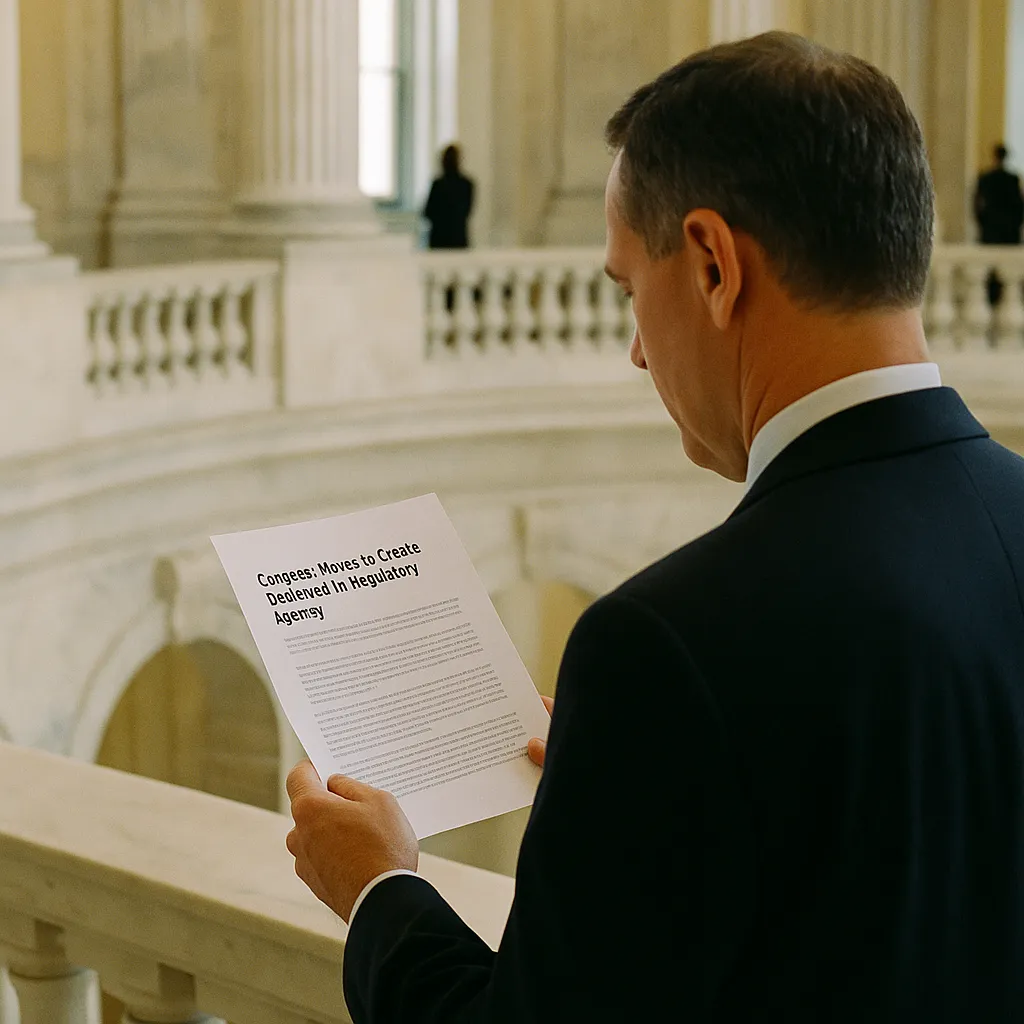
House and Senate lawmakers introduced joint legislation to block deployment of advanced AI systems until a new federal AI regulatory agency is established—the most concrete U.S. push yet for a standalone AI regulator.
House and Senate lawmakers introduced joint legislation last week that would prohibit deployment of the most capable AI systems in the United States until a new federal regulatory agency is established to oversee the technology—the most concrete push yet for a standalone AI regulator in American history, and one that sets a potential hard stop on frontier model releases if it advances.
The bill, introduced by bipartisan sponsors in both chambers, represents a fundamentally different approach to AI governance than any prior U.S. legislation: rather than regulating specific AI applications after the fact, it would create a prerequisite institution before advanced systems can deploy. Nextgov/FCW reported on the bill's introduction as part of a broader package of technology legislation moving through committee.
What the Bill Would Do
The legislation's core mechanics, as reported:
- Deploy restriction: Systems above a defined capability threshold—likely tied to benchmark performance, compute thresholds, or a combination—could not be released to the public or to enterprise customers until the new agency is operational and has issued foundational rules
- Agency creation: Mandates establishment of a dedicated federal AI regulatory body with authority to set safety standards, conduct pre-deployment reviews, and impose penalties
- Congressional timeline: Sets a deadline for agency creation, though the specific timeframe has not been publicly disclosed
The bill enters a legislative calendar already crowded with AI-related proposals, including the Sectoral AI Governance Act, which would direct existing agencies like the FTC, FDA, and FAA to update their rules to address AI, and multiple state-level frameworks in California, Colorado, and elsewhere.
Why Lawmakers Are Moving Now
The bill's timing follows a string of events that have each, individually, illustrated the absence of federal AI oversight:
Get this in your inbox.
Daily AI intelligence. Free. No spam.
- AI-generated malware found in active deployment using Google's Gemini to rewrite its own code and evade detection, with no regulatory body assigned to respond
- AI billing upcoding adding $1 billion in excess hospital charges with no agency having jurisdiction to set documentation standards
- Frontier model competition between OpenAI, Anthropic, and Google accelerating capability releases—GPT-6 Astra, Claude Opus 5.5—faster than any existing agency can track
- State-level fragmentation, with California's SB 53 signed into law and Colorado advancing its own AI disclosure requirements, creating a patchwork that large tech companies have lobbied against as unworkable
The argument for a dedicated agency, rather than distributing AI oversight across the FDA, FTC, and NIST, is that no existing agency has the technical staff, the statutory authority across all sectors, or the mandate to act on AI as a cross-cutting technology. The argument against it is that creating a new agency takes years, and the technology will not wait.
The Political Landscape
Bipartisan sponsorship is notable in the current Congress but does not guarantee passage. Technology companies have historically preferred voluntary frameworks and existing-agency oversight over new standalone regulators, and the lobbying response to this bill is expected to be significant.
The more immediate question is committee jurisdiction. AI legislation can plausibly be claimed by the Commerce, Science, and Transportation committees in both chambers, as well as Judiciary, Armed Services, and Homeland Security—each of which has developed its own AI-adjacent work. A bill this broad will need to resolve jurisdictional competition before it can advance.
What a Federal AI Agency Would Actually Do
The practical scope of a federal AI regulator would depend entirely on the enabling legislation, but based on international models—particularly the EU AI Office, the UK AI Safety Institute, and Canada's AIDA proposals—a U.S. AI agency would likely:
- Conduct pre-deployment evaluations of frontier models for safety and security risks, similar to what the AI Safety Institute currently does on a voluntary basis
- Set incident reporting requirements so that AI failures, harms, and near-misses create a public data record
- Issue sector guidance in coordination with existing agencies rather than replacing them
- Manage export controls on AI systems and underlying model weights in coordination with the Commerce Department
What it would not do, at least initially, is approve or reject specific AI products the way the FDA approves drugs—the technical challenge of predicting AI behavior at deployment is too hard, and the political resistance to pre-approval requirements would be immediate.
What Existing Agencies Say
The National Institute of Standards and Technology (NIST), which published the AI Risk Management Framework in 2023 and updated it in 2025, has consistently positioned itself as a standard-setter rather than a regulator. The FTC has brought enforcement actions against specific AI-enabled practices—deceptive product claims, privacy violations—but has said publicly that it lacks authority to regulate AI safety broadly.
The Federal AI Safety Institute, established in 2024 within NIST, has no enforcement authority and operates on voluntary cooperation from AI developers. Several of its senior officials have publicly stated that voluntary commitments from AI labs are insufficient as the technology scales.
What to Watch
The bill's first real test is whether it attracts enough cosponsors in the next 60 days to signal that committee chairs will schedule hearings. If it does, watch for a White House position—the Biden administration's 2023 executive order created a framework, but the current administration has signaled preference for industry-led governance. A formal statement opposing or supporting a standalone agency would clarify the legislative path significantly. International timing matters too: the EU AI Act's high-risk provisions are entering full enforcement in early 2027, and Congress is aware that U.S. companies operating in Europe will face EU oversight regardless of what happens domestically.
Did this help you understand AI better?
Your feedback helps us write more useful content.
Get tomorrow's AI briefing
Join readers who start their day with NexChron. Free, daily, no spam.