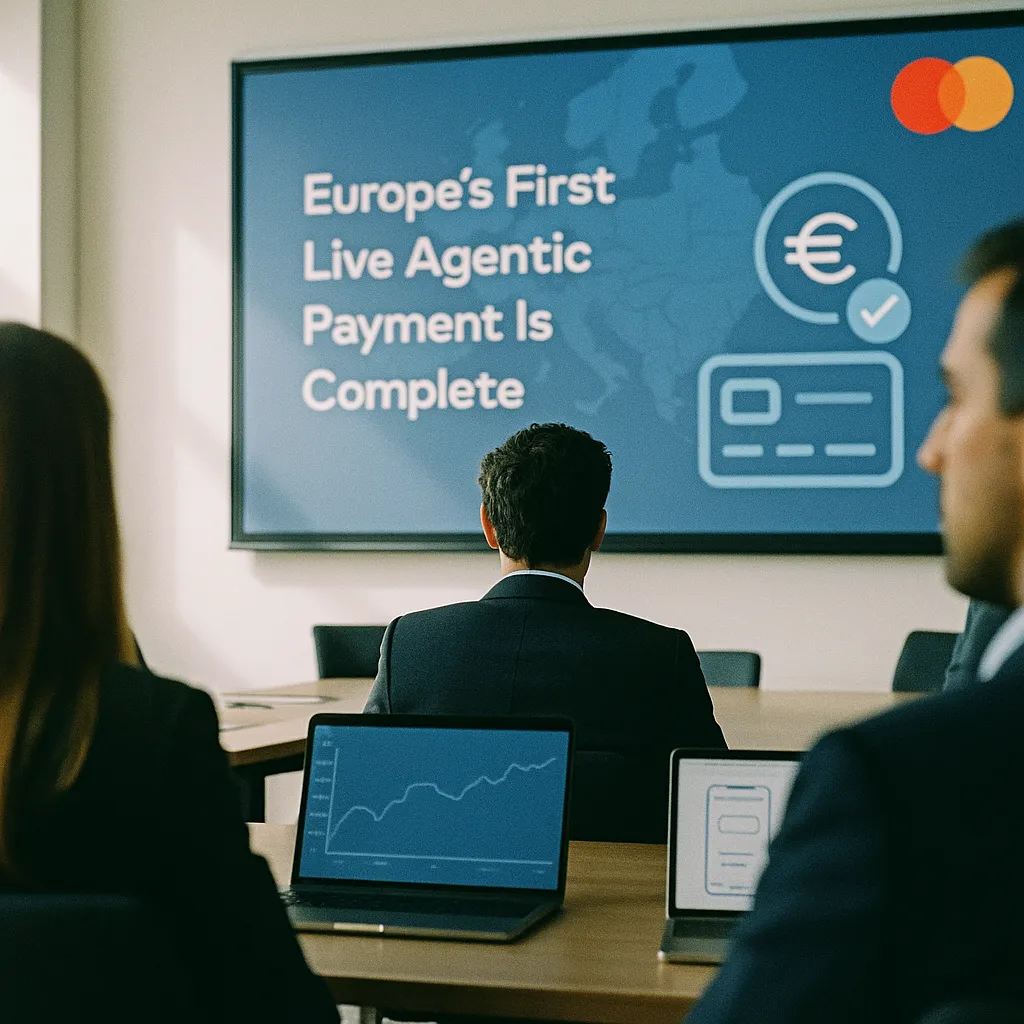
Mastercard, ING, and Worldline have completed Europe's first live end-to-end agentic payment—real money, production infrastructure, one human approval.
Europe's First Live Agentic Payment Is Complete. Mastercard, ING, and Worldline Did It.
By Hector Herrera | June 18, 2026 | Finance
Mastercard, ING, and Worldline have completed what they describe as Europe's first live end-to-end agentic payment—an AI assistant found concert tickets and purchased them with a single human approval step, using real money on production infrastructure. The announcement came at Money 20/20 Europe in Amsterdam, moving agentic finance from conference room concept to verified real-money deployment on live systems.
That distinction—production infrastructure, real money, not a sandbox environment—is what separates this from the category of AI finance demonstrations that have filled industry events for the past two years.
What Happened at Money 20/20 Europe
According to LLRX's coverage of AI in finance at the event, the demonstration proceeded as follows: an AI assistant identified concert tickets that matched a user's stated preferences, selected and initiated the purchase, and moved money through the payment rail—all requiring only a single approval step from the human account holder. No manual form entry. No card details entered by hand. The AI handled discovery, selection, and payment execution.
The three companies involved each held a distinct role:
- Mastercard — payment network and transaction infrastructure
- ING — bank and account-holder interface
- Worldline — payment processing and merchant-side settlement
The live nature of the transaction is what makes this announcement significant. Agentic AI systems have been demonstrated in financial contexts for over a year—purchasing airline tickets, managing subscriptions, initiating fund transfers—but consistently in demo environments where no real money moves and no live merchant processes a transaction. Running the same flow on production infrastructure, with a real bank account and a real payment processor, is a different technical and legal achievement.
What "Agentic Payment" Actually Means
An agentic payment is a transaction executed autonomously by an AI agent on behalf of a human, where the human's authorization covers a category of action rather than the specific transaction details. The user sets parameters—"find me tickets to a live music event near me this weekend under €80"—and the agent executes within those constraints without further input.
Get this in your inbox.
Daily AI intelligence. Free. No spam.
This is meaningfully different from digital wallets or autofill, where the human still initiates each specific transaction. An agentic system can browse, compare, select, and pay without additional human input beyond the initial authorization.
The single approval step that Mastercard, ING, and Worldline demonstrated is a deliberate design choice—balancing automation with accountability. The human sees what the agent is about to do and confirms it, then the agent executes. More advanced agentic systems could theoretically operate with pre-authorized parameters and no per-transaction approval at all, but regulators are unlikely to be comfortable with fully unsupervised financial transaction execution without significant safeguards in place.
Agentic payments represent one of the more consequential structural shifts in how consumer finance could operate. Every significant financial transaction today still requires a human to initiate it, enter payment details, confirm the amount, and often authenticate again with biometrics or a code. That friction exists partly for security and partly because reliable automation of the full payment flow has not been technically feasible until recently.
If agentic payments mature—with appropriate fraud detection, consent frameworks, and dispute resolution mechanisms—they could fundamentally change how consumers interact with money in routine commerce. Subscriptions, bill payments, travel bookings, and everyday purchases could shift to AI-orchestrated execution with periodic human review rather than per-transaction initiation.
For banks and payment networks, the strategic stakes extend well beyond convenience. Whoever defines the authorization models, consent frameworks, and liability structures for agentic transactions will have outsized influence over the architecture of the next generation of consumer finance. The Mastercard–ING–Worldline announcement is as much a standards-and-positioning move as it is a technology milestone.
The Regulatory Question
No European Union regulatory framework currently governs agentic payments specifically. The Payment Services Directive (PSD2) and its successor address strong customer authentication and third-party payment access, but both were written before AI agents capable of executing autonomous financial transactions were a commercial reality.
As agentic payment systems move from proof-of-concept toward commercial deployment, European regulators—particularly the European Banking Authority and national financial supervisors—will face pressure to define what "authorization" means when a human approves a category rather than a specific transaction. That question is not yet answered.
What to Watch
The first commercial agentic payment product available to retail consumers in Europe is the milestone to watch for next. The Money 20/20 demonstration established technical feasibility on production infrastructure; the path from a conference stage to a product available to everyday customers requires fraud modeling, regulatory clearance, dispute resolution frameworks, and consumer trust-building that will take most of 2026 and likely into 2027.
Also watch how Open Banking providers and fintech challengers respond. If the incumbent payment network players define the agentic payment standards, the terms of competition in European payments shift significantly in their favor.
Hector Herrera covers AI in business, finance, and the economy for NexChron.
Did this help you understand AI better?
Your feedback helps us write more useful content.
Get tomorrow's AI briefing
Join readers who start their day with NexChron. Free, daily, no spam.