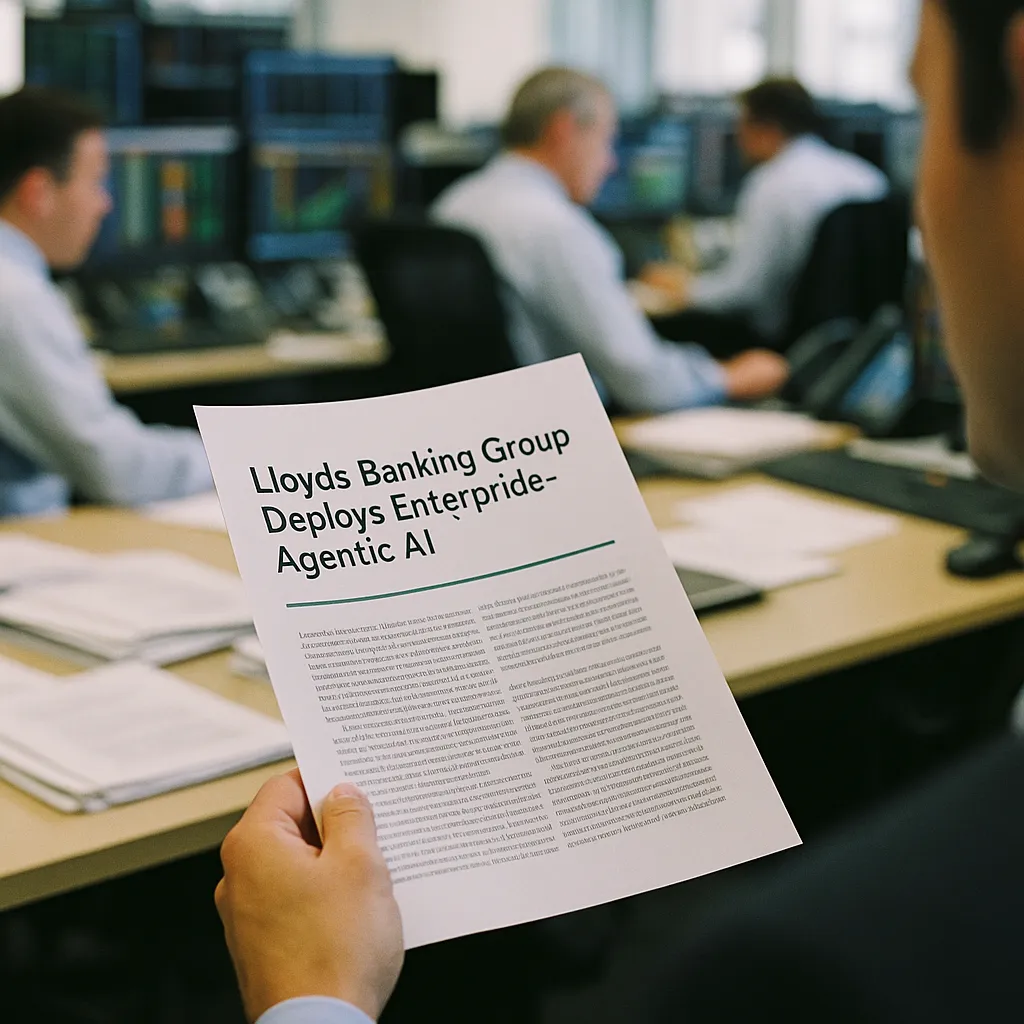
Lloyds Banking Group has rolled out agentic AI systems enterprise-wide, projecting £100 million in value this year from autonomous fraud investigations, complaint handling, and compliance checks.
Lloyds Deploys Agentic AI, Targets £100M Value
Date: 2026-06-08
Slug: lloyds-agentic-ai-100m-enterprise-deployment-2026
SEO Keyword: agentic AI banking enterprise deployment
Meta Title: Lloyds Deploys Agentic AI, Targets £100M Value
Meta Description: Lloyds Banking Group deploys agentic AI enterprise-wide, targeting £100M in value from fraud, complaints, and compliance automation.
Source URLs: ["https://www.pymnts.com/news/banking/2026/3-takeaways-as-ai-moves-into-banks-daily-operating-machinery/"]
Tags: ["finance", "banking", "agentic AI", "Lloyds", "Bank of America", "enterprise AI", "automation"]
Read Time: 4
Lloyds Banking Group has deployed agentic AI — systems that can take multi-step actions autonomously, not just respond to single queries — across its enterprise operations, and is projecting those systems will generate £100 million in value in 2026 alone. The announcement, reported by PYMNTS, marks one of the most concrete public commitments by a major bank to AI as core operating infrastructure rather than a productivity add-on — and it signals where the broader industry is heading.
This is a meaningful distinction. For the past three years, banks have deployed AI primarily as an assistant: a tool that summarizes documents, drafts emails, or surfaces data on demand. An employee still initiates every action; the AI responds. Agentic AI works differently. It receives a goal — investigate this fraud claim, resolve this customer complaint, flag this compliance issue — and executes a sequence of steps to complete it, checking in with human supervisors at defined points rather than requiring a human to direct each move. The bank is essentially adding a tier of digital co-workers that can run workflows end to end.
The Use Cases Lloyds Is Betting On
The three domains Lloyds has prioritized for agentic AI deployment are not arbitrary. They are among the most labor-intensive, rule-bound, and error-prone operations in retail banking.
Fraud investigations require analysts to pull transaction records, cross-reference behavioral patterns, check against known fraud typologies, contact merchants, and document findings — often under regulatory deadlines. The process is repetitive and high-stakes. An agentic system can execute the data-gathering and cross-referencing steps autonomously, surface a preliminary finding with supporting evidence, and route the case to a human analyst for final judgment. Cycle times compress; analyst attention is concentrated where human judgment is irreplaceable.
Complex customer complaints follow a similar structure. A complaint about an unauthorized charge, a disputed mortgage term, or a blocked international transfer typically involves pulling account history, reviewing correspondence, checking policy, drafting a response, and escalating if the issue exceeds a threshold. Each of those steps is defined by rules. Agentic AI can execute the rules without requiring a human to manage the sequence — freeing customer service staff for calls that require genuine empathy or discretion.
Compliance checks are where the volume-to-value ratio is highest. Regulatory compliance in banking involves continuous monitoring of transactions, communications, and customer files against an evolving ruleset. The manual labor required to do this at scale is one of the industry's largest cost centers. Agentic systems can run continuous checks, generate audit trails, and flag anomalies for human review — compressing compliance costs without reducing coverage.
The £100 million figure Lloyds is projecting comes from combining time savings, error reduction, and capacity reallocation across all three domains at enterprise scale. That is not a rounding error. For context, Lloyds reported a net income of roughly £5.9 billion in 2025. A £100 million AI efficiency gain in a single year represents a meaningful operating leverage improvement, particularly if — as the bank presumably expects — the figure grows as the systems mature and expand to additional workflows.
The Human Oversight Architecture
What separates Lloyds' deployment from earlier automation waves — and from the autonomy that tends to alarm regulators — is the explicit human oversight layer built into every agentic workflow.
Get this in your inbox.
Daily AI intelligence. Free. No spam.
The bank has been clear that these systems are not replacing human decision-makers on consequential calls. They are handling the structured, procedural steps that precede and surround those decisions. A fraud analyst still reviews the AI's findings and makes the final determination. A compliance officer still signs off on flagged cases. A customer service manager still handles escalations that exceed the AI's authority threshold.
This architecture matters for two reasons. First, it is what the UK's Financial Conduct Authority and Prudential Regulation Authority will expect to see when they examine AI deployments at systemically important banks. Regulators in the UK and EU have been explicit that automated systems in financial services must include human accountability at every consequential decision point. Lloyds' design appears structured to satisfy that requirement.
Second, it is what makes the £100 million claim credible rather than speculative. Fully autonomous AI systems operating without oversight would face significant regulatory headwind and would likely require years of validation before deployment at scale. Human-in-the-loop architectures can move faster because they are risk-bounded — the AI cannot cause a compliance violation or a customer harm without a human having a chance to catch it first.
Bank of America: A Parallel Data Point
Lloyds is not moving alone. Bank of America has rolled out an AI-powered meeting-preparation tool for its wealth management advisers — a deployment that illustrates the same enterprise-scale logic from a different angle.
The tool prepares advisers for client meetings by automatically pulling account history, recent market developments relevant to the client's holdings, open service requests, and relationship notes — information that advisers previously assembled manually before each meeting. Bank of America has projected the tool can save up to 4 hours of preparation time per client meeting.
Multiply that across thousands of advisers and hundreds of thousands of client meetings annually, and the aggregate time savings becomes a significant operational gain — hours that advisers can redirect toward actual client conversation, new business development, or handling a larger book of business without proportionally increasing headcount.
The Bank of America case is instructive because it shows a different entry point for agentic AI in banking: not cost center automation (Lloyds' fraud and compliance focus) but revenue enablement (freeing relationship managers to do more of the work that directly generates fee income). Both vectors — cost reduction and revenue capacity — are legitimate paths to the £100 million-scale returns that large banks are now publicly projecting.
What the Industry Shift Means
The broader signal in both deployments is that banking has crossed a threshold. For much of 2023 and 2024, banks were running AI pilots — controlled experiments in isolated business units, carefully insulated from core operations, generating learning but not enterprise-scale value. Pilots are now converting to production deployments at major institutions, with specific dollar targets attached.
This shift has three downstream implications.
For bank employees, the near-term effect is workflow redesign rather than immediate job elimination. The roles most affected — fraud analysts, compliance reviewers, customer service representatives — are not disappearing in the short term. They are changing. The proportion of their work that involves executing structured procedures is shrinking; the proportion that requires judgment, escalation authority, and customer relationship management is growing. Workers who develop competency in the latter are more valuable; those whose value was primarily in the former face real displacement risk over a 3–5 year horizon.
For regulators, the acceleration means that guidance frameworks that were adequate for AI pilots are now being stress-tested by production systems. The UK's AI and financial services regulators have been more proactive than most — the FCA has published detailed AI governance expectations and has been running its AI Lab for several years. But the speed of enterprise deployment is outpacing even that relatively advanced regulatory posture.
For competing banks, the competitive pressure is real. If Lloyds realizes £100 million in operating efficiency in 2026 and scales the program in 2027 and 2028, it will be operating at a structurally lower cost per transaction than banks still running manual workflows. In an industry where basis points matter, that kind of efficiency gap compounds quickly.
The banks that treat agentic AI as a technology experiment are falling behind the banks that are treating it as an operating model redesign. Lloyds has made its position clear.
Hector Herrera covers AI and finance at NexChron. Follow NexChron for daily AI intelligence.
Did this help you understand AI better?
Your feedback helps us write more useful content.
Get tomorrow's AI briefing
Join readers who start their day with NexChron. Free, daily, no spam.