Deepfake fraud in insurance has surged 2,137% in three years, and only 32% of carriers say they can detect it — while AI-native underwriting compresses timelines from days to minutes.
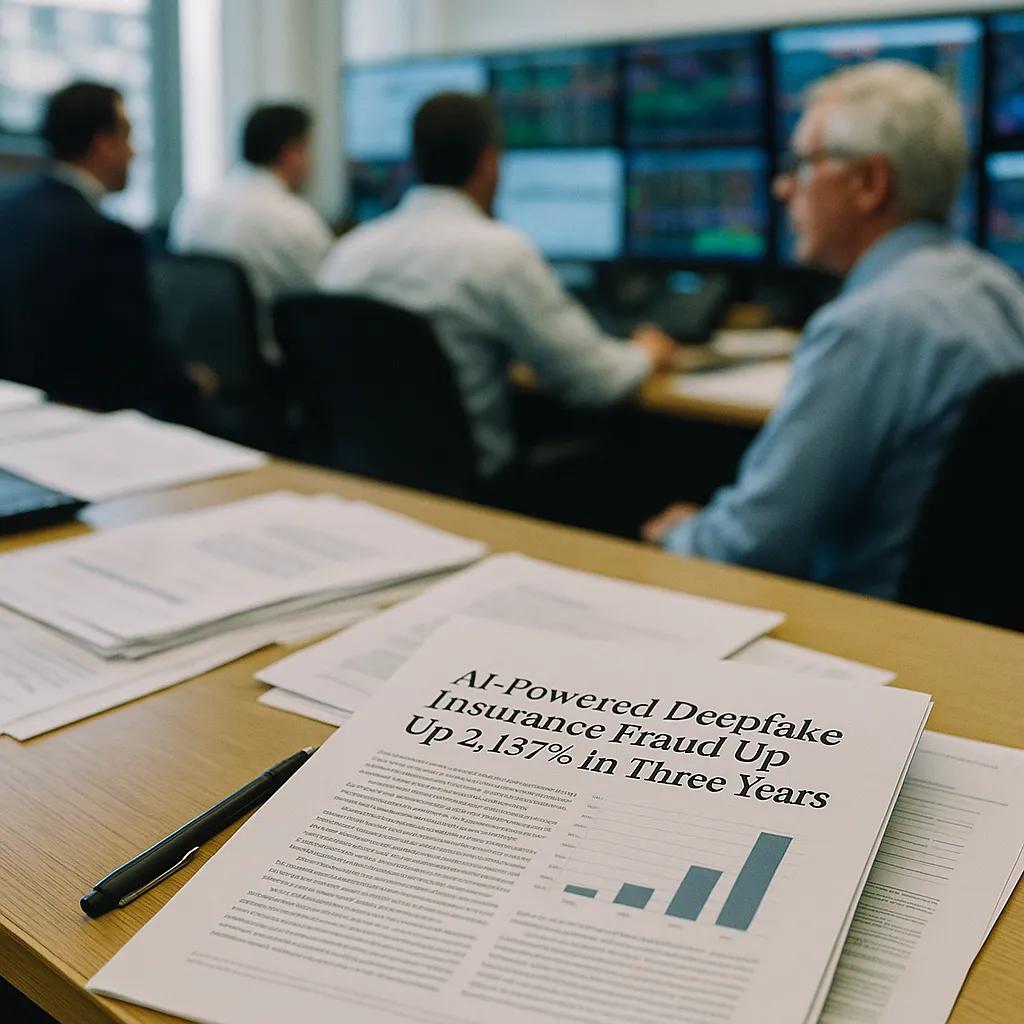
AI-Powered Deepfake Insurance Fraud Up 2,137% in Three Years as Carriers Race to Build Countermeasures
By Hector Herrera | September 13, 2026
AI-generated deepfake fraud in insurance — synthetic documents, voice clones, and fabricated video evidence — has surged 2,137% over the last three years, and only 32% of insurers say they can reliably detect it. The same AI capabilities enabling the fraud are now being adopted by carriers for underwriting and detection, compressing timelines from three days to three minutes while the battle over who uses the technology more effectively plays out in real time.
The Fraud Problem
Deepfake fraud is not a future risk in insurance — it's a current operational reality. Industry reports compiled by FinanceX Magazine document the 2,137% growth figure in a September 2026 analysis of the InsurTech market transformation.
The attack surface is broad:
- Synthetic identity documents — AI-generated IDs, medical records, and property records submitted to support fraudulent claims
- Voice cloning — synthetic audio of real policyholders used to authorize changes, file claims by phone, or impersonate claimants in call center interactions
- Fabricated video evidence — AI-generated footage of accidents, property damage, or medical conditions that did not occur
The 32% confidence figure is the most operationally alarming number. It means roughly two-thirds of insurers are processing claims they cannot reliably authenticate against deepfake-generated evidence. At scale, that's a systemic fraud exposure problem, not a one-off incident issue.
Why the Number Is 2,137%
The percentage sounds extreme, but it has a straightforward explanation: three years ago, creating a convincing AI-generated synthetic document or voice clone required technical skill and specialized tools available to a small population. Today it requires a consumer-grade app and ten minutes.
The barrier to entry for AI-generated fraud collapsed in 2023-2024 as diffusion models and voice synthesis became commercially available without restriction. The insurance industry's fraud detection infrastructure — built to catch human fabrication, paper forgery, and staged accidents — was not designed for this threat vector. The gap between fraud capability and detection capability is what the 2,137% growth represents.
Get this in your inbox.
Daily AI intelligence. Free. No spam.
The Countermeasures Race
The same AI advances enabling fraud are being deployed defensively. For carriers that have implemented AI on the underwriting and claims side, the results are quantifiable:
- Underwriting timelines have collapsed from three days to approximately three minutes for standard personal lines policies
- Straight-through processing rates — claims and policies handled entirely by automated systems without human review — have jumped to 70–90% at leading carriers
- AI-focused companies captured 95.2% of the $1.63 billion in global InsurTech VC funding in Q1 2026, according to the FinanceX Magazine analysis
That last figure matters: nearly all venture capital flowing into insurance technology is now explicitly AI-focused. Investors are not funding insurance companies that are adding AI features; they're funding companies built around AI as the core operating model.
What AI-Native Underwriting Actually Looks Like
The three-minute underwriting number is worth unpacking. Traditional underwriting for a homeowner's or auto policy involves pulling credit data, property records, loss history from CLUE (Comprehensive Loss Underwriting Exchange), and manual review of edge cases. AI-native systems:
- Pull and analyze all data sources simultaneously rather than sequentially
- Apply real-time risk scoring that incorporates current weather data, local crime indices, and market conditions — not just static historical records
- Flag anomalies for human review rather than routing all applications through human review by default
- Use computer vision to assess property condition from satellite imagery and street view data, reducing dependence on in-person inspections for standard risk tiers
The result is a genuine operational transformation, not a speed-up of the existing process.
The Detection Gap Creates Uneven Liability
The 32% confidence rate creates a specific liability problem: carriers that cannot detect deepfakes are paying fraudulent claims, but they're also likely rejecting some legitimate claims on suspicion of fraud because their detection systems are imprecise. Both errors are costly — one financially, one legally and reputationally.
Carriers investing in AI fraud detection are deploying tools that analyze:
- Metadata consistency in submitted documents (creation timestamps, software signatures, editing history)
- Biometric liveness detection for video and voice evidence
- Cross-reference verification against third-party data sources that a fraudster cannot simultaneously fabricate
None of these are foolproof against sufficiently sophisticated attacks, but they raise the cost and skill threshold for fraud, which reduces the volume of successful attempts.
What to Watch
The regulatory response is still forming. Insurance regulation in the US is state-level, which means there is no uniform standard for what fraud detection capability carriers must have, and no required disclosure when a deepfake fraud attempt is detected. Watch for state insurance commissioners — particularly in California, New York, and Texas — to begin drafting guidance on deepfake fraud disclosure and minimum detection standards. The first major enforcement action against a carrier for knowingly inadequate deepfake detection will accelerate that regulatory timeline significantly.
This article covers financial industry topics. It is informational and does not constitute financial or investment advice.
Did this help you understand AI better?
Your feedback helps us write more useful content.
Get tomorrow's AI briefing
Join readers who start their day with NexChron. Free, daily, no spam.