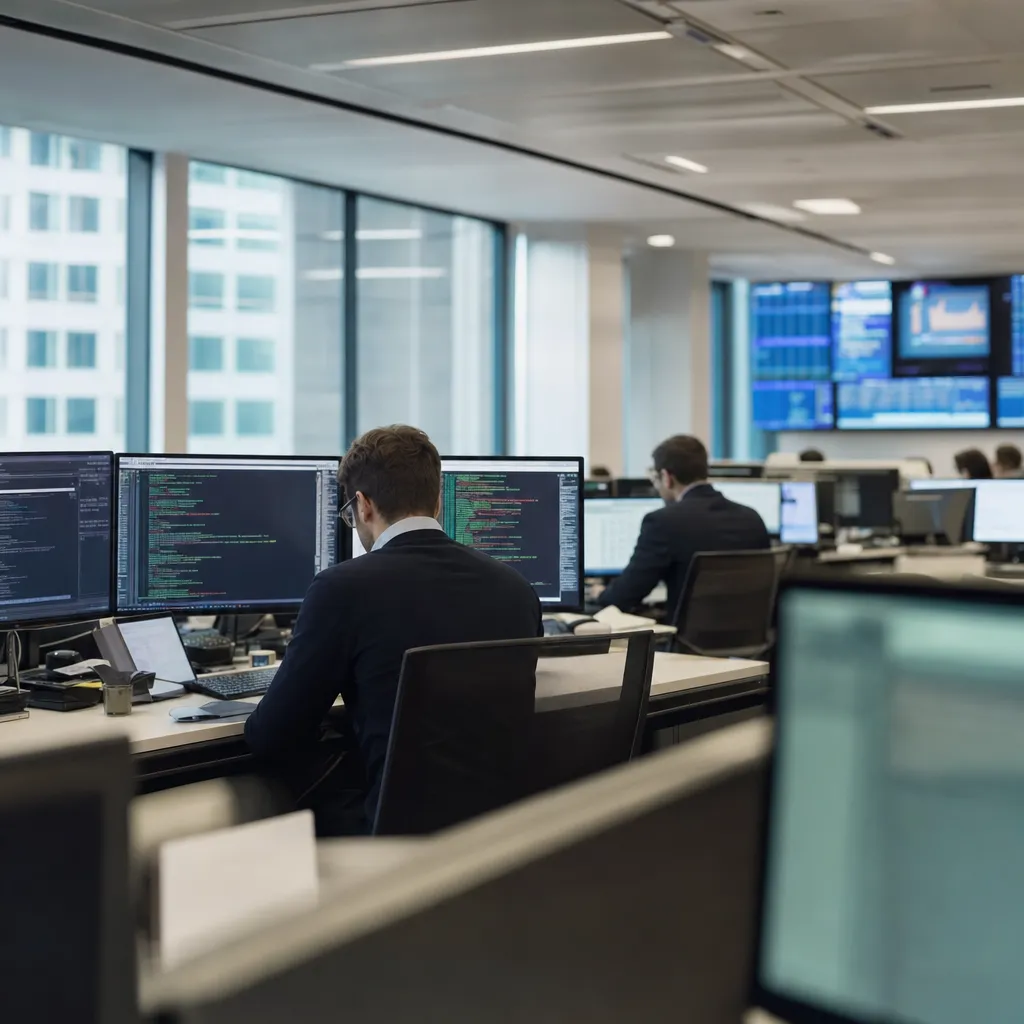
Goldman Sachs has pulled advanced AI coding assistants from most of its workforce after an internal risk review — a significant counternarrative as rivals race to deploy AI broadly.
Goldman Sachs has pulled access to advanced AI coding assistants from most of its workforce, restricting these tools to engineers only after an internal review concluded the productivity gains did not justify the risk exposure for non-technical roles. The pullback is a significant counternarrative: at the moment most financial institutions are racing to deploy AI, one of the world's most influential banks is pumping the brakes.
The decision matters not just for Goldman, but for how the entire financial sector is thinking about where AI liability lands when things go wrong.
What Changed and Why
According to Bloomberg, Goldman Sachs conducted an internal review of AI coding tool usage across its workforce and concluded that the risk profile for non-engineering use was not acceptable. Access to advanced coding assistants — tools in the class of GitHub Copilot and similar products — is now limited to the engineering teams that build and maintain Goldman's systems.
Traders, bankers, analysts, and operations staff who had been experimenting with AI coding tools to automate data workflows, build ad-hoc scripts, or accelerate quantitative analysis are now cut off.
The stated rationale centers on productivity versus risk: Goldman's review found that the gains from broader deployment did not outweigh the exposure created when non-engineers use AI tools to interact with systems they don't fully understand — particularly systems that touch live financial data, client accounts, or trading infrastructure.
The Liability Problem Nobody Has Solved
Goldman's caution reflects a real, unresolved problem in financial AI deployment: nobody has definitively answered who is liable when an AI tool causes an unauthorized financial action.
Imagine a scenario — not hypothetical, based on incidents documented in 2025 and 2026 — where a bank employee uses an AI coding assistant to build a quick script that queries client account data, makes an error in the prompt or the AI generates subtly incorrect code, and the resulting script moves funds in a way the employee didn't intend. Who is responsible? The employee, for using the tool? The bank, for permitting it? The AI tool vendor, for producing faulty output?
Get this in your inbox.
Daily AI intelligence. Free. No spam.
No court has established clear precedent. The existing financial liability framework assumes that financial actions are taken by humans who understand what they're doing. AI tools introduce a layer of opacity — the user may not understand the code the AI generated, and may not have verified it before execution.
Goldman's solution — restrict AI coding tools to the engineers who can actually evaluate what the code does — is a defensible position. It's also a significant constraint on the productivity gains AI vendors have been promising.
The Industry Contrast
Goldman's move runs against the grain of where most of its competitors are heading. JPMorgan has been aggressive about AI deployment, with its LLM Suite reaching tens of thousands of employees. Morgan Stanley has deployed OpenAI-powered tools to its financial advisors. Citigroup has been building out AI-assisted compliance and risk workflows.
The contrast illustrates a genuine split in how major financial institutions are calculating the risk-reward tradeoff for AI deployment:
- Broad deployment camp: Get AI tools in the hands of employees as quickly as possible, capture the productivity gains, and work out the liability questions as they arise.
- Controlled deployment camp: Establish clear risk boundaries first, deploy only where liability and verification procedures are well-defined, and expand carefully.
Goldman is firmly in the second camp — which is consistent with its historically conservative approach to technology adoption. The firm was late to algorithmic trading compared to some rivals but eventually built one of the most sophisticated quantitative trading operations in the world.
What This Signals for Agentic AI
The Goldman pullback carries particular significance as the industry moves toward agentic AI — systems that don't just assist with tasks but autonomously execute them. If banks are struggling with the liability question for AI coding assistants used by humans, the question becomes orders of magnitude more complex for AI agents that initiate financial actions without human prompting.
Industry groups including ISDA and GFMA have been working on frameworks for AI agent authorization in financial services, but published guidance remains early-stage. The EU AI Act's high-risk category classifications cover some financial AI use cases, but operational liability in real-world failure scenarios is still being litigated in multiple jurisdictions.
Goldman's internal review is effectively saying: we're not ready to clear the liability question for broad AI coding tool access, so we're not offering it. That's a risk-management decision, not an anti-AI position.
What to Watch
The key question is whether Goldman's approach spreads. If other tier-one banks conduct similar reviews and reach similar conclusions, the narrative around AI productivity in financial services gets significantly more complicated. Vendor claims of 20-40% productivity improvements need to be weighed against the risk management cost of determining where and how to safely deploy.
Watch for Goldman's posture to evolve as the industry develops clearer liability frameworks. The firm is likely to remain restrictive until it can clearly define accountability — at which point its deployment may actually be faster and more systematic than peers who shipped broadly and are now cleaning up edge cases.
Source: Bloomberg, November 2, 2026
Did this help you understand AI better?
Your feedback helps us write more useful content.
Get tomorrow's AI briefing
Join readers who start their day with NexChron. Free, daily, no spam.