A Sonarworks survey of over 1,100 professional music producers finds broad acceptance of AI for technical studio tasks and deep skepticism toward AI generating lyrics, melodies, or making aesthetic decisions.
Music Producers Have Drawn a Line on AI. Technical Help: Yes. Creative Decisions: No.
By Hector Herrera | May 1, 2026 | Creative
A survey of more than 1,100 professional music producers has produced the clearest picture yet of where working musicians stand on AI: they welcome it in the technical domain and reject it in the creative one. Sonarworks, the audio technology company, published the findings this week, and the data draws a line that the music industry is now beginning to encode in union contracts and licensing terms.
This matters beyond music. The creative industries are the leading edge of a broader societal negotiation about what work AI should do and what work should remain distinctly human. What music producers are demanding from AI today will become the template for how other creative fields structure their AI policies over the next decade.
What 1,100 Producers Actually Said
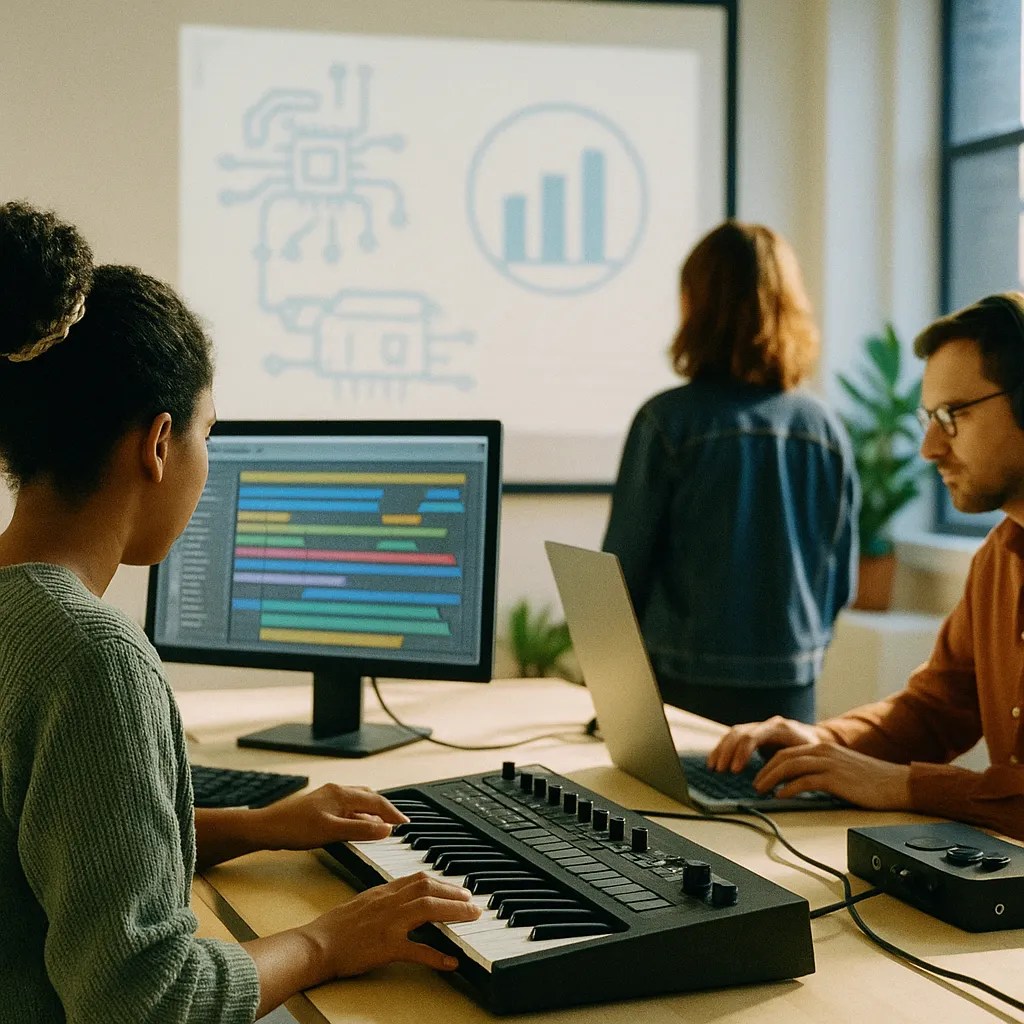
According to the Sonarworks survey, broad acceptance exists for AI applied to technical studio tasks:
AI use cases producers support:
- EQ and mixing assistance — AI analyzing frequency balance and suggesting adjustments
- Noise reduction — AI cleaning up recordings, removing background interference
- Mastering — AI-driven loudness normalization and final processing for distribution
- Stem separation — isolating individual instruments from mixed recordings
- Vocal tuning — pitch correction and timing alignment tools
AI use cases producers reject:
- Lyric generation — AI writing or suggesting song lyrics
- Melody composition — AI creating or completing melodic lines
- Aesthetic decisions — AI choosing arrangement approaches, instrumentation, or emotional direction
- Creative identity replacement — any AI system that generates content indistinguishable from a specific producer's style without explicit consent
The pattern is consistent: producers accept AI as a technical assistant that improves the execution of human creative decisions, and reject AI as a creative decision-maker that displaces human authorship.
Why This Line Makes Sense to Them
The distinction producers are drawing is not arbitrary or technophobic. It tracks a coherent principle: AI can improve how you realize a creative idea; it cannot be the source of the creative idea.
Consider what separates a music producer's craft from a technical engineer's craft. The technical work — getting the frequencies right, cleaning the audio, ensuring the master translates across playback systems — has clear quality criteria that can be measured and optimized. An AI that makes this work faster and better without changing what the music is has obvious value.
The creative work — deciding what a song is emotionally about, what the arrangement communicates, what distinguishes this artist's sound from every other artist's sound — is where authorship lives. Producers are not opposed to tools that expand their creative possibilities. They are opposed to tools that substitute a machine's choices for their own, particularly when those choices become commercially valuable in ways that accrue to the tool's developer rather than the human creator.
Get this in your inbox.
Daily AI intelligence. Free. No spam.
The survey captures this: producers "want AI that saves time without displacing authorship or flattening creative identity." That last phrase — flattening creative identity — is the key fear. If every producer uses the same AI to make creative decisions, the results converge. Genre conventions harden. The stylistic diversity that makes music cultures generative starts to shrink.
Where the Industry Is Acting
The findings reflect positions that are moving beyond opinion into formal policy:
Union contracts. The American Federation of Musicians and the Screen Actors Guild-AFTRA have both negotiated AI provisions into recent agreements. The music industry's union structures are now working to add similar provisions to producer agreements — specifically around AI systems that train on a producer's existing catalog without consent and then generate music in that producer's style.
Licensing terms. Major music publishers and distribution platforms are revising their terms of service to address AI-generated content. The core question — does music generated by an AI using a specific producer's style constitute a derivative work requiring the original producer's permission? — has not been definitively answered in court. But the industry is not waiting for litigation to set the standard.
Platform policy. Spotify, Apple Music, and streaming platforms are under pressure to label AI-generated or AI-assisted content. Several platforms have begun requiring disclosure. The practical challenge is enforcement — detecting AI contribution in music production is technically difficult, and the line between AI-assisted and AI-generated is genuinely blurry.
The survey sends a signal to AI audio tool developers that is worth decoding carefully.
Market opportunity in technical tools is large and uncontested. Producers are not resisting AI in mixing, mastering, stem separation, and noise reduction. Companies building excellent AI tools in these categories have willing customers. Sonarworks itself makes AI-driven reference monitoring tools that are well-regarded in the production community.
Market opportunity in creative AI generation is contested and trust-dependent. Tools that generate lyrics, compose melodies, or make aesthetic choices face significant cultural resistance among professional producers. Companies in this space are not necessarily building something producers will never adopt — but they are building something that requires a different kind of trust to earn. Consent, transparency, and compensation for training data are the friction points.
The biggest risk is stealth AI integration. Producers who trust their tools expect to know when AI is shaping creative outcomes. Tool developers who add AI-driven creative suggestions without clear disclosure — burying them in feature updates, labeling them as "smart suggestions" rather than AI-generated alternatives — will face backlash when producers discover what they did not consent to.
The Broader Creative Industry Context
Music producers are not alone in drawing this line. Visual artists, writers, graphic designers, and game developers are all navigating versions of the same negotiation. The consistent pattern across creative fields: AI assistance in execution is acceptable; AI substitution in creative authorship is not.
What makes the music survey particularly useful data is the sample size and professional specificity. More than 1,100 working producers is a large enough cohort to be statistically meaningful, and the professional context matters — these are people who earn their livelihood from creative decisions, not casual users experimenting with AI tools.
The line they have drawn is not permanent and not absolute. It will move as tools improve, as consent and compensation frameworks develop, and as new generations of producers who grew up alongside AI enter the profession. But for 2026, the line is clear: AI earns its place in the studio by making human creativity more efficient. It loses that place when it tries to replace what makes human creativity worth experiencing.
What to Watch
The first major legal case involving AI generation in a producer's style — without consent — will define the legal landscape more clearly than any survey. Several cases are working through dispute resolution. When one reaches a court with jurisdiction to set precedent, the outcome will either validate or challenge the line producers are drawing.
Also watch whether streaming platforms' AI disclosure requirements have teeth. Voluntary disclosure has not produced meaningful transparency in any technology context. If platforms implement detection-based labeling and enforce it, the economics of AI-generated music will shift substantially.
Hector Herrera covers AI and the creative industries for NexChron.
Did this help you understand AI better?
Your feedback helps us write more useful content.
Get tomorrow's AI briefing
Join readers who start their day with NexChron. Free, daily, no spam.