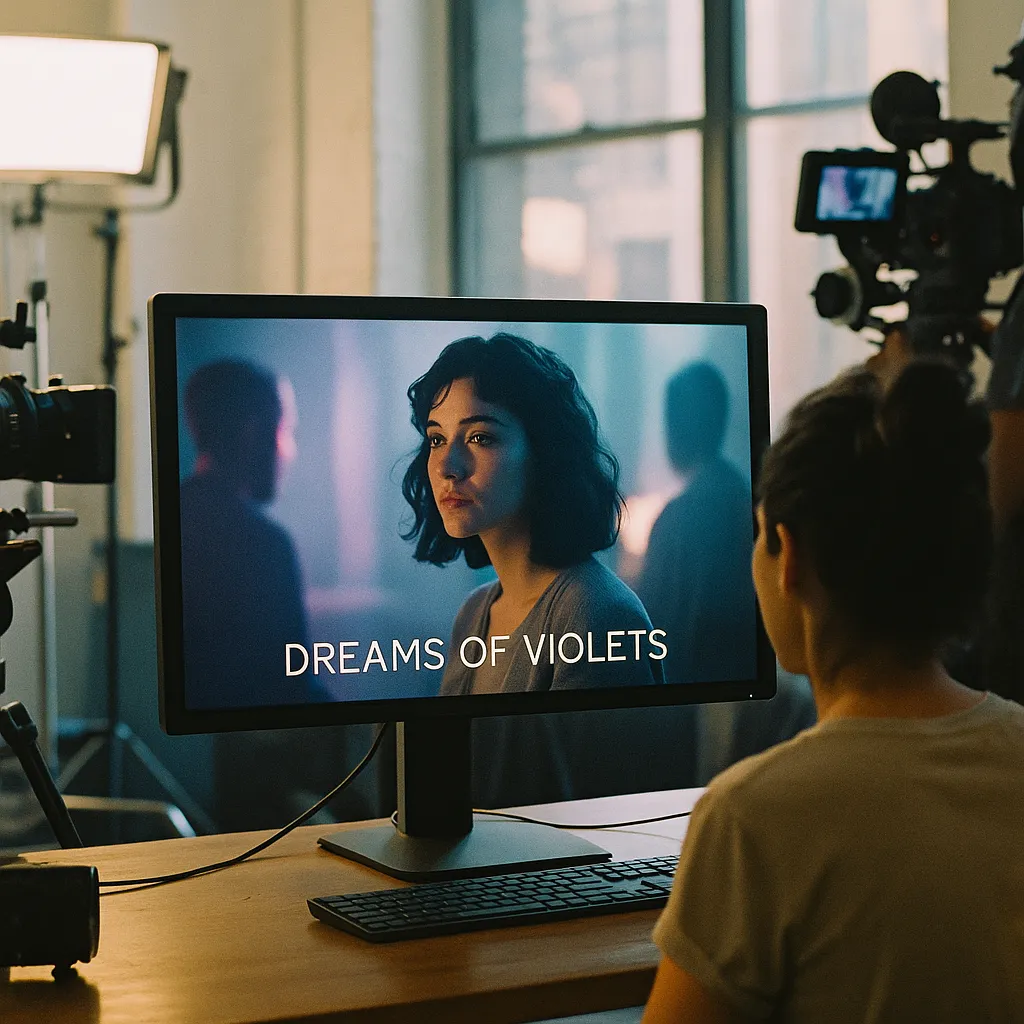
The first AI-generated feature film, 'Dreams of Violets,' had its world premiere at Tribeca on June 10 — and the questions it raised for the film industry can no longer be treated as hypothetical.
Dreams of Violets Premieres at Tribeca — The Film Industry's AI Reckoning Just Got Real
Dreams of Violets, the first AI-generated feature film to screen at a major international festival, had its world premiere at the Tribeca Festival on June 10 — and the room didn't know quite how to react.
The 75-minute docudrama, inspired by the 2022 Tehran protests and generated entirely by AI without a single frame of human-shot footage, drew audience and critical responses that reignited debates the film industry has been managing from a distance for three years: Who made this? What do they owe to the people whose suffering it depicts? And can AI-generated cinema actually carry genuine human narrative intent? That last question turns out to be harder to dismiss when it's 75 minutes long and you just watched it.
What Tribeca Admitted Into the Canon
Getting into Tribeca is a credibility signal in independent film. The festival has screened work that launched careers. It has now screened a film with no cinematographer, no actors, no grip crew, and no location footage. That's not a programming accident — Tribeca's programmers knew what they were selecting.
Dreams of Violets tells a story rooted in the protests that swept Iran in 2022 following the death of Mahsa Amini in police custody. The subject matter matters here: this isn't AI generating abstract visuals or fantasy sequences. It's a political narrative about real people who died. The AI-generation process raises a different set of ethical questions when the subject is a human rights crisis than when it's a stylized short film.
The film was produced under the credit "Fountain 0," working with generative video models that now exist in stable commercial release. The specific toolchain has not been fully disclosed.
The Numbers That Define the Threshold
- 75 minutes. Feature-length. Not a short film, not a proof of concept — a full-length feature.
- Zero human-shot footage. Every frame generated by AI systems. No cameras, no lighting crew, no location scouts.
- First at a major festival. Tribeca's selection marks the first time a fully AI-generated feature has cleared the programming bar at a credentialed international film festival anywhere in the world.
Variety's coverage of the premiere describes the audience and critic reactions as a live version of the theoretical debate the industry has been running: not just "can AI make movies" but "what do we do now that it has?"
What the Industry Can No Longer Defer
The film industry has been running a low-grade AI debate for three years. Most of it focused on studios using AI to de-age actors, cut visual effects costs, or generate concept art — applications that affected specific workflows and created targeted union concerns. The 2023 and 2024 guild negotiations addressed AI in post-production and AI-assisted writing. They did not contemplate a fully AI-generated theatrical feature at a credentialed festival.
Get this in your inbox.
Daily AI intelligence. Free. No spam.
Dreams of Violets changes that frame. This isn't AI assisting a film crew. This is AI replacing the film production pipeline entirely — and producing something a major festival programmer decided was worth the world's attention.
For the guilds — the Writers Guild, Directors Guild, IATSE, and SAG-AFTRA — the premiere is a concrete reference point for the next contract cycle. Their existing AI provisions were written for a world where AI helped make films, not a world where AI made the film.
For independent filmmakers, the calculus is different. The barriers to production — equipment, crew, travel, locations — just moved dramatically. A filmmaker with a story and access to generative video tools can now complete a feature. Tribeca just confirmed that such a feature can earn institutional recognition.
For the documentary tradition, Dreams of Violets opens a specific and uncomfortable question. The protest footage the film depicts — the faces, the streets, the confrontations — were generated. No one was there with a camera. No one filmed those moments. The AI synthesized a visual representation of real events without the evidentiary chain that documentary filmmaking normally requires. That's not a settled ethical question. It tends to get resolved slowly, through industry practice, audience acceptance, and — eventually — contractual language.
The Authorship Problem Has No Clean Answer
The people behind Dreams of Violets made real decisions: they chose the subject, shaped the narrative, wrote the prompts or scripts that guided the AI, and selected which generated sequences made the final cut. That sounds like filmmaking.
Whether it is filmmaking — in the legal, contractual, and cultural sense that has governed the industry for a century — is precisely what the Tribeca premiere forces everyone to answer.
What to Watch
Distribution. Does Dreams of Violets secure a theatrical or streaming deal? If it does, the economics of AI film production become real to studio and streamer finance departments, not just festival programmers.
Guild response. The major Hollywood guilds have been quiet since the premiere. A fully AI-generated Tribeca feature is the kind of event that moves the policy calendar.
The next submission wave. Festival programmers will face a rising volume of AI-generated feature submissions this fall. How they handle that volume — and whether Tribeca's decision becomes a precedent or an outlier — will define the next phase of this debate.
By Hector Herrera
Did this help you understand AI better?
Your feedback helps us write more useful content.
Get tomorrow's AI briefing
Join readers who start their day with NexChron. Free, daily, no spam.