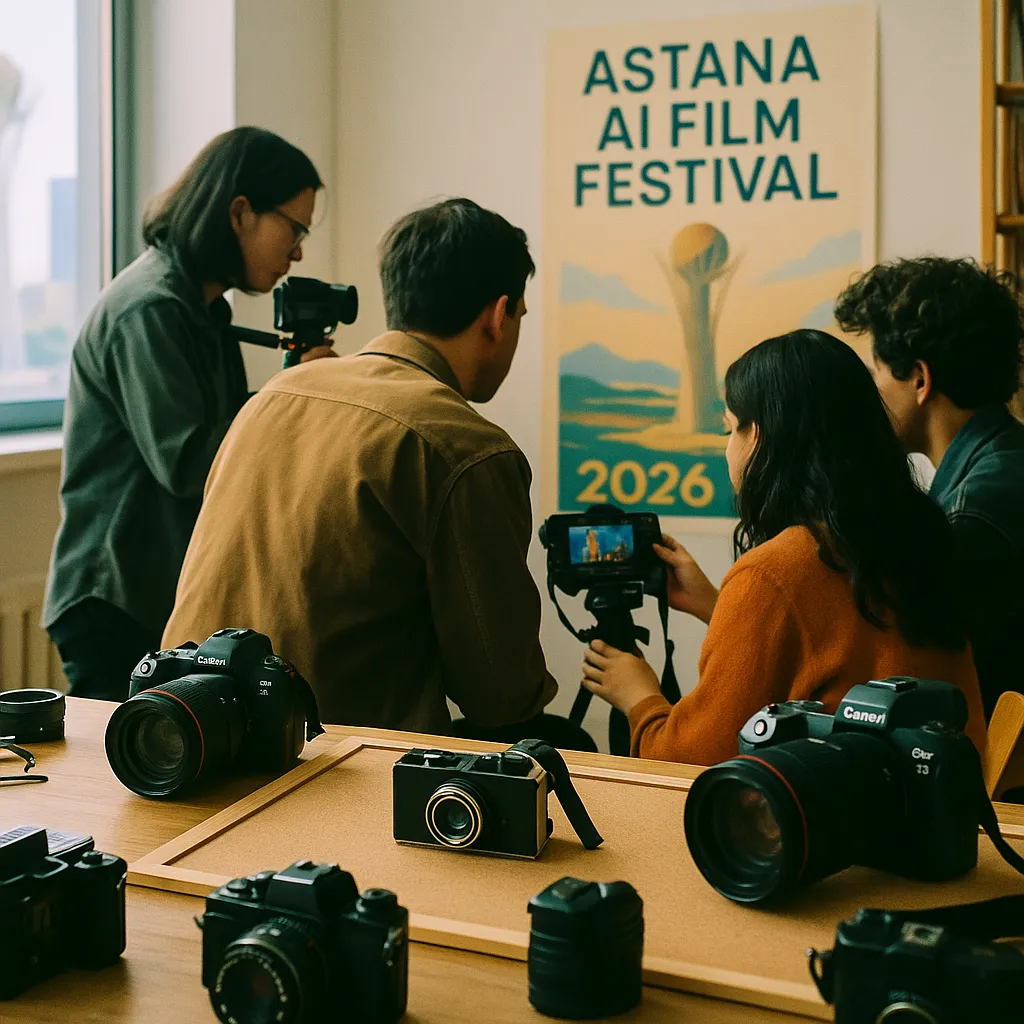
The Astana AI Film Festival crowned its 2026 winners on October 3, drawing 636 entries from 84 countries — evidence that AI filmmaking has become a genuine global creative discipline.
The Astana AI Film Festival concluded its 2026 competition on October 3, crowning winners from a record 636 submissions drawn from 84 countries. Those numbers aren't just attendance statistics. They mark the point where AI filmmaking transitions from a novelty competition at tech conferences to a global creative discipline with its own awards circuit, judging standards, and emerging professional community.
The festival — formally the Astana AI International Film Festival (AAIFF) — bills itself as the world's largest competition dedicated exclusively to AI-generated cinema. The 2026 edition was its largest to date, per QazInform's coverage of the results.
What the Numbers Mean
636 films submitted from 84 countries. The geographic distribution matters as much as the volume. 84 countries is not a tech-hub-concentrated field. It mirrors the footprint of international cinema broadly — meaning AI film production is accessible to filmmakers in markets that have historically been excluded by the capital costs of traditional production.
That accessibility is structural, not accidental. AI filmmaking eliminates the hardware requirements — cameras, lighting rigs, location costs, editing suites, physical crew — that have concentrated traditional film production in a small number of wealthy countries. A filmmaker in Kazakhstan, Senegal, or Guatemala with strong creative instincts and access to an AI generation platform can now compete at the same technical level as a filmmaker in Los Angeles or London. The competitive field at AAIFF reflects that reality.
Get this in your inbox.
Daily AI intelligence. Free. No spam.
The Craft Has Its Own Vocabulary
The judging framework for AAIFF 2026 reflects a discipline that has developed its own standards. Precision language and cinematic prompting have replaced physical camera operation as the defining skill. Judges evaluated how effectively filmmakers used text direction, iterative prompting, and compositional choices to achieve specific visual storytelling results — not whether they could operate or access physical equipment.
This shift has real implications for film education. Traditional cinematography instruction centers on technical mastery of physical production: lens selection, lighting ratios, camera movement, post-production workflows. AI filmmaking instruction centers on creative direction, narrative structure, and an understanding of how AI generation systems interpret language — specifically cinematic language. They share a foundation in visual storytelling but diverge significantly in the skills they develop.
Film schools and creative programs that haven't yet integrated AI production tools face a widening competency gap. Their graduates will increasingly compete against filmmakers who trained in AI-native workflows.
The Global Circuit Is Forming
Winning films from AAIFF 2026 will tour an international circuit of AI film events, headlined by the AI Film Summit in Los Angeles later this month. That touring structure — where competitive festival wins translate into booking opportunities and industry visibility — is exactly how traditional film festival circuits work. Its emergence in AI film marks the professionalization of the sector: winning at AAIFF is now a résumé credential with downstream commercial value.
The circuit's formation also intensifies debates about disclosure standards. As AI-generated films move into mainstream festival competitions and streaming distribution, the question of whether they carry formal "AI-generated" labels — and what those labels mean for audience expectations and creator credit — becomes commercially significant. Right now those questions are resolved informally at the platform level. That won't hold at scale.
What to Watch
The AI Film Summit in Los Angeles will be the place to watch for industry-level agreements on disclosure and distribution standards for AI-generated film. If the summit produces a formal position on AI film labeling — even a voluntary standard — it could shape how streaming platforms, broadcast networks, and international festival organizations categorize AI work over the next several years. Watch also for whether any AAIFF 2026 winners break into mainstream streaming distribution: that would be the clearest signal yet that AI-generated content has crossed from the niche festival circuit to the general audience market.
Did this help you understand AI better?
Your feedback helps us write more useful content.
Get tomorrow's AI briefing
Join readers who start their day with NexChron. Free, daily, no spam.