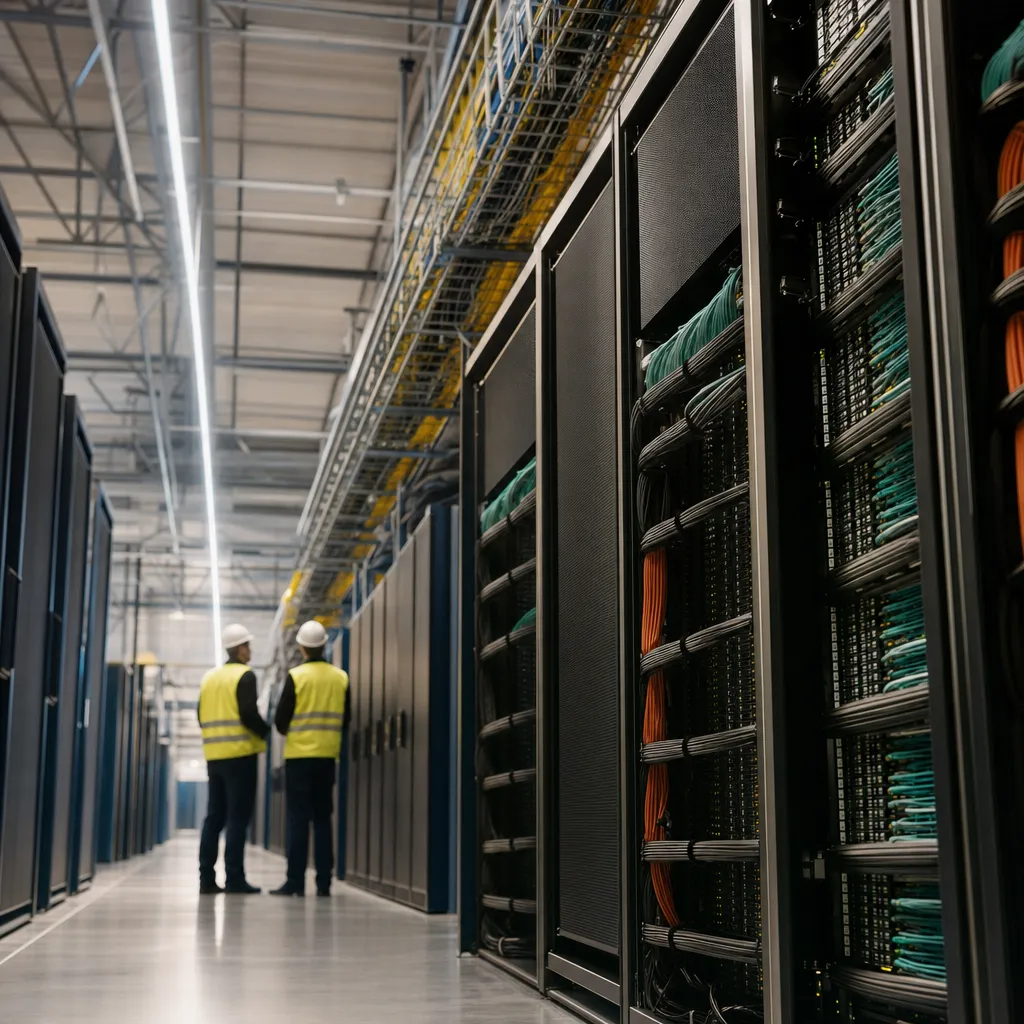
TensorWave will deliver 457 megawatts of AMD Instinct MI455X compute to OpenAI under a six-year deal — the first public neocloud contract under the AMD-OpenAI strategic partnership.
TensorWave Signs Six-Year Deal to Deliver OpenAI 457 Megawatts of AMD-Powered AI Compute
By Hector Herrera | November 16, 2026
TensorWave has signed a six-year agreement to deliver 457 megawatts of AI compute capacity to OpenAI across multiple US data centers, all powered by AMD Instinct MI455X GPUs. It is the largest publicly disclosed neocloud contract under the broader AMD-OpenAI strategic partnership — and it confirms that OpenAI is diversifying its hardware base well beyond Nvidia's ecosystem ahead of its next wave of model training and inference at scale.
Background
OpenAI has historically run its training workloads on Nvidia hardware through Microsoft Azure. That relationship remains central to the company's infrastructure, but as OpenAI's compute demands have grown to dozens of gigawatts of capacity planned over the next decade, it has been building out alternative supply chains. AMD and OpenAI announced a multi-year, multi-generation strategic arrangement earlier this year covering six gigawatts of AMD Instinct hardware — a commitment that requires a network of data center partners to actually deliver the physical capacity. TensorWave is the first of those partners to surface with public deal terms.
Deal Details
According to Data Center Dynamics:
- Capacity: 457 megawatts across multiple US data centers — roughly equivalent to the power draw of a mid-size city district
- Hardware: AMD Instinct MI455X GPUs, the latest generation of AMD's AI accelerator lineup
- Timeline: capacity begins coming online in H1 2027, with full deployment by early 2028
- Term: six years — a long-horizon commitment that signals OpenAI is planning for sustained, multi-year workloads on this infrastructure
- Relationship context: this is the first publicly disclosed neocloud partnership under the AMD-OpenAI multi-year arrangement; additional partners are expected
TensorWave is a neocloud provider — a newer class of AI-focused data center operator that builds GPU clusters for rent or dedicated contracts, distinct from hyperscalers like Microsoft, Google, and AWS.
Get this in your inbox.
Daily AI intelligence. Free. No spam.
Why This Matters
For OpenAI, the deal does two things simultaneously: it adds raw capacity ahead of inference demand that is growing faster than any single supplier can satisfy, and it reduces hardware concentration risk. Training and running frontier models on a single GPU architecture creates a single point of failure — supply disruptions, yield issues, or export control actions targeting one vendor can throttle the entire operation.
For AMD, this is the most concrete validation yet that its Instinct line is capable of winning large-scale, long-horizon contracts from AI's most demanding customer. AMD has closed the performance gap with Nvidia on several benchmark dimensions, but enterprise and hyperscaler customers have been slow to shift workloads because of ecosystem inertia — CUDA tooling, familiar workflows, existing staff expertise. A six-year OpenAI commitment breaks through that inertia in a visible way.
For the data center industry, 457 megawatts is a significant block of power. At current US grid conditions, that represents a major procurement challenge — most markets can't add that much AI-specific load quickly. The deal's 2027–2028 timeline reflects that reality: even a contract signed today requires 12–18 months of permitting, construction, and grid interconnection before the first GPU goes live.
For Nvidia, the deal is not an existential threat, but it is a signal. OpenAI continues to run the majority of its infrastructure on Nvidia hardware through its Microsoft Azure partnership. This deal does not change that. What it does is establish a credible alternative at scale — which gives OpenAI negotiating leverage and reduces Nvidia's ability to set pricing on future contracts with its largest customer.
What to Watch
The MI455X is the first AMD accelerator to publicly land a contract of this size with a frontier AI lab. Watch for AMD's CDNA 4 roadmap updates and whether OpenAI's initial workloads on this hardware shift from inference to training over the contract term — that would be a stronger signal about AMD's ability to close the remaining gap on large-scale training runs. Additional neocloud partnerships under the AMD-OpenAI six-gigawatt umbrella are expected to be announced through 2027; the total disclosed capacity will be a useful indicator of how much of that six-gigawatt target is real versus aspirational.
Hector Herrera covers AI infrastructure and business at NexChron.
Did this help you understand AI better?
Your feedback helps us write more useful content.
Get tomorrow's AI briefing
Join readers who start their day with NexChron. Free, daily, no spam.