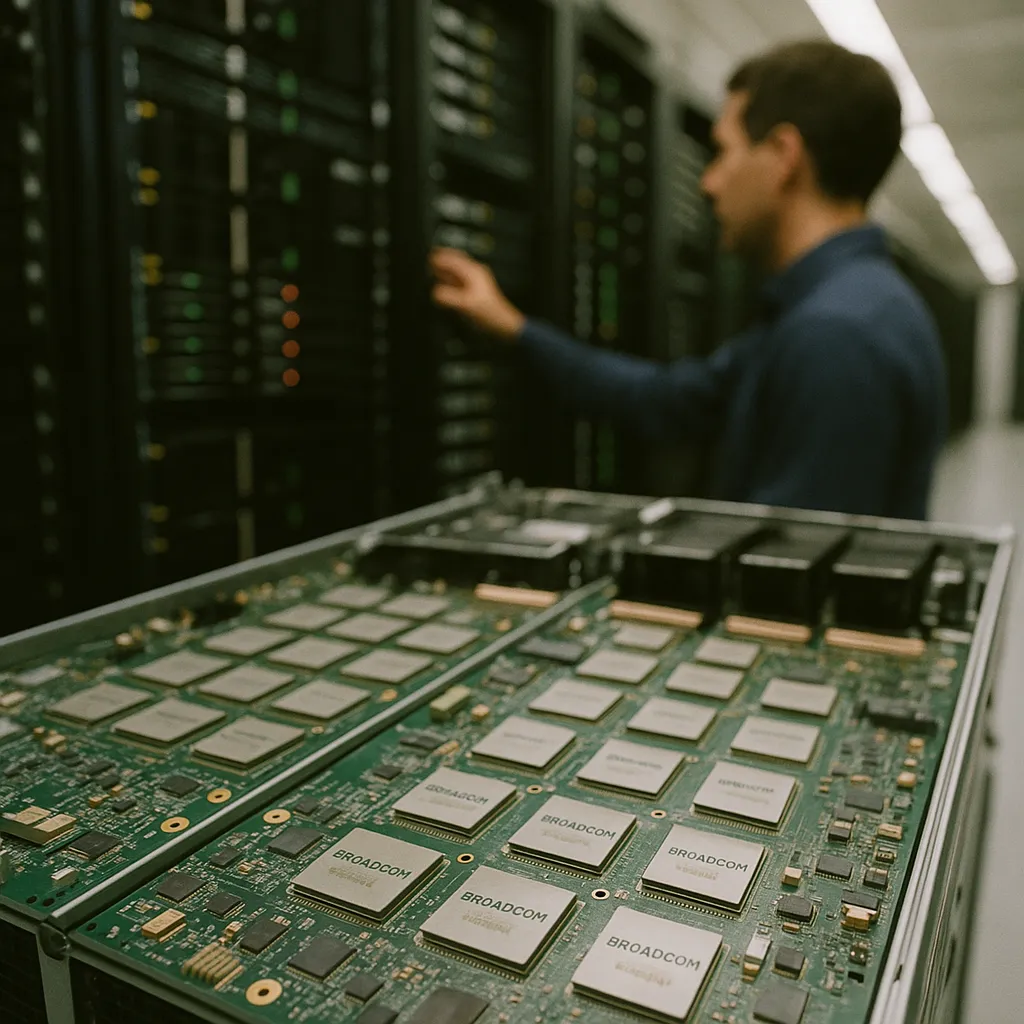
Broadcom is arranging over $50 billion in private credit from Apollo and Blackstone to finance the custom AI chips it is building with OpenAI under the Nexus programme.
Broadcom Lines Up $50 Billion in Private Credit to Finance OpenAI Custom Chips
By Hector Herrera | October 9, 2026 | Business
Broadcom is arranging more than $50 billion in private credit financing for the custom AI chips it is building with OpenAI — and a separate $60 billion package for Anthropic's compute is reportedly in the works. The scale of debt being assembled signals that AI infrastructure spending has grown too large for traditional bond markets to absorb comfortably.
Fortune reported the financing details on October 9, 2026, with Apollo and Blackstone named among the lenders in early-stage talks for the OpenAI package.
What's Being Built
The financing is tied to OpenAI and Broadcom's "Nexus" programme — a partnership to develop custom AI accelerator chips (specialized processors designed to run AI workloads more efficiently than general-purpose GPUs). Custom silicon is one of the most capital-intensive bets in tech: chip design, fabrication, and deployment at data center scale requires billions of dollars before a single workload runs.
The structure here is private credit rather than public debt issuance. Private credit refers to loans arranged directly between companies and large institutional lenders — in this case, major alternative asset managers like Apollo and Blackstone — rather than bonds sold on public markets. It typically carries higher interest rates than public debt but moves faster and imposes fewer disclosure requirements.
The Numbers in Context
- $50B+: Broadcom/OpenAI Nexus chip financing (early-stage)
- ~$60B: Separate reported package for Anthropic's compute infrastructure
- Combined: Roughly $110 billion in private credit being mobilized for two AI companies' chip and compute needs alone
For reference, the entire US corporate high-yield bond market issued roughly $350 billion in 2025. Two AI infrastructure deals are now approaching one-third of that figure — not in public bonds but in private arrangements, largely outside the visibility of public markets.
Get this in your inbox.
Daily AI intelligence. Free. No spam.
Why Private Credit
Public bond markets work well for established, predictable cash flows. AI infrastructure spending has neither characteristic right now. Lenders in the private credit space can negotiate covenants and structures tailored to the risk profile of frontier AI build-outs — including provisions tied to chip delivery timelines, compute utilization targets, or revenue milestones.
Apollo and Blackstone are the two largest alternative asset managers in the world, each managing over $600 billion. Their involvement signals that institutional capital has moved past skepticism about AI infrastructure and into active deployment.
What This Means for the Industry
For AI companies: The ability to raise this scale of private credit means OpenAI and Anthropic are not capacity-constrained by traditional capital markets. Both companies can continue aggressive infrastructure expansion — custom chips, data centers, power agreements — without depending on IPOs or traditional corporate lending.
For chip makers: Broadcom is positioning itself as the primary custom silicon alternative to Nvidia. The Nexus programme gives it a long-term, high-volume customer relationship with OpenAI, anchored by financing that reduces counterparty risk. If the chips perform, Broadcom has a defensible moat in the post-GPU AI era.
For financial markets: $110 billion in private credit flowing into AI infrastructure is a structural shift. It means AI capital formation is happening in markets that are less transparent and less regulated than public debt. Analysts and regulators who track systemic risk will need to follow private credit flows, not just public equity.
For Nvidia: The Broadcom/OpenAI and Anthropic deals are bets on custom silicon displacing commodity GPUs for at least some workloads. Nvidia remains dominant for training frontier models, but inference — running models at scale for users — is increasingly competitive ground where custom chips can be more efficient.
What to Watch
Whether the $50 billion OpenAI package closes at the reported terms will be an early signal of how much risk appetite private credit markets actually have for frontier AI infrastructure. Apollo and Blackstone are in "early-stage talks" — that language leaves room for negotiations to shift significantly on structure, rate, or size. Watch for any announcement of a signed term sheet as confirmation that the deal is moving forward.
Sources: Fortune, October 9, 2026
Did this help you understand AI better?
Your feedback helps us write more useful content.
Get tomorrow's AI briefing
Join readers who start their day with NexChron. Free, daily, no spam.