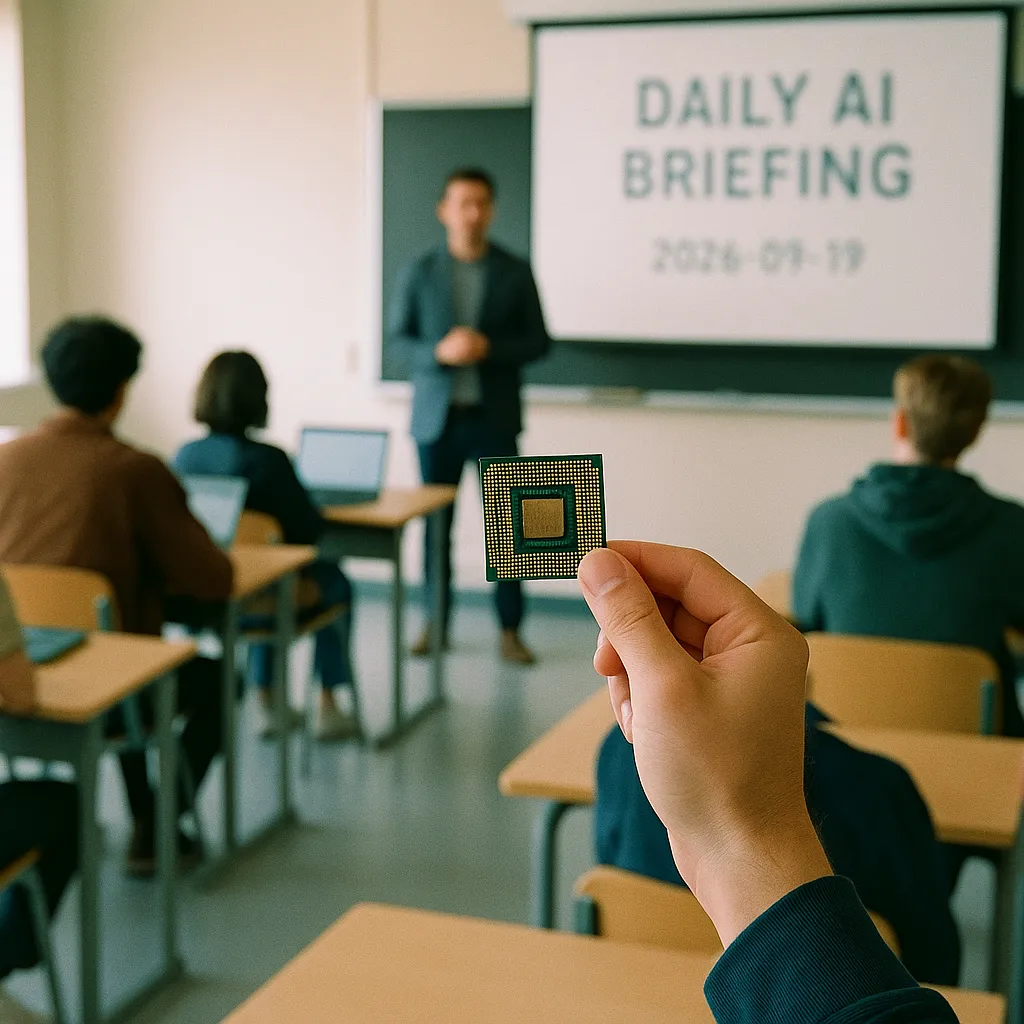
Your daily AI intelligence for September 19, 2026.
Good morning. Here's your AI intelligence for Saturday, September 19, 2026.
Policy and Governance
The Council of Europe formally adopted the world's first legally binding international AI treaty on September 16. The Framework Convention on Artificial Intelligence obligates signatory nations — including the United States, the United Kingdom, and European Union member states — to align their domestic AI laws with human rights, democratic values, and rule-of-law standards. This is not a soft declaration. Countries that ratify the treaty must build enforceable legal frameworks or amend existing ones. It is the most significant multilateral AI governance action to date, and it will set a binding floor for what "responsible AI" means in law — not just in policy statements and voluntary commitments.
On the domestic front, New York City placed a one-year moratorium on student-facing generative AI tools for all K–8 students — nearly 600,000 children in the nation's largest school district. The ban covers AI writing assistants, chatbots, and other generative tools in the classroom and on school devices. This is the most expansive AI restriction imposed on any U.S. K–12 district. NYC's position stands in direct contrast to districts that have pushed AI literacy programs as graduation requirements. The policy debate is now clearly drawn: one camp believes generative AI in early education is developmentally harmful and undermines foundational skill-building; the other argues that exclusion creates a long-term equity gap for children who will enter a workforce already reshaped by these tools. Expect other large districts to feel pressure to take a formal position.
Technology and Infrastructure
China's AI chip strategy got a significant data point this week. Z.ai — the company behind the GLM model series — reported that its GLM-5.3-Flash model, a 320-billion-parameter system with a one-million-token context window, is now running on more than 100,000 Chinese-made accelerators. More notable: throughput tripled in under two weeks. That kind of rapid performance scaling on domestic hardware directly challenges the assumption that U.S. export controls have permanently capped Chinese AI development. It does not mean the hardware gap has closed, but it signals that Chinese labs are extracting efficiency gains from existing chips at a faster pace than most analysts projected.
Google made a structural shift in how smart homes work on September 16, launching early access to a Model Context Protocol server for Google Home. MCP has become an emerging industry standard for AI tool integrations, and the effect here is concrete: Claude, ChatGPT, and any other MCP-compatible AI agent can now control Google's connected home ecosystem via natural language — without Google's own assistant as the intermediary. Google is voluntarily ending the walled garden model it has maintained for years. The bet is that an open ecosystem grows the overall market fast enough that Google's device footprint remains central regardless of which AI assistant the user prefers.
Get this in your inbox.
Daily AI intelligence. Free. No spam.
Economy and Work
Stanford's Digital Economy Lab published research this week showing that workers aged 22 to 25 in highly AI-exposed occupations are employed 19 percent below where they would be absent AI-driven hiring changes. The gap does not appear in standard unemployment statistics because these young workers are not filing for unemployment — many have simply left the workforce or never entered it at the rate prior cohorts did. This is a structural problem, not a cyclical one. Entry-level positions that traditionally served as career on-ramps — research roles, junior analysis, first-draft writing, customer support — are increasingly being handled by AI agents rather than new hires. The career ladder is shortening from the bottom up, and it is happening quietly enough that most economic indicators are not yet registering it.
Healthcare
A Washington state health system reported this week that ambient AI documentation tools save primary care physicians 34 minutes of EHR work per day. That translates to roughly three additional patient encounters per week per physician — a meaningful capacity gain in a system that faces a serious and growing physician shortage. Ambient AI listens to patient encounters and generates clinical notes automatically, removing the documentation burden that has been a leading driver of physician burnout for over a decade. This week's report reflects real-world deployment at scale, not a controlled research trial, which makes the numbers more credible and more consequential for health systems weighing adoption.
Legal and Business
Checkbox launched what it calls "First Pass" — an AI agent that reviews contracts and legal intake requests before they reach attorneys. SAP, PepsiCo, and BILL are already live on the platform. The workflow shift is significant: AI handles initial review, flags risk, and categorizes intake, with human attorneys engaging only at the flagged items and in actual negotiation. This compresses the time between contract receipt and legal action, and it reduces the volume of raw, unprocessed work that reaches attorneys. It is not replacing lawyers — it is changing where lawyers spend their time. Expect this upstream-AI model to become standard practice in enterprise legal departments within 18 months.
Culture
Luca Guadagnino's biographical comedy-drama Artificial — with Andrew Garfield playing Sam Altman — will world premiere at the New York Film Festival on October 5. The film was dropped by Amazon MGM earlier this year and picked up by Neon for distribution. A studio-scale feature film about a sitting AI CEO, directed by one of the most acclaimed filmmakers working today, is itself a cultural event worth noting. AI has moved from science fiction backdrop to biographical subject matter. How Artificial is received by critics and audiences — and what it says about the public's ambivalence toward the founders of these companies — will be a useful signal.
What to Watch Today
-
NYC district response. School districts nationwide are watching how the K–8 AI moratorium lands with New York parents and educators. The first public signals from teachers, principals, and parent groups will shape whether other large urban districts follow suit or push back with competing frameworks.
-
Council of Europe ratification timeline. Adoption of the AI treaty is the first step; domestic ratification and implementation are where it will be tested. Watch which signatory nations move first to amend their laws — and whether the U.S. Senate engages with the treaty at all.
-
Z.ai performance trajectory. If throughput tripling in two weeks reflects a sustained pace of efficiency gains on current Chinese hardware, the next published benchmark will be a meaningful indicator of where Chinese frontier AI development actually stands relative to U.S. labs.
Did this help you understand AI better?
Your feedback helps us write more useful content.
Get tomorrow's AI briefing
Join readers who start their day with NexChron. Free, daily, no spam.