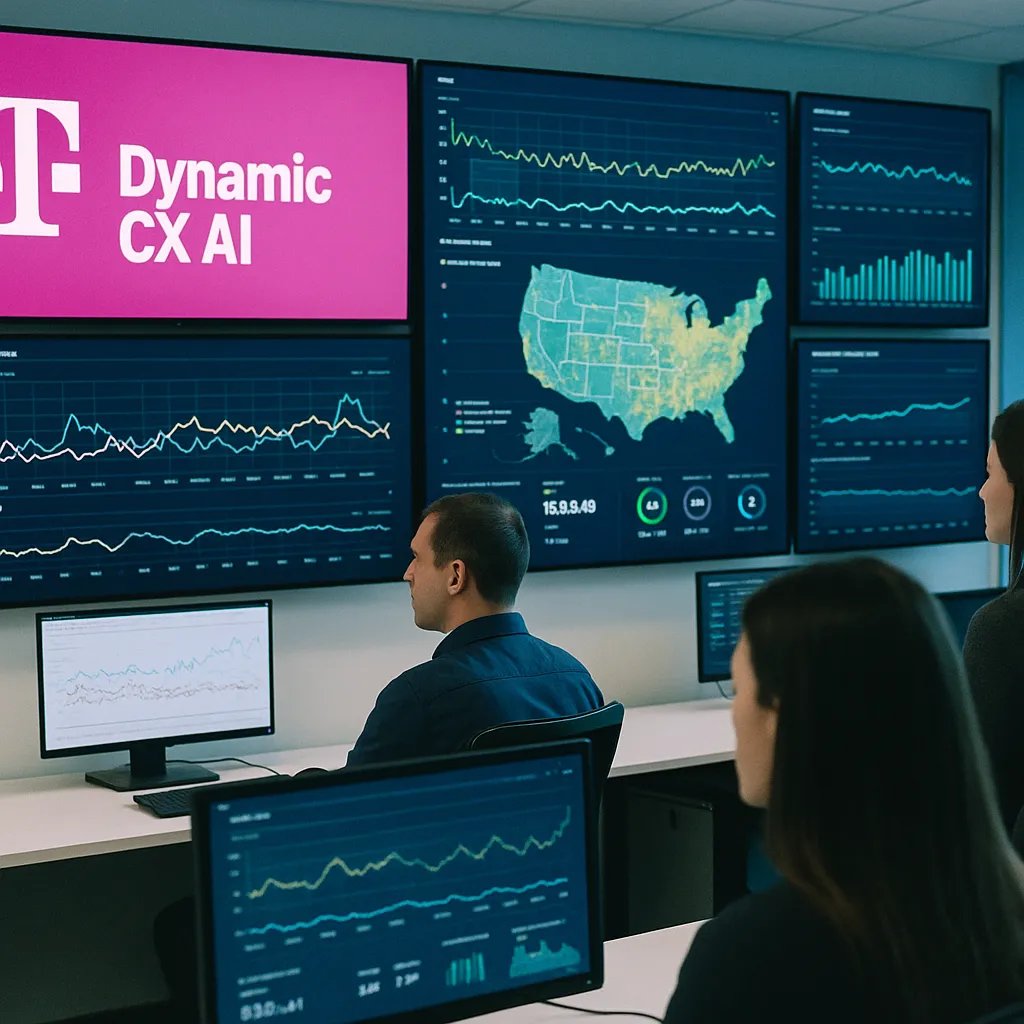
A new Ericsson white paper argues that agentic AI will require carriers to rebuild network architecture from the ground up, with the transition taking three to five years for committed carriers.
Ericsson Says AI Agents Won't Just Improve Telecom Networks — They'll Force a Complete Rebuild
By Hector Herrera | April 30, 2026
Agentic AI — systems that act autonomously to achieve goals rather than just responding to queries — will require telecom carriers to redesign their network architecture from the ground up, according to a new white paper from Ericsson. The paper is direct about the scope of what it's describing: this isn't AI assistance layered on existing networks. It's a structural rebuild.
Ericsson is one of the world's two dominant network equipment vendors — its opinion on what telecom infrastructure needs to look like carries weight with every major carrier globally. When Ericsson publishes a white paper arguing that current network architecture is incompatible with the operational model that AI agents require, it is simultaneously describing the market and setting the terms of competition.
Why Existing Architecture Is the Problem
Current telecom networks were designed around a fundamental assumption: human operators make decisions, and AI tools help them make better ones. The workflow is human-centric. An engineer reviews an anomaly alert, analyzes recommendations from an AI-assisted diagnostics system, and executes a configuration change. The human is in the loop for all consequential decisions.
Agentic AI breaks that assumption at scale. A 5G network with millions of edge nodes, thousands of configurable parameters per node, and real-time traffic demands that change by the second cannot be managed through a human-in-the-loop operational model. The math doesn't work. There are more autonomous decisions required per hour than any team of engineers can review and approve.
For autonomous network operation to function at 5G scale, Ericsson's paper argues, AI agents need to be embedded at every layer of the network stack — not added as an overlay on top of existing management systems, but integrated into the architecture itself:
- Radio access network (RAN): AI agents managing spectrum allocation, interference mitigation, and power optimization in real time, responding to conditions that change faster than human monitoring can track
- Transport network: Autonomous traffic engineering that routes data flows, manages congestion, and executes failover without waiting for human approval of each routing decision
- Core network: Self-configuring network slices (dedicated virtual network segments — logically separate networks running on shared physical infrastructure) for different service types, adapting dynamically to demand
- Operations and support: AI that can detect anomalies, diagnose root causes, execute remediation, and close the loop — without a ticket queue waiting for a human to assign the task
The problem with today's siloed architecture — where AI tools in different network domains don't share a common operational model or data layer — is that it prevents the cross-layer optimization required for true autonomy. An AI agent managing the RAN can't coordinate with one managing the transport network if they're operating in separate systems with incompatible interfaces.
Get this in your inbox.
Daily AI intelligence. Free. No spam.
What the Rebuild Requires
Ericsson's paper outlines three architectural dimensions that carriers must build toward:
AI-native infrastructure — network equipment designed from the outset to expose parameters, state, and control interfaces to AI agents. Not retrofitted through management APIs that translate between human-designed interfaces and machine agents, but architected to be queried and controlled by AI systems as the primary operational model.
Shared intent layer — a common framework across network domains where operators specify what the network should achieve — expressed as business outcomes and service objectives rather than technical configurations — and AI agents determine how to achieve it. This separates policy from execution in a way that makes the human role meaningful at the right level (setting goals) rather than requiring humans to manage the implementation details that AI systems can handle better.
Continuous learning loops — systems that train on real network behavior and feed improvements back autonomously, rather than requiring periodic human-supervised retraining. The network gets better through operation, not just through planned upgrade cycles.
The paper estimates the full transition will take three to five years for carriers willing to commit to it — and significantly longer for those that try to bolt AI agents onto existing legacy infrastructure rather than undertaking the architectural rebuild.
What This Means for Carriers and Competitors
For carriers, this is primarily a procurement decision. Equipment vendors who design AI-native infrastructure from the start — with agent-accessible control planes, shared intent frameworks, and integrated learning loops — will deliver materially better autonomous operation than vendors retrofitting existing products with AI management overlays. Choosing the right vendor architecture now is a five-to-ten-year commitment.
Ericsson is clearly positioning itself as the AI-native choice. But this paper also sets a competitive standard that Nokia — the other dominant global network equipment vendor — must respond to. Nokia has its own AI networking roadmap; Ericsson's paper forces the comparison into the open.
For enterprise customers and MVNOs (mobile virtual network operators — companies that operate mobile services on leased carrier infrastructure), the shift has a specific implication: network SLAs (service level agreements — contractual performance guarantees) will eventually be enforced by AI agents. Carriers operating with autonomous network management will be able to make and honor performance commitments that human-managed networks couldn't consistently deliver, because AI agents can respond to degradation faster than humans can detect and escalate it.
What to Watch
The first major carrier to announce a genuinely agentic network operations center — where AI agents handle all routine network configuration, optimization, and remediation with human oversight only for exception cases and policy decisions — will validate Ericsson's thesis in a way no white paper can. Watch for pilot announcements from Tier 1 carriers in Europe and South Korea, where network density, regulatory environment, and infrastructure investment levels make the ROI case clearest.
Also watch how this unfolds in the context of O-RAN (Open RAN — an industry initiative to disaggregate radio access network components using open interfaces). O-RAN's open architecture is theoretically better suited to AI agent integration than proprietary stacks, but it has also been slower to deliver on performance commitments. If AI-native agentic operation becomes the defining competitive differentiator, the O-RAN vs. proprietary debate will be reframed around which architecture enables autonomous operation more effectively.
Did this help you understand AI better?
Your feedback helps us write more useful content.
Get tomorrow's AI briefing
Join readers who start their day with NexChron. Free, daily, no spam.