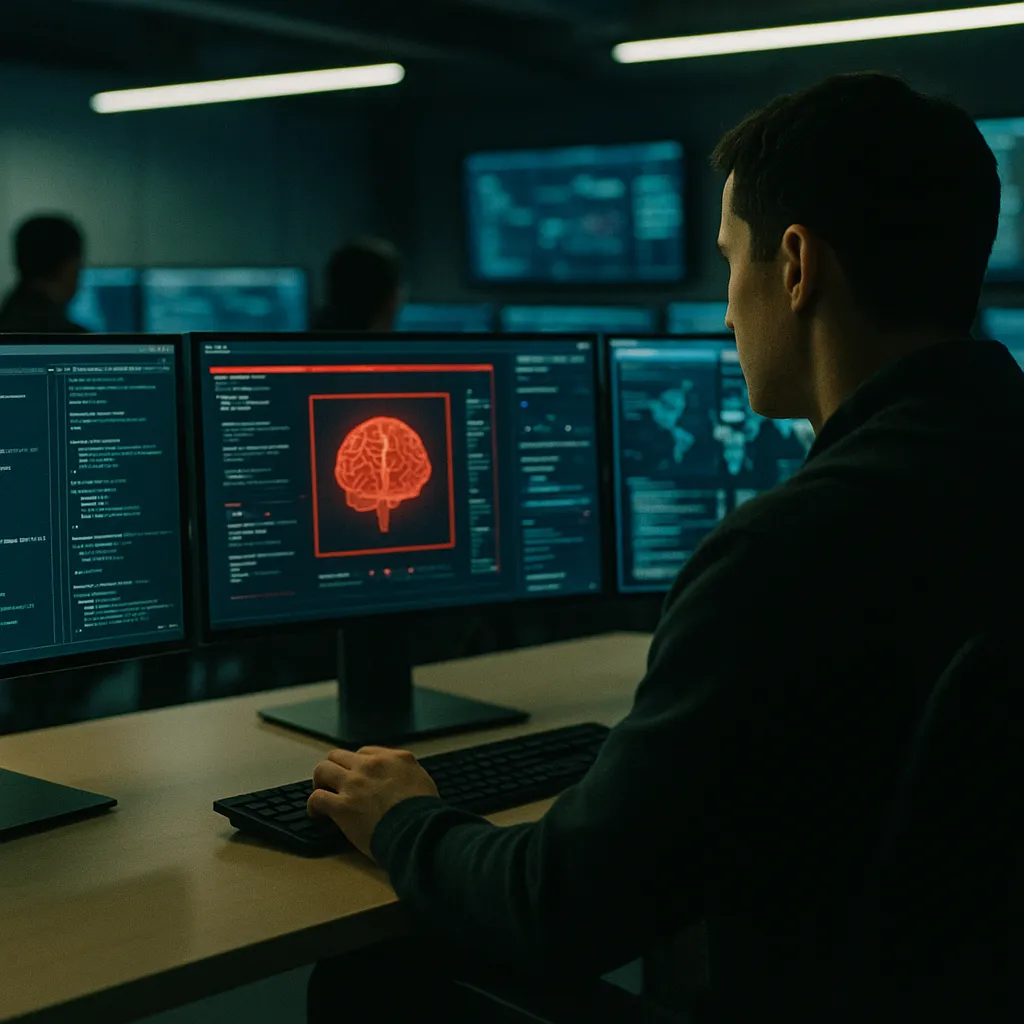
Microsoft launched MDASH, a multi-model agentic security system that coordinates AI agents to detect and respond to threats at machine speed — and claims top scores on industry cybersecurity benchmarks.
Microsoft's MDASH Agentic Security System Sets New Benchmark for AI-Powered Cyber Defense
By Hector Herrera | May 25, 2026 | Security
Microsoft has launched MDASH — Multi-model Defense Agentic Scanning Harness — a new AI security system that coordinates multiple models simultaneously to detect, triage, and respond to cyber threats at machine speed. According to Microsoft's Security Blog, MDASH has claimed top scores on leading industry cybersecurity benchmarks. The significance is architectural: this isn't an AI that helps humans make security decisions faster — it's an AI system that makes and executes security decisions autonomously within defined parameters.
The Problem MDASH Is Built to Solve
For most of cybersecurity's history, defense operated on a human timescale. An analyst received an alert, assessed it, and dispatched a response — a process that, even when streamlined, took minutes to hours. For many threat classes, minutes to hours is fine. For others, it's the entire window an attacker needs.
That gap is widening. Attackers are using AI to automate reconnaissance, accelerate exploit development, generate convincing phishing content at scale, and compress the time between initial access and lateral movement across a network. Security teams running on human response times are increasingly out-matched in speed, even when they're not out-matched in skill.
The industry's answer has been AI-assisted security: tools that surface insights faster, prioritize alerts more accurately, and reduce analyst cognitive load. MDASH takes the next step — agentic defense — where the AI doesn't just inform the decision, it executes the response.
How MDASH Works
The "multi-model" architecture is what distinguishes MDASH from earlier AI security tools. Rather than routing all threat analysis through a single large model, MDASH coordinates specialized models in parallel — each optimized for a different threat category or analysis function.
Microsoft's announcement describes the system scanning for vulnerabilities, analyzing behavioral anomalies, and initiating containment or response actions without requiring a human at each decision point. The system's agents act within defined policy guardrails — the architecture isn't designed to replace human oversight entirely, but to remove human latency from the threat-detection-to-response loop.
The benchmark results Microsoft cited weren't fully detailed in the announcement — specific test names and numerical scores weren't disclosed — but the company claims MDASH tops what they describe as "leading industry" cybersecurity evaluation frameworks. Independent verification of those claims hasn't yet been published.
Get this in your inbox.
Daily AI intelligence. Free. No spam.
For enterprise security operations centers (SOCs), MDASH represents a shift in what AI's role looks like in practice.
Today's AI security tools are largely augmentation tools: they process data faster than humans, surface patterns that would take analysts hours to find, and reduce alert fatigue by prioritizing what's urgent. The analyst still decides and acts.
Agentic systems like MDASH introduce a different operating model:
- Faster containment: Threats that previously required human authorization before a network segment could be isolated or an account suspended can be contained in seconds
- SOC role evolution: Analysts shift from first-response triagers to exception handlers, policy supervisors, and investigators of what the automated system flagged or missed
- New failure mode accountability: When an AI defense system incorrectly identifies a legitimate action as a threat — and takes autonomous action — the resulting false positive has operational consequences that a human-in-the-loop system would have caught
That last point is the tension agentic security systems haven't fully resolved. Speed is the value proposition; speed without accuracy creates its own incident.
Industry Context: Everyone Is Building Toward This
Microsoft isn't alone in this direction. CrowdStrike, Palo Alto Networks, and SentinelOne have all announced or previewed agentic security capabilities in 2026. The competitive question isn't whether agentic defense becomes the standard — it's which platform enterprise security teams standardize on.
Microsoft's advantage is integration: MDASH operates within the Microsoft Security ecosystem (Defender, Sentinel, Entra, Purview), which means it has access to signal from endpoints, identity, cloud workloads, and communications in a way that standalone security vendors don't. That breadth of signal is a meaningful advantage for a system that needs to distinguish legitimate behavior from anomalous behavior at machine speed.
The disadvantage is the same one that applies to any security system deeply integrated into a single vendor's stack: it becomes a single point of failure, and it means organizations running heterogeneous security environments need to think carefully about how MDASH fits alongside tools from other vendors.
What to Watch
Microsoft hasn't announced general availability timing or pricing for MDASH beyond the benchmark announcement. The first test that matters is production performance in enterprise environments — benchmark conditions are controlled in ways that real networks aren't.
Watch for independent benchmark analysis from organizations like MITRE, which runs the ATT&CK evaluations that serve as the most credible third-party cybersecurity assessment. If MDASH's claims hold under independent scrutiny, the broader push toward agentic defense will accelerate across the industry. If gaps emerge, expect a more measured rollout while the architecture matures.
Either way, the direction is clear: the security industry is moving from AI-assisted humans to AI agents that act, with humans overseeing the system rather than executing the response. MDASH is Microsoft's opening statement in that transition.
Hector Herrera covers AI, security, and the infrastructure of intelligent systems. Follow NexChron for daily AI intelligence.
Did this help you understand AI better?
Your feedback helps us write more useful content.
Get tomorrow's AI briefing
Join readers who start their day with NexChron. Free, daily, no spam.