A new analysis finds 28.3% of CVEs disclosed in 2026 are exploited within 24 hours of publication, driven by AI tooling that converts vulnerability disclosures into working exploits in minutes.
28% of CVEs Are Now Exploited Within 24 Hours of Disclosure — AI Is the Accelerant
By Hector Herrera | May 20, 2026 | Security
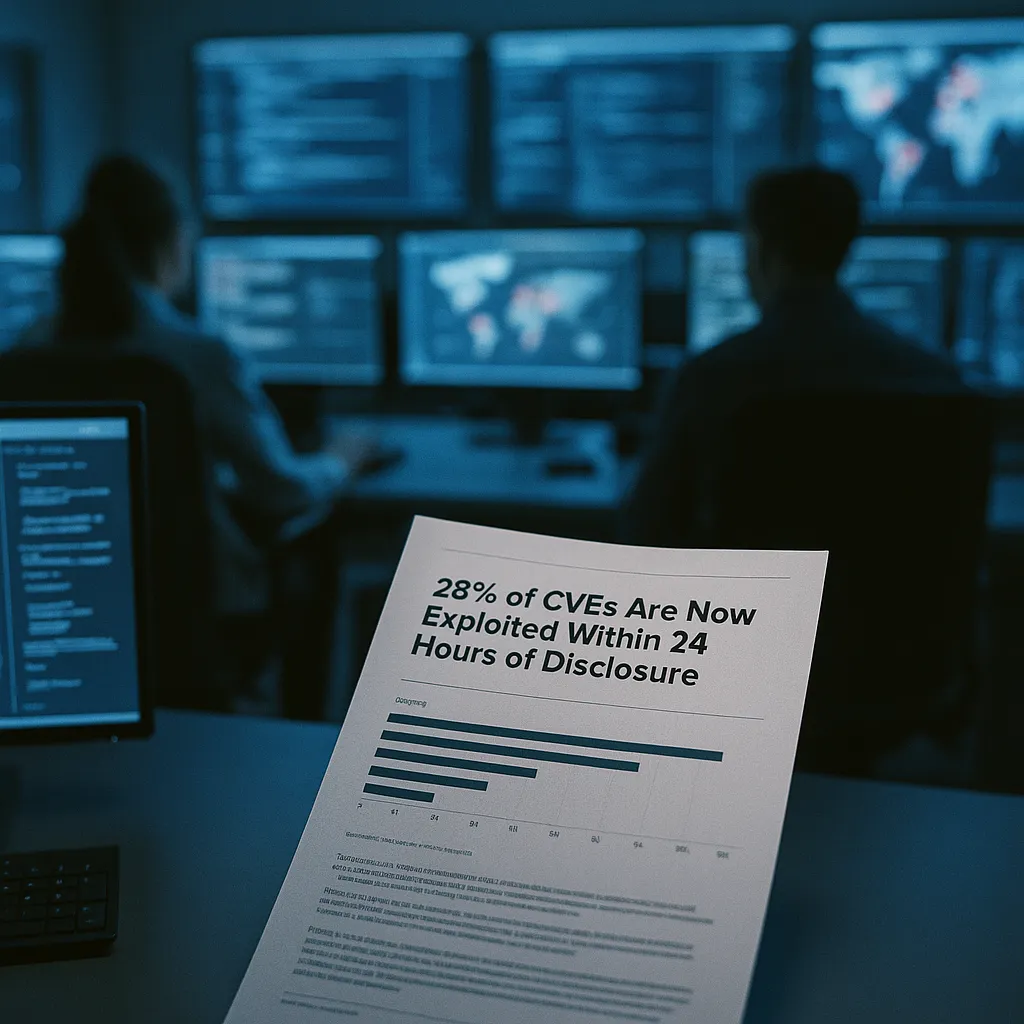
28.3% of publicly disclosed vulnerabilities in 2026 are being exploited within 24 hours of their CVE publication, according to a new analysis from The Hacker News. The cause is AI-powered attack tooling that converts a vulnerability disclosure into a working exploit in minutes. Security teams are operating in a world where the window between disclosure and active exploitation has compressed from weeks to hours — and the data suggests that window is still shrinking.
The Numbers
The analysis documents a cluster of shifts that collectively reframe the 2026 threat landscape:
- 28.3% of CVEs disclosed in 2026 are exploited within 24 hours of publication
- AI code resolution capability jumped from 33% of GitHub issues resolved in August 2024 to nearly 81% by late 2025 — the capability uplift that threat actors have weaponized for rapid exploit development
- 82.6% of analyzed phishing campaigns in 2026 are AI-powered, using hyper-personalized content built on scraped behavioral data
- Deepfake audio and video are now standard components of sophisticated phishing attacks, not novel exceptions
The 33%-to-81% code resolution leap is the most important number in that set. It means AI systems can now handle the complex software reasoning required to convert a vulnerability description into functional malicious code — at a rate that would have required senior offensive security expertise just 18 months ago.
What AI Changed About the Exploit Lifecycle
The traditional CVE-to-exploit timeline worked roughly like this: a vulnerability is disclosed, an attacker reads the advisory, understands the technical mechanism, writes proof-of-concept code, tests it, and deploys it. At each step, human expertise was the bottleneck. The fastest threat actors could compress this to days. Most groups worked in weeks.
AI collapses that timeline by automating the technical translation steps. A frontier model fed a CVE advisory and access to the affected software's codebase can generate working proof-of-concept code in minutes. The human expert is no longer required for the mechanical steps — only for target selection and deployment. The 24-hour exploitation rate reflects this new baseline.
This matters for how defenders think about patching windows. A 72-hour patching SLA (service-level agreement) — which was aggressive by historical standards — is now structurally insufficient for critical-severity vulnerabilities. If roughly one in four CVEs goes from disclosure to active exploitation within 24 hours, a three-day patch cycle means organizations are operating exposed for the most dangerous quarter of the vulnerability landscape.
Get this in your inbox.
Daily AI intelligence. Free. No spam.
The Phishing Acceleration
The 82.6% AI-powered phishing rate is not primarily a volume story — it is a personalization story. Prior-generation phishing attacks were effective but detectable: generic templates, odd phrasing, mismatched sender domains. AI-generated phishing now uses:
- Behavioral data scraped from social media, corporate websites, and LinkedIn profiles to build personalized message content that references real organizational context
- Deepfake voice cloning of known contacts to make audio-based social engineering attacks convincing in ways that no previous phishing technique achieved
- Real-time contextual awareness — attacks that reference actual recent events in the target's professional life, not generic pretexts
Email filters trained on previous phishing patterns are systematically less effective against this generation of attacks because the content no longer follows the heuristics those filters were built to catch. The false negative rate on AI-generated spear phishing is materially worse than on traditional campaigns.
What Defenders Can Do
The analysis identifies four priorities for organizations responding to AI-accelerated attack velocity:
1. Patching velocity as primary KPI. AI-assisted patch prioritization and automated patching for low-risk systems are no longer optional upgrades — they are baseline requirements. The operational goal is reducing the critical-patch window from days to hours for high-severity CVEs.
2. Attack surface reduction. Smaller exposed surfaces mean fewer viable targets from any disclosed CVE. Reducing internet-facing systems, retiring unused services, and enforcing least-privilege access are defensive multipliers. An attacker with AI-assisted exploit generation still needs a reachable target.
3. AI-powered detection to counter AI-powered attacks. Traditional signature-based detection cannot keep pace with novel exploit code generated fresh for each campaign. Behavioral anomaly detection and AI-assisted triage are the tools that match the threat's new velocity.
4. Phishing training recalibration. Existing security awareness training teaches employees to spot tell-tale signs of phishing that AI-generated attacks no longer exhibit. Training programs need to shift toward verification protocols — confirming requests through separate channels — rather than content-based detection.
The Compounding Risk
Palo Alto Networks separately issued a May 2026 warning that organizations have a 3-to-5 month window before adversaries broadly gain access to frontier-class AI offensive capabilities at scale. That assessment, combined with the 28.3% same-day exploitation rate documented here, suggests this is not a plateau — it is an early-phase reading on a trend that is likely to worsen through 2026.
What to Watch
The Q2 2026 CVE exploitation data from CISA (Cybersecurity and Infrastructure Security Agency) and NVD (National Vulnerability Database) will either confirm this trend is structural or show it as a single-quarter spike. If the 24-hour exploitation rate holds or rises in Q2 data — expected in late July — that will be the trigger for federal guidance updates on patching SLA requirements for critical infrastructure operators.
Hector Herrera is the founder of Hex AI Systems and author of NexChron.
Did this help you understand AI better?
Your feedback helps us write more useful content.
Get tomorrow's AI briefing
Join readers who start their day with NexChron. Free, daily, no spam.