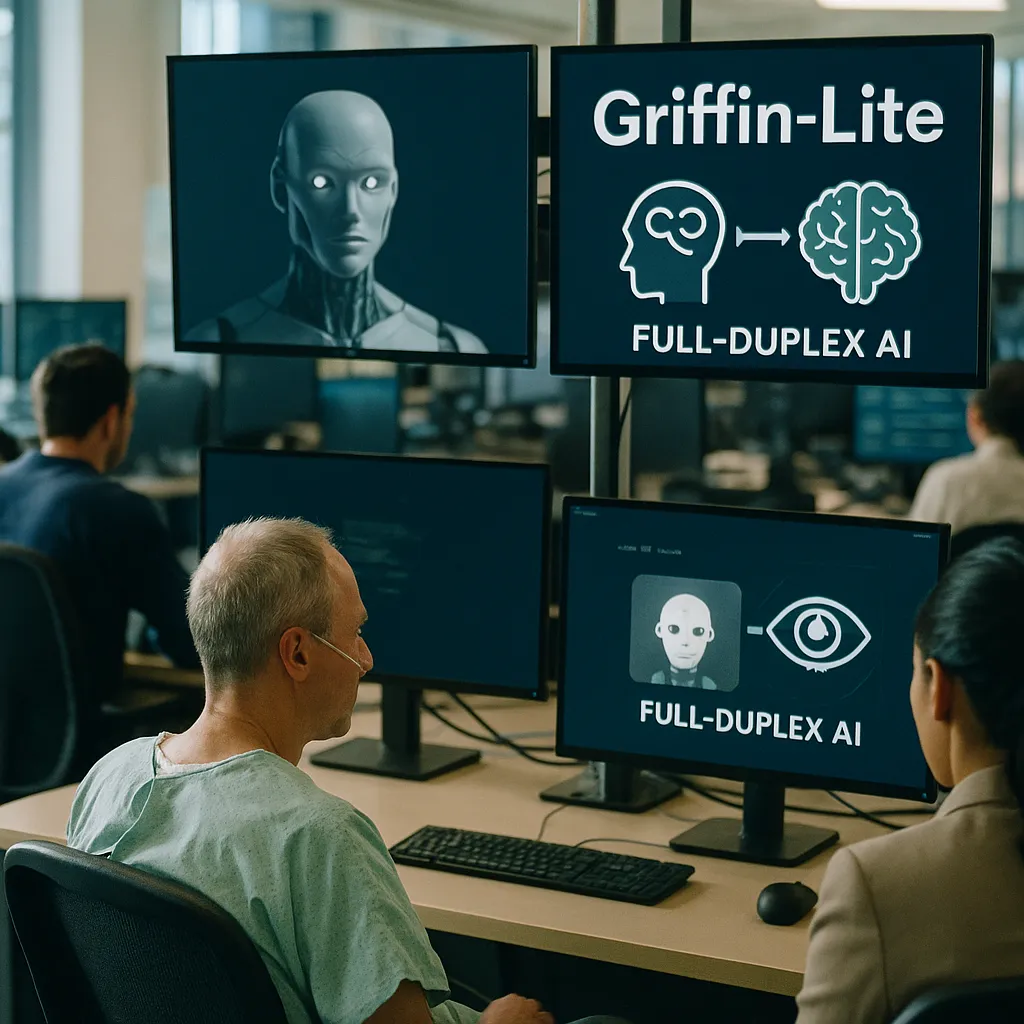
Tavus introduced Griffin-Lite, the world's first Human Interaction Model — a full-duplex video AI that simultaneously sees, thinks, and responds in real-time video without turn-taking pauses.
Tavus Launches Griffin-Lite, the First Full-Duplex AI That Sees, Thinks, and Responds in Video
By Hector Herrera | October 4, 2026
Every AI conversation model you've used has a fundamental structure: you go, it goes. Even the fastest voice AI agents operate on turn-taking — you speak, the system processes, the system responds. Tavus just shipped something structurally different.
Griffin-Lite, introduced this week, is what Tavus calls a Human Interaction Model (HIM) — a full-duplex video AI that simultaneously perceives visual input from the user, reasons about it, and generates synchronized speech and video response in real time. No turn-taking. No processing pause. The AI sees you, thinks, and responds in video while you're still in frame.
What Makes Griffin-Lite Different
The distinction from existing AI systems is worth unpacking clearly, because the category is genuinely new.
Voice AI agents (OpenAI Realtime API, Google Gemini Live, ElevenLabs Conversational AI) process audio input and generate audio output. They can be fast. They cannot see the user. They cannot generate a visual response.
Video generation tools (Synthesia, HeyGen, Runway) create video output but are not interactive. You feed them a script; they generate a video. There is no real-time perception of a live user.
Video call AI systems have existed as experiments, but they typically operate sequentially — capture a frame or audio clip, process it, respond — introducing noticeable latency that breaks the conversational experience.
Get this in your inbox.
Daily AI intelligence. Free. No spam.
Griffin-Lite, according to Tavus, processes video input from the user continuously and generates a video-avatar response without the sequential perception-then-response gap. The system handles visual context — seeing expressions, gestures, what the user is looking at — and incorporates that into its responses in real time.
What This Enables
The commercial implications of full-duplex video AI span several categories:
- Customer service. AI-mediated video support that feels like a human agent call — but available 24/7, at zero per-minute cost after infrastructure.
- Healthcare consultations. AI triage or follow-up appointments conducted over video, where the AI can observe patient presentation (complexion, apparent mobility, emotional state) and respond contextually.
- Education and tutoring. One-on-one video tutoring with an AI that monitors student engagement, notices confusion on a student's face, and adapts its explanation in real time.
- Sales and onboarding. Product demos and onboarding flows delivered by a video AI agent that responds to questions and visible reactions.
The common thread: scenarios where text or voice interaction is inadequate, and where human video availability is limited or expensive.
The Limits Worth Noting
Griffin-Lite is a first-generation product in a genuinely new category. Several open questions will determine its real-world adoption:
Latency. Full-duplex video generation is computationally intensive. How Griffin-Lite performs on consumer-grade connections and at scale is not yet established from independent testing.
Avatar quality. The generated video response comes from an AI avatar. Current avatar technology is good but not indistinguishable from a real person under extended interaction — the uncanny valley remains a practical issue for high-stakes applications.
Consent and disclosure. Deploying a video AI agent in contexts where users may not know they're talking to an AI raises significant ethical and regulatory questions. California's pending rules on AI disclosure in consumer contexts, for example, will apply directly to Griffin-Lite deployments. Several jurisdictions are already drafting requirements that AI video agents must clearly identify themselves.
Data handling. A system that continuously processes live video of users captures far more sensitive data than a voice or text AI. Privacy compliance — especially under GDPR and CCPA — requires careful architecture.
What to Watch
Tavus has positioned Griffin-Lite as a developer platform, meaning adoption depends on what developers build on top of it. Watch for early enterprise integrations in customer service, healthcare, and education — those verticals have the clearest economic case and the infrastructure to manage the compliance questions.
The broader significance is categorical: Griffin-Lite opens a conversation about what AI interaction looks like when it's no longer turn-based and no longer text or audio only. How regulators, enterprises, and users respond to always-on, visually-aware AI will define the next phase of AI interface design.
Hector Herrera is the founder of NexChron and builds AI systems at Hex AI Systems.
Did this help you understand AI better?
Your feedback helps us write more useful content.
Get tomorrow's AI briefing
Join readers who start their day with NexChron. Free, daily, no spam.