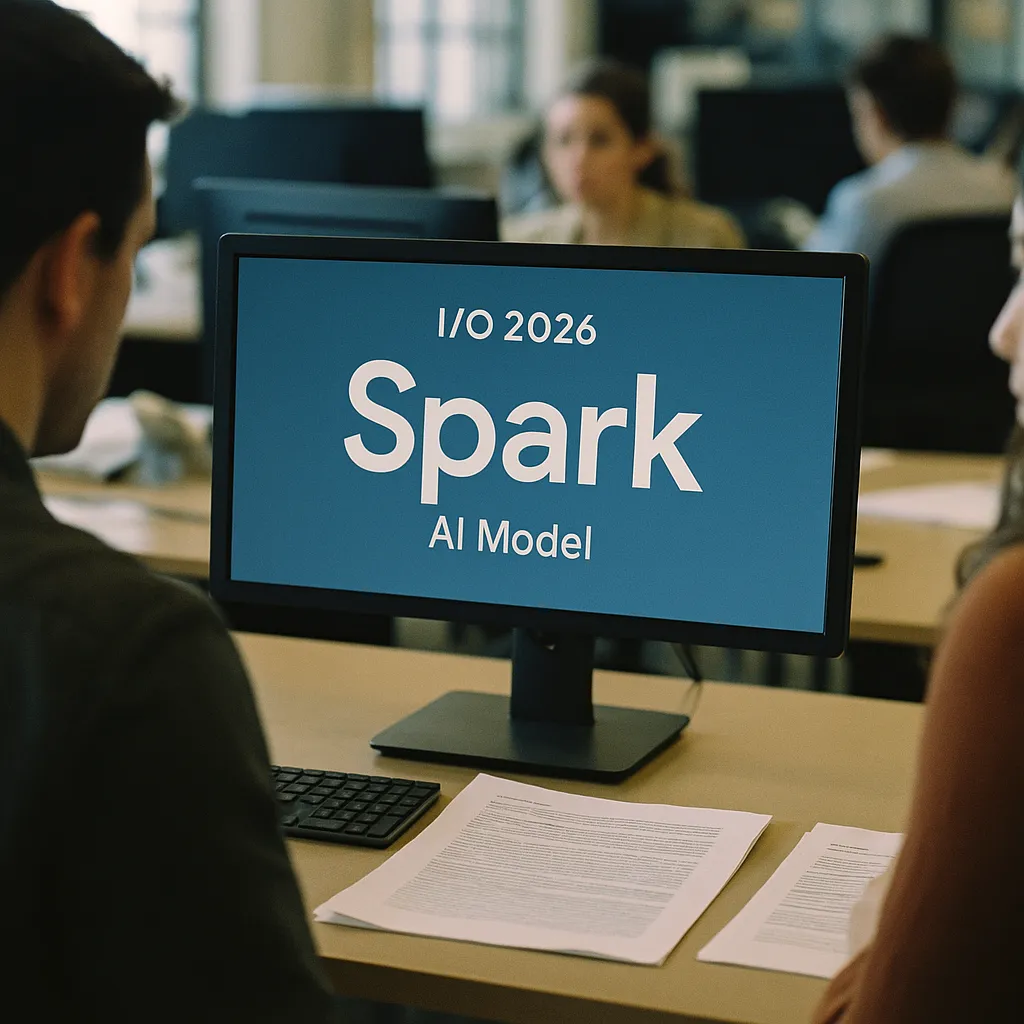
Google launched Gemini Spark at I/O 2026, a persistent AI agent running in dedicated virtual machines with Workspace and MCP integration. Gemini 3.5 Flash went live and AI Ultra pricing dropped 60 percent to $100/month.
Google I/O 2026: Gemini Spark Debuts as a 24/7 Personal AI Agent
By Hector Herrera | May 19, 2026 | News
Google used its I/O 2026 keynote to launch Gemini Spark, a personal AI agent that runs continuously in dedicated virtual machines and connects to Workspace, calendar, email, and third-party tools via the Model Context Protocol (MCP). At the same event, Gemini 3.5 Flash went live across Google Search and the Gemini app, while the price of Google AI Ultra dropped from $250 to $100 per month — a 60 percent cut that meaningfully widens consumer access to Google's top-tier AI tier.
This is the most aggressive product push Google has made in the generative AI era. After two years of playing catch-up to OpenAI on consumer features, the company is now positioning its AI as always-on infrastructure, not just a chat window you open when you need an answer.
What Google Announced at I/O 2026
According to CNBC's I/O coverage, the key launches were:
- Gemini Spark — A persistent AI agent that lives in a dedicated virtual machine tied to your Google account. Unlike chat-based AI assistants that forget context between sessions, Spark maintains memory across tasks and runs proactively in the background. It connects to Google Workspace (Docs, Gmail, Calendar, Drive) and to external tools that support MCP, the emerging open protocol for AI-to-tool communication.
- Gemini 3.5 Flash — Now live in Search and the Gemini app. Google claims the model is four times faster than competing frontier models at a significantly lower inference cost. Flash is positioned for high-volume, latency-sensitive tasks rather than deep reasoning.
- AI Ultra price cut — Google's premium subscription tier, which bundles access to the most capable Gemini models, dropped from $250/month to $100/month. The move brings it closer to OpenAI's ChatGPT Pro ($200/month) on price while undercutting it significantly.
Why Gemini Spark Matters
Most AI assistants today are reactive: you ask, they answer, the session ends. Gemini Spark is designed to be proactive — it can monitor your inbox for action items, track project deadlines in your calendar, and surface information before you think to ask for it.
Get this in your inbox.
Daily AI intelligence. Free. No spam.
The MCP integration is significant. MCP (Model Context Protocol) is an open standard, originally advanced by Anthropic, that lets AI agents communicate with external tools in a structured way. By building Spark on MCP, Google is betting on interoperability rather than a closed ecosystem. Developers can connect their own applications to Spark without waiting for Google to build native integrations.
What this means for businesses: Companies running on Google Workspace now have an AI agent that can, in principle, coordinate across tools — drafting a response to a client email, checking the relevant contract in Drive, and flagging a calendar conflict, all without switching apps. That reduces friction in workflows that currently require three separate tools.
What this means for consumers: The AI Ultra price drop makes Gemini Spark accessible to more users. At $100/month, it is still a premium product — not a casual purchase — but the 60 percent price cut signals that Google is prioritizing adoption over near-term revenue from its top tier.
The Competitive Context
Google is catching up fast. For most of 2024 and 2025, OpenAI held the lead on consumer AI products — ChatGPT's memory features, GPT-4o's multimodal capabilities, and the ChatGPT iOS/Android app all set the pace. Google's Gemini app launched to mixed reviews and struggled with early errors that made headlines.
I/O 2026 is a deliberate course correction. The Spark agent, the Flash speed claims, and the price cut are all targeted directly at OpenAI's product lineup. Whether Spark's always-on model actually delivers on its promise in daily use will depend on real-world performance Google hasn't yet had to prove.
What to Watch
Look for third-party developers to begin publishing MCP integrations for Spark within weeks — the open protocol lowers the barrier to entry. The more important test will be whether Spark's persistent memory performs reliably or becomes another AI feature that sounds better in a keynote than it works in a browser tab.
Sources: CNBC
Did this help you understand AI better?
Your feedback helps us write more useful content.
Get tomorrow's AI briefing
Join readers who start their day with NexChron. Free, daily, no spam.