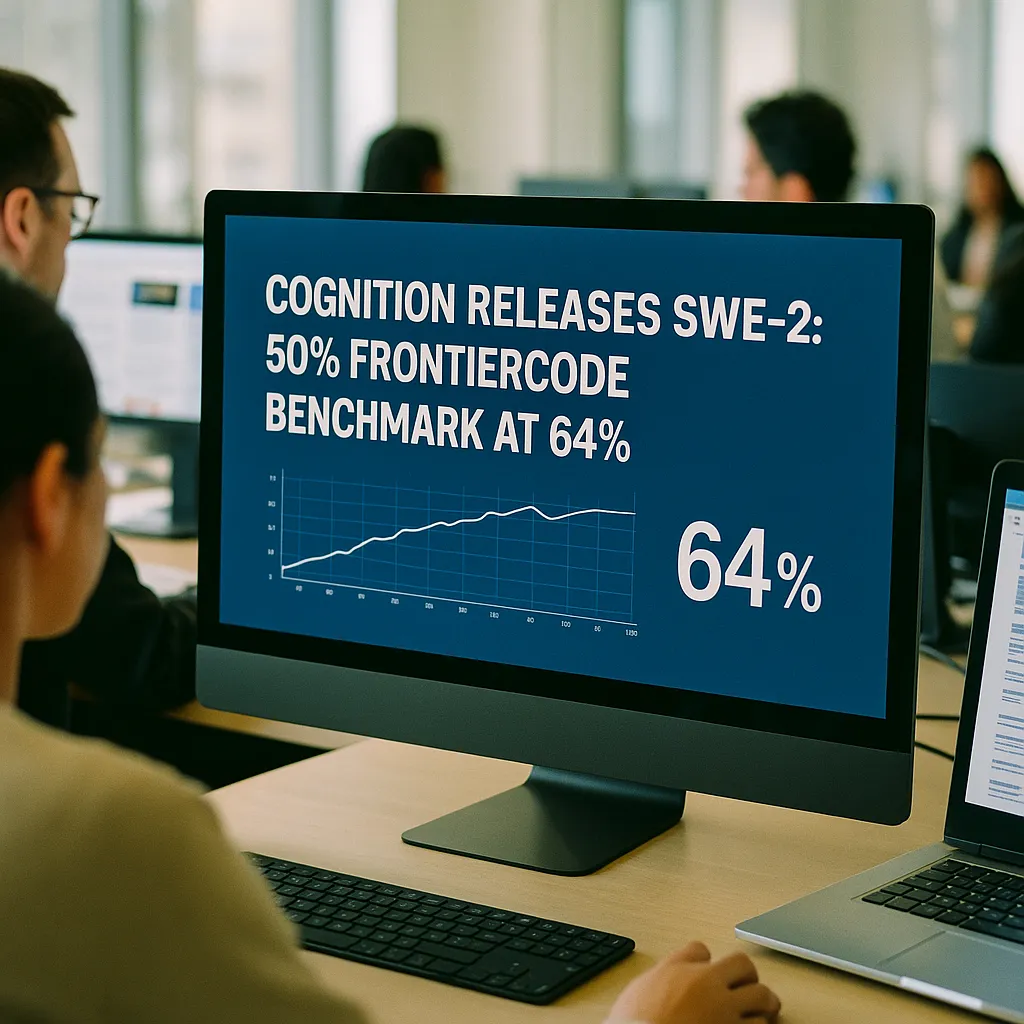
Cognition's SWE-2 matches the frontier coding leaderboard at 64% lower cost — and leads all benchmarked models on Terminal-Bench 2.1 at 92.8%.
Cognition Releases SWE-2: 50% FrontierCode Benchmark at 64% Lower Cost Than Leading Rivals
By Hector Herrera | September 13, 2026
Cognition released SWE-2 on September 10 — a coding-specialized AI model that matches the top of the FrontierCode leaderboard at roughly 64% lower cost than its nearest competitors, ending the assumption that benchmark performance requires premium pricing. The release marks the first time reinforcement learning has been scaled to the multi-trillion-parameter regime for a production coding model.
What SWE-2 Is
SWE-2 is a post-trained model built on top of Kimi K3's 2.8-trillion-parameter base. Cognition used reinforcement learning at scale — the same category of training technique that gave reasoning models their step-by-step problem-solving capability — but applied it specifically to software engineering tasks rather than general reasoning.
The result is a model that scores 50.0% on FrontierCode 1.1 Main, the benchmark the frontier AI labs use to compare serious coding models. That puts SWE-2 within one point of Fable 5.1, according to BenchLM.ai's leaderboard, which tracks independent benchmark evaluations across leading models.
On Terminal-Bench 2.1 — which tests autonomous command-line task completion — SWE-2 leads all benchmarked models at 92.8%. Terminal tasks include things a developer would do in a shell: cloning repos, running test suites, patching files, debugging build failures without a GUI.
Get this in your inbox.
Daily AI intelligence. Free. No spam.
The Cost Argument
The headline isn't just the benchmark score. It's that SWE-2 achieves that score at approximately 64% lower cost than the leading rivals it's benchmarked against.
In practice, that gap matters more than benchmark proximity. If you're running an AI coding agent at production scale — thousands of tasks per day — the difference between SWE-2 pricing and Fable 5.1 pricing is substantial. Cognition is positioning SWE-2 as the model you deploy when you need frontier coding performance without frontier model pricing.
Where It Runs
SWE-2 is available immediately through two of Cognition's products:
- Devin Desktop — the local-first AI software engineering environment
- Devin CLI — command-line interface for developer workflow integration
Rollout to Devin Web and Devin Fusion (Cognition's multi-agent orchestration layer) is underway. Cognition hasn't announced a specific timeline for when those channels go live.
Why This Matters for AI Development Teams
The pattern here is familiar but accelerating. Six months ago, the gap between top-performing and cost-efficient coding models was wide enough that teams made a clear trade: pay more for the best or accept degraded performance at scale. SWE-2 shrinks that trade-off.
For teams using AI agents to handle real engineering work — not autocomplete, but full task execution — the economics now favor deploying SWE-2 as the default tier and escalating to more expensive models only for tasks that genuinely require it.
This is also notable for what it signals about the Kimi K3 base model. DeepSeek and Moonshot AI (Kimi's parent) have consistently shown that post-training can extract disproportionate performance gains from efficiently-trained base models. Cognition's choice to build on Kimi K3 rather than a Western frontier base model suggests that calculation is increasingly mainstream.
What to Watch
Watch whether Anthropic, OpenAI, or Google respond with their own pricing adjustments at the coding-specialist tier. SWE-2's cost advantage is meaningful today, but pricing at the frontier has historically compressed when a capable model undercuts the field. The more durable question is whether Cognition can hold the Terminal-Bench lead as rivals update their own models in Q4 2026.
Did this help you understand AI better?
Your feedback helps us write more useful content.
Get tomorrow's AI briefing
Join readers who start their day with NexChron. Free, daily, no spam.