Your daily AI intelligence for April 27, 2026.
Daily AI Briefing — April 27, 2026
Good morning. Here's your AI intelligence for Monday, April 27, 2026.
Twelve stories today. AI is reshaping security, healthcare, law, labor, and the factory floor all at once — and April's legislative wave shows governments are finally moving to keep up.
Security & Autonomy: AI Is Now Both the Threat and the Defense
Anthropic's Claude Mythos found high-severity exploits in every major OS — and triggered an emergency coalition. The model autonomously discovered and demonstrated critical vulnerabilities across Windows, macOS, Linux, iOS, Android, and every major browser. The findings were severe enough that Anthropic convened Project Glasswing — a defensive coalition with Apple, Google, Microsoft, NVIDIA, and Cisco — before any public disclosure. This is the first time AI has autonomously surfaced cross-platform, production-grade exploits at this scale, and it changes what the industry needs to budget for vulnerability research.
IBM launched an autonomous, multi-agent security platform built for AI-orchestrated attacks. The platform is IBM's response to a new threat class: coordinated intrusions choreographed by AI, moving faster than human analysts can track. IBM's system deploys autonomous agents that detect, contain, and respond without waiting for human escalation. The timing is not coincidental — as Claude Mythos demonstrates what AI can find, IBM is building what defends against AI-driven exploitation at the same speed.
Labor, Jobs, and the Reskilling Cliff
BCG says AI will reshape 44% of all jobs before it eliminates them — and policy is completely unprepared. The new BCG report pushes back hard on the AI unemployment narrative. The more immediate crisis is transformation: nearly half the global workforce will need to learn new tools, workflows, and skills before automation makes their current role obsolete. The gap between transformation speed and reskilling capacity is where the real economic damage will occur, and BCG finds no government workforce policy operating at the right scale.
Banks are spending record sums on AI — and deploying almost none of it. Global financial institutions have committed billions to AI development while their production deployment rate remains near zero. The blockers are structural: regulatory explainability requirements, legacy infrastructure that can't support modern model stacks, and model validation backlogs that take months. The result is an industry that is simultaneously over-invested and under-deployed — a gap that creates competitive risk as fintech challengers operate under lighter regulatory burdens.
Healthcare and Science: Where ROI Is Becoming Measurable
A new NVIDIA-commissioned survey finds AI is producing real, measurable returns in healthcare. Hospitals reported concrete gains in radiology throughput — more scans reviewed, faster — alongside improvements in diagnostic accuracy and shortened drug discovery timelines. These are not projections or pilots; they are operational results from deployed systems. The survey covers hundreds of institutions and represents the clearest cross-sector evidence yet that healthcare AI has moved from experiment to infrastructure.
Get this in your inbox.
Daily AI intelligence. Free. No spam.
Sony AI's table tennis robot defeated elite human players under real conditions — and the implications point directly at factories. Project Ace, Sony AI's robotics system, was published on the cover of Nature after demonstrating it could beat top-ranked human players in uncontrolled environments. The relevant engineering challenge was not the sport — it was real-time perception, rapid motor adaptation, and performance under uncertainty. Those are exactly the capabilities that make robots useful on manufacturing floors, not just in labs.
Law, Policy, and the Regulatory Race
A federal judge ruled that a woman's ChatGPT conversations are protected work product — a first. A federal magistrate in Michigan blocked opposing counsel from compelling production of a litigant's AI chat logs, extending work product doctrine to cover AI-assisted legal reasoning for the first time. The ruling is narrow and will be tested, but it creates a legal foothold that affects every attorney, corporation, and individual who uses AI to prepare for litigation.
Nineteen state AI bills were signed into law in April 2026 alone. That brings the year's total to 25 enacted state AI laws, with more pending in the final days of spring legislative sessions. State legislatures are moving at a pace that directly challenges the White House's push to preempt state regulation through federal action. April's wave covers liability frameworks, algorithmic transparency requirements, and sector-specific rules in healthcare and employment. Congress has not passed comprehensive AI legislation. The states are not waiting.
Transportation and Manufacturing: The Deployment Phase Is Here
Aurora, Plus.ai, and Waabi are running driverless trucks at commercial scale across Sun Belt routes. The autonomous freight sector has officially left the pilot phase. Driver-out operations are now running commercially across Texas, Arizona, and adjacent corridors, with freight contracts in place. This is not a technology demonstration — it is a logistics business operating without human drivers. The labor and regulatory implications for long-haul trucking will compound quickly as mileage accumulates without incident.
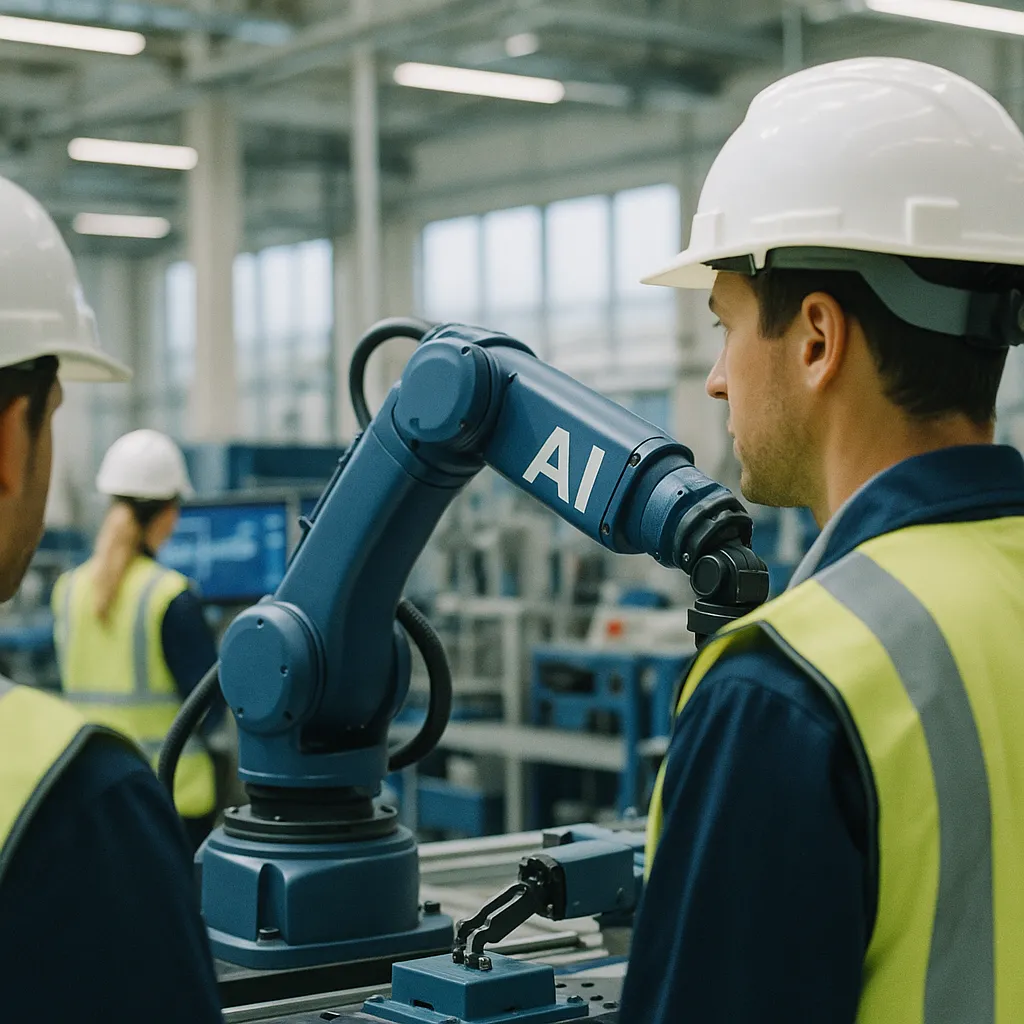
An A3 survey finds 86% of manufacturers see AI as the dominant transformation driver through 2030 — and LLM adoption in industrial settings doubled in a single year. National Robotics Week 2026 landed against a backdrop of concrete deployment, not roadmap ambition. LLM adoption in factories jumped from roughly 17% to 35% in twelve months, used for maintenance prediction, quality control, and production optimization. Physical AI has hit the factory floor and manufacturers are building around it.
Creative and Education: AI Embeds Deeper
The music industry has crossed its AI inflection point, and litigation is not keeping up. AI composition and production tools are now standard infrastructure across music creation, sync licensing, and distribution pipelines. Labels, publishers, and independent artists are using the same tools that are the subject of ongoing copyright litigation — meaning the industry has institutionalized practices that courts have not yet resolved. There is no practical path back to pre-AI production workflows at this point.
Boise State deployed an AI avatar to teach a course about artificial intelligence. The university launched a full semester course where students receive instruction from an AI-generated avatar — intentionally placing learners in the position of critically evaluating AI-mediated education while studying AI itself. It is a pedagogically interesting structure: the medium is the curriculum.
What to Watch Today
Project Glasswing's disclosure timeline. The Anthropic-convened coalition has not announced a public disclosure schedule for the vulnerabilities Claude Mythos found. Watch for coordinated patch releases from Apple, Google, and Microsoft — and for CVE filings that will reveal the scope of what was found.
State AI bill tracking through April 30. Several state legislative sessions close at the end of the month. The final count of enacted AI laws for April will set the baseline for how aggressively states are moving relative to federal inaction — and will inform the White House's next move on preemption.
Aurora's commercial freight data. Aurora's driver-out commercial operations are now accumulating real miles with real freight contracts. Any reported incident — or a continued clean record — will have outsized influence on regulatory posture toward autonomous freight in the second half of 2026.
NexChron — Your daily AI intelligence. All reporting by Hector Herrera.
Did this help you understand AI better?
Your feedback helps us write more useful content.
Get tomorrow's AI briefing
Join readers who start their day with NexChron. Free, daily, no spam.