Your daily AI intelligence for April 24, 2026.
Daily AI Briefing — April 24, 2026
Good morning. Here's your AI intelligence for Friday, April 24, 2026.
Today the regulatory map fractures in opposite directions at once. The EU is moving to classify ChatGPT as a regulated search engine. The White House wants to erase state AI laws without building anything to replace them. Robots are completing logistics tasks on live factory floors. Attorneys are being sanctioned for citations that don't exist. The Stanford AI Index reports that AI can now solve nearly every real software engineering problem — and that AI companies are telling us less about how they do it. A professor replaced himself with an AI avatar. And Google's smart speaker is no longer waiting for you to say hello.
Policy Collision: Brussels and Washington Pull in Opposite Directions
The European Commission is preparing to designate ChatGPT as a "very large online search engine" under the Digital Services Act — a classification that would activate the EU's highest tier of platform obligations, covering algorithmic transparency, content moderation accountability, bias auditing, and mandatory researcher data access. OpenAI has never been subject to this framework. A formal designation would require rapid structural changes and set a clear precedent: treating conversational AI as a regulated information intermediary, not just a software product.
At the same time, the Trump administration is pushing Congress to override state AI laws it considers burdensome — while explicitly refusing to create any new federal regulator to fill the resulting gap. The practical outcome of that combination would be a void: state-level protections neutralized, no federal enforcement mechanism to replace them. For companies operating across multiple states, the compliance landscape may become simultaneously simpler on paper and more unpredictable in practice, with no clear authority to resolve disputes or set minimum standards.
These two moves are not symmetric. The EU is extending regulatory reach into a product that never had it. The White House is proposing to remove regulation that already exists, without substituting anything. The direction of travel is exactly opposite — and both are moving at the same time.
Labor: The Attribution Has Changed
Global tech layoffs have crossed 73,000 through April 2026 — and companies are no longer being vague about the reason. A growing share of layoff announcements explicitly cite AI-driven restructuring rather than market conditions or cost pressure. That attribution shift matters more than the raw number. When companies name AI as the cause rather than economic environment, they're signaling something about their internal planning and their read of investor expectations.
A Gallup survey in this data found 18% of U.S. workers believe their job will be eliminated by AI within five years. That figure has moved considerably from two years ago. Whether those workers are right about their specific roles is a separate question — but the perception divide between knowledge workers who feel secure and those who don't is now clearly visible in the survey data, not just in editorial commentary.
Legal: Hallucinations Have Consequences
Courts across the country are reaching inconsistent conclusions about how to handle attorneys who submit AI-generated briefs with fabricated citations. Some courts are banning AI-assisted filings outright. Others are leaning toward disclosure requirements and deterrence. None of it is uniform, and lawyers working across jurisdictions can't apply a single compliance rule.
Get this in your inbox.
Daily AI intelligence. Free. No spam.
The underlying problem isn't going away: large language models hallucinate confidently, and legal work requires verified citations. A second risk is compounding the first — routing attorney-client communications through a commercial AI service may destroy privilege protection, since courts have historically treated third-party disclosure as a waiver. A brief full of hallucinated citations is embarrassing and sanction-worthy. Communications with clients that inadvertently become discoverable through a commercial AI platform is a different category of risk entirely.
Machines at Work
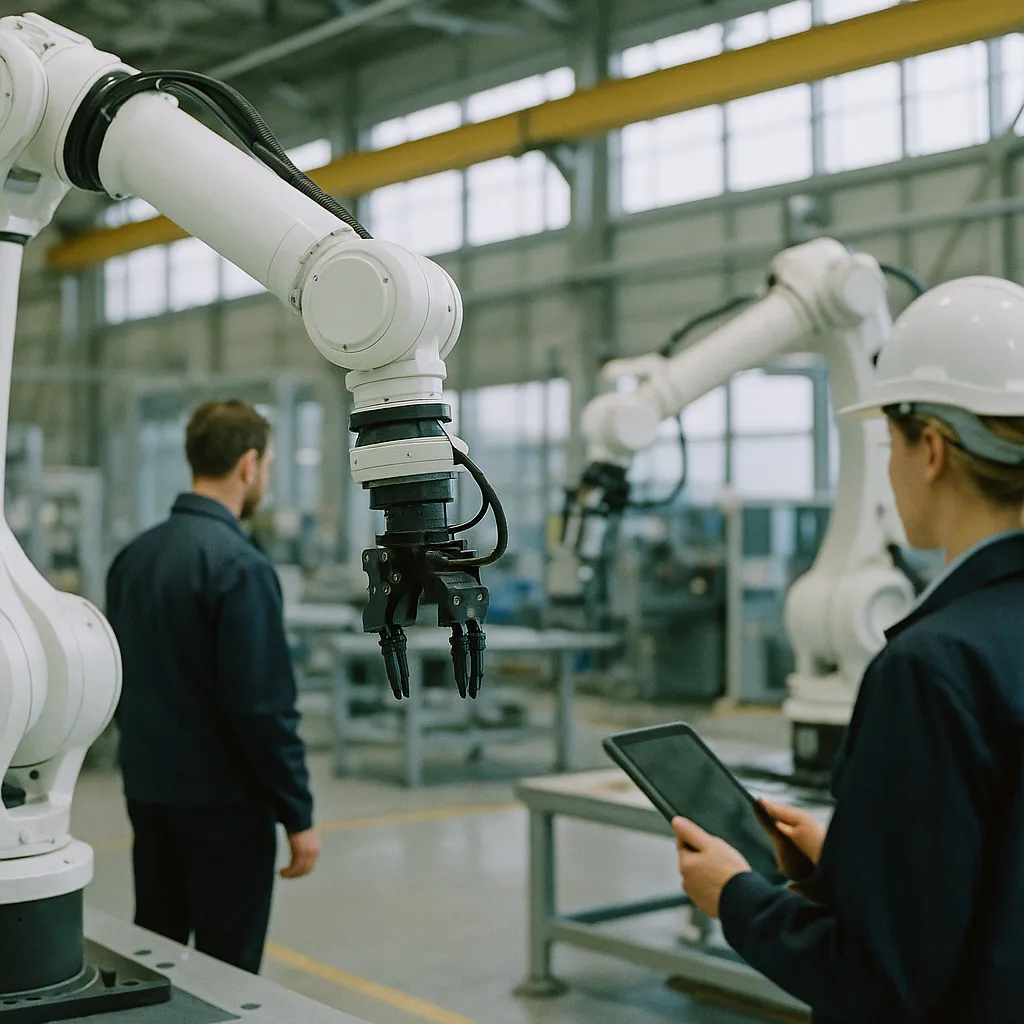
At Hannover Messe 2026, NVIDIA and Siemens put a wheeled humanoid robot to work on the floor of a live electronics factory — completing real logistics tasks, not trade show demonstrations. The development cycle was compressed to seven months through simulation-first training in NVIDIA's Isaac Sim environment: the robot learns the job in virtual space before it touches physical hardware. The implication for factory deployment isn't just speed — it's cost. Simulation-first dramatically reduces the number of physical trials needed to get a robot to production reliability.
A different approach to the autonomy problem surfaced the same week. Humble Robotics emerged from stealth with a $24 million seed round and a ground-up cabless autonomous electric truck built for fixed dock-to-dock freight routes. The vehicle has no driver's cab — it was never designed for one. The use case is deliberately narrow: specific routes, controlled endpoints, predictable cargo. That narrowness is the strategy. General autonomous trucking has proven difficult to deploy at scale. Humble's bet is that solving a tightly constrained version of the problem reaches commercial deployment faster than solving the general version does.
What the Data Actually Shows
The Stanford AI Index 2026 has two headlines that don't point in the same direction. SWE-Bench scores — the benchmark measuring AI ability to solve real-world software engineering tasks — are approaching 100%. Frontier models can now handle nearly any software engineering problem they're given. That's a meaningful threshold, not an incremental improvement.
The second finding runs the other direction: leading AI systems are disclosing less about how they work than they were in prior cycles. Training data sourcing, model architecture, and evaluation methodology are all getting less transparent, not more. At the same time, the U.S.-China performance gap on key benchmarks has closed significantly. The capability convergence is real. The transparency divergence — companies disclosing less at the exact moment capabilities are converging — is the story underneath the benchmark headlines.
The Classroom and the Living Room
Boise State University is running a graded college course delivered entirely by an AI avatar of the human instructor — one of the first documented cases of full instructor replacement by AI in a degree-granting program. Students enrolled knowing this. What it tests isn't just the technology; it's whether students receive equivalent educational value from an AI trained on a specific human's knowledge and communication style, and what "equivalent" means in a context where human mentorship is traditionally part of what higher education sells. The results will be worth watching carefully.
Google updated Gemini for Home to keep the microphone active after each response, enabling natural follow-up questions without repeating the wake word. It's a small UX change with a non-trivial implication: the device is now in a persistently listening state by default after each exchange. For users who've thought carefully about ambient audio capture, the behavior shift is worth noting. For most users, it will simply feel like the speaker got easier to talk to.
What to Watch Today
The EU DSA enforcement track. Watch how OpenAI responds to a formal VLOSE designation — and whether the disclosure and auditing requirements trigger substantive changes in how ChatGPT surfaces and documents sources. The first enforcement action under this designation will be the real test of how much force the framework carries.
Hannover Messe follow-on. NVIDIA's simulation-first approach is now on live factory record. The next signal is which manufacturers announce pilot programs — and how quickly the gap between "demo at a trade show" and "full deployment on a production line" actually closes.
Stanford AI transparency findings. The drop in AI disclosures is documented. The policy response isn't visible yet. Watch whether EU AI Act implementation officials and U.S. lawmakers use the finding as leverage in hearings or rulemaking this week — or whether it lands with no institutional response at all.
— Hector Herrera, NexChron
Did this help you understand AI better?
Your feedback helps us write more useful content.
Get tomorrow's AI briefing
Join readers who start their day with NexChron. Free, daily, no spam.