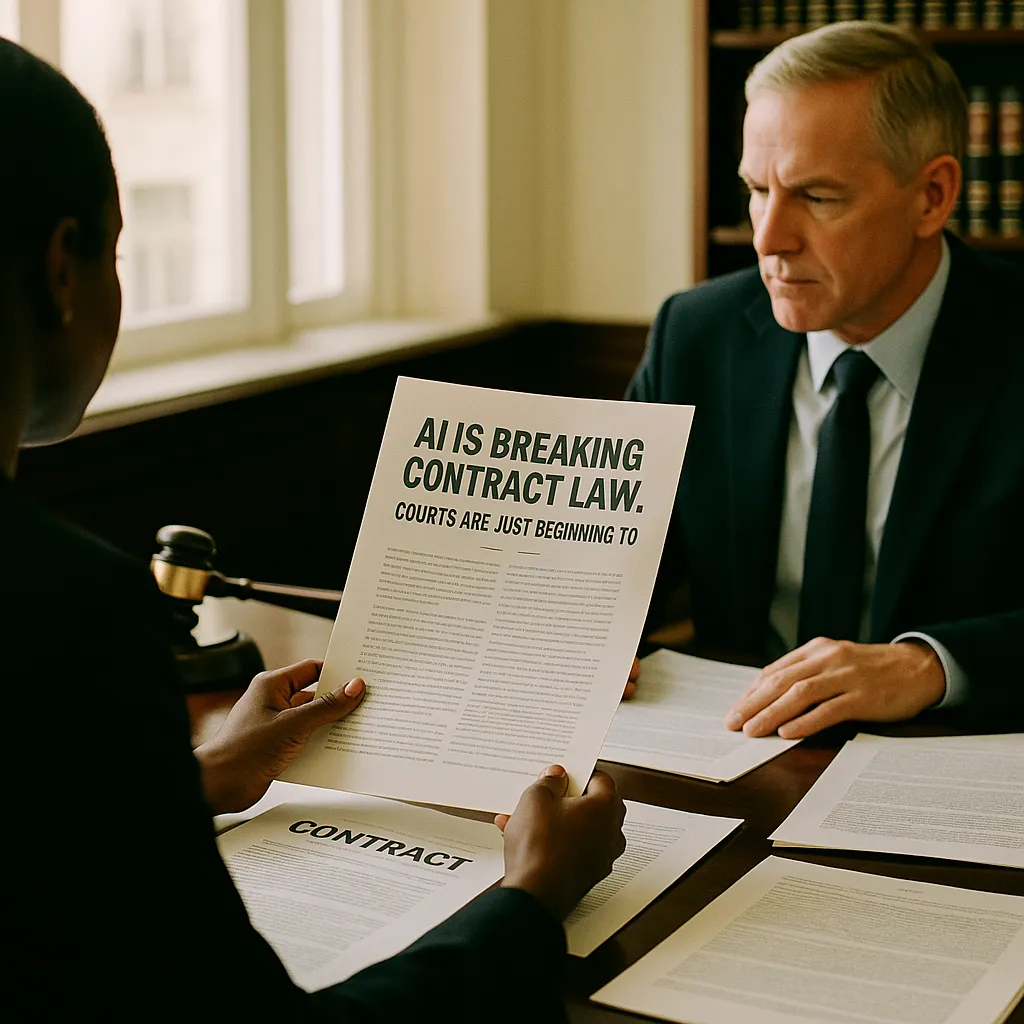
Alston & Bird's April 2026 AI Quarterly finds courts issuing consequential AI rulings without a coherent framework, including a privilege-destroying ruling for law firms using commercial AI tools.
AI Is Breaking Contract Law. Courts Are Just Beginning to Figure Out the Rules.
By Hector Herrera | April 30, 2026
The volume of novel legal questions triggered by AI is surging, and courts are issuing consequential rulings before any coherent framework exists to receive them. Alston & Bird's April 2026 AI Quarterly, released this week, documents what may be the most consequential quarter yet for AI-generated case law — and it lands with a specific, immediate warning for legal professionals and businesses alike.
The most urgent finding: a Southern District of New York ruling has determined that feeding privileged attorney communications into commercial AI tools destroys attorney-client privilege. That ruling has operational implications for every law firm and in-house legal team using ChatGPT, Claude, Gemini, or any commercial AI assistant.
The Privilege Problem
Attorney-client privilege is one of the foundational protections in US law. It prevents courts from compelling the disclosure of confidential communications between lawyers and their clients. The Southern District ruling applies a straightforward legal logic that produces a devastating practical consequence: when those communications are entered into a commercial AI tool, they are no longer "confidential" in the legal sense — because the user has voluntarily disclosed them to a third party (the AI provider).
This isn't a hypothetical edge case. Lawyers routinely draft strategy memos, upload deposition transcripts, query AI tools about case theories, and summarize client fact patterns to generate document drafts. Every one of those interactions now carries a risk of privilege waiver — potentially forcing disclosure of sensitive communications in discovery proceedings.
The practical response is already beginning: cautious law firms are implementing strict policies governing which documents can touch external AI systems. Expect sustained demand growth for on-premise or private-cloud AI deployments that keep client data entirely off third-party infrastructure. Legal AI vendors — Harvey, Clio, LexisNexis, Thomson Reuters — will face immediate pressure to offer architecturally isolated deployment options with contractual commitments around data handling that can withstand privilege challenges.
The Hallucination Liability Gap
Beyond privilege, the Alston & Bird quarterly identifies a second, fast-growing legal risk: contract indemnification gaps around AI agent hallucinations. An AI hallucination, in legal and technical terms, refers to a confident, authoritative-sounding output from an AI system that is factually incorrect.
Get this in your inbox.
Daily AI intelligence. Free. No spam.
As businesses deploy AI agents to draft contracts, manage compliance workflows, generate regulatory filings, and execute commercial decisions, clients are pushing back hard on vendors to assume liability when autonomous AI errors cause harm. The demand is reasonable. The problem is structural: most existing software indemnification frameworks were written for systems that contain bugs, not systems that make autonomous judgments that happen to be wrong.
The quarterly describes this as the fastest-growing source of commercial AI dispute, with no settled legal standard governing who bears the loss when an AI agent makes a materially wrong decision on a client's behalf. The absence of precedent is itself a risk — companies operating under AI agent contracts are carrying uncertain liability exposure that no current insurance product cleanly covers.
The Broader Legal AI Landscape
The privilege ruling and hallucination indemnification gap are the most commercially urgent findings, but the quarterly identifies active litigation and regulatory pressure across a wider front:
Intellectual property — ongoing disputes about the legality of AI training on copyrighted content, and whether AI-generated works with minimal human input qualify for copyright protection. No definitive appellate ruling has settled either question in the US.
Employment discrimination — first cases testing whether AI-assisted termination decisions — where an AI system recommends the decision and a human approves it — trigger disparate impact liability under federal anti-discrimination law. The legal theory is novel; early rulings are mixed.
Consumer protection — FTC enforcement actions against AI tools that make misleading capability claims, particularly in healthcare and financial services, where user reliance on inaccurate AI outputs can cause direct harm.
Contract formation — questions about whether agreements negotiated or executed by AI agents on behalf of parties create binding obligations, and under what circumstances an AI agent's actions can be repudiated.
The through-line is consistent: the law is being written in real time through individual rulings, with significant inconsistency across jurisdictions and no federal AI liability framework to provide baseline clarity.
What Businesses Need to Do Now
The quarterly's findings have immediate implications for any company deploying AI in consequential workflows:
- Legal teams should audit which external AI tools have access to privileged communications and implement data governance policies that eliminate the privilege waiver risk identified in the SDNY ruling
- Technology vendors should review AI agent contracts for indemnification scope and consider whether their current coverage assumptions will survive the first major hallucination dispute
- Compliance functions should map AI use against the jurisdictions where their work product will be enforced — because the legal standards differ materially across US districts and internationally
What to Watch
The SDNY privilege ruling is likely to be tested on appeal. If it holds and is adopted by other circuits, it will force structural changes to the legal AI market — creating an entirely separate tier of privilege-safe AI infrastructure with isolated compute, contractual non-disclosure guarantees, and audit trails designed for legal hold. The vendors who build that infrastructure first will capture a premium segment of the market.
Watch also for the first major AI hallucination indemnification dispute to reach a published ruling. That case will establish the first real precedent for how courts allocate liability when autonomous AI systems cause commercial harm — and it will immediately become the reference point for every AI contract negotiation that follows.
Did this help you understand AI better?
Your feedback helps us write more useful content.
Get tomorrow's AI briefing
Join readers who start their day with NexChron. Free, daily, no spam.