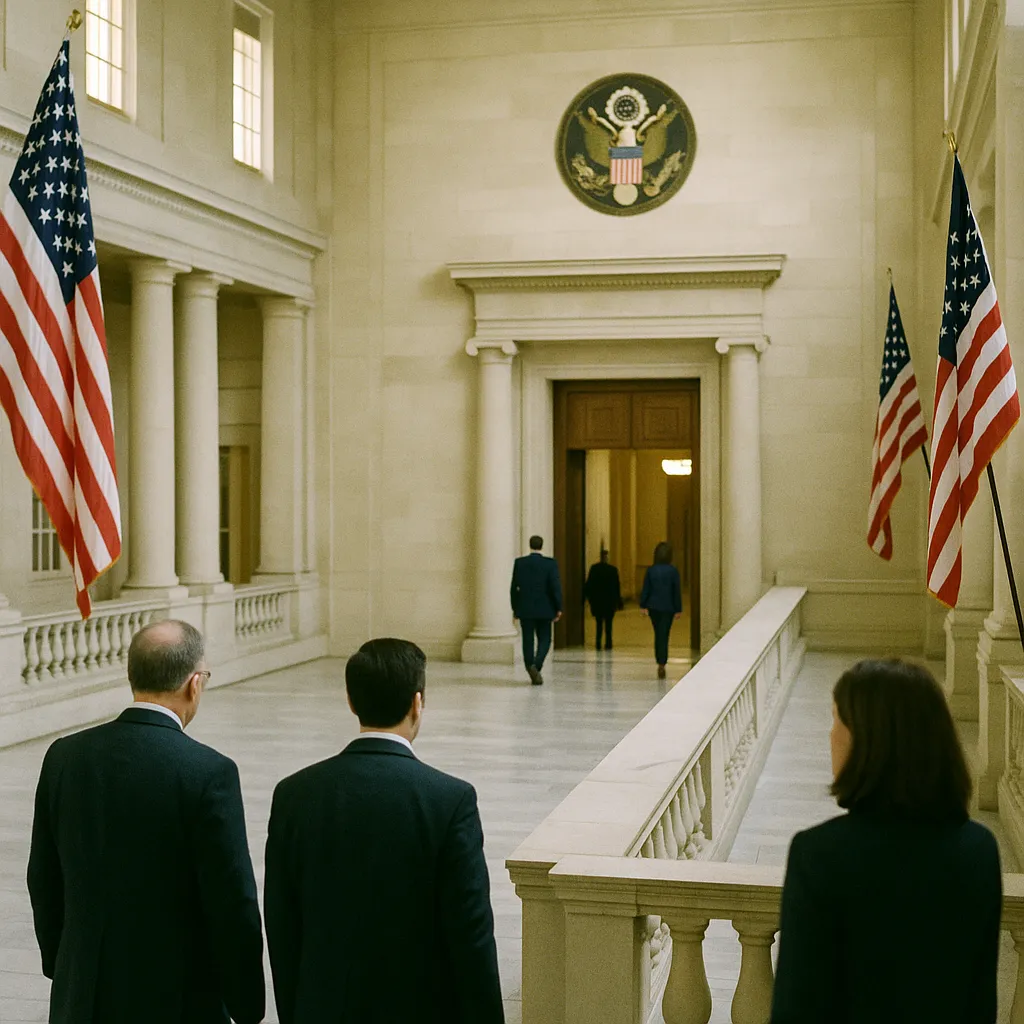
The White House's March 2026 AI framework asserts federal primacy over AI governance. More than 25 states with their own AI laws are not complying, and the legal fight is moving to courts.
White House Move to Centralize AI Regulation Meets Bipartisan State Resistance
By Hector Herrera | May 10, 2026 | Government
The federal government and more than two dozen states are on a collision course over who controls AI regulation in the United States, and the first deadlines are weeks away. The White House issued a National Policy Framework for AI in March 2026 asserting federal primacy over AI governance. States are not complying, and the legal fight is moving from legislatures to courts.
The Federal Framework and What It Claims
The March 2026 National Policy Framework for AI does not propose a new law — that requires Congress, which has not passed comprehensive AI legislation. Instead, it asserts that existing federal authority is sufficient to preempt conflicting state AI regulations, and directs federal agencies to identify and challenge state rules that it deems inconsistent with federal AI policy.
The administration's argument has two parts:
- Market fragmentation. A patchwork of 25+ state AI laws with different definitions, disclosure requirements, and enforcement mechanisms creates compliance costs that disadvantage U.S. companies relative to Chinese competitors operating under a single national framework.
- Innovation chilling. State-level algorithmic impact assessments, mandatory explainability requirements, and sector-specific AI prohibitions slow deployment in ways that, the administration argues, compound into a structural competitive disadvantage.
What States Are Doing Instead
States are not waiting. According to a legal analysis from Vorys, more than 25 states have enacted their own AI laws with enforcement deadlines beginning this summer. The bipartisan character of the resistance is notable — this is not a partisan split between red and blue states.
Colorado's Artificial Intelligence Act takes effect June 30, 2026. It is the most comprehensive state AI law currently on the books, requiring high-risk AI system operators to conduct bias impact assessments, disclose AI use to consumers, and maintain documentation of system outputs. Colorado drew explicit inspiration from the EU AI Act's risk-tiered structure.
Other states with active or imminent AI laws include:
Get this in your inbox.
Daily AI intelligence. Free. No spam.
- Texas — algorithmic decision-making transparency requirements in employment
- Illinois — video interview AI disclosure, expanded biometric privacy
- Virginia — consumer rights around automated decision systems
- New York — the RAISE Act, targeting consequential decision transparency in housing and credit
The states' core argument is that the federal vacuum is real. Congress has not passed a comprehensive AI law. The administration's March framework is an executive assertion, not a statute. States point to consumer harms — AI-generated fraud, discriminatory lending, biased hiring tools — and argue they have both the authority and the obligation to protect residents.
Where the Legal Terrain Gets Complicated
Federal preemption of state law is not automatic. It requires either an express statutory preemption clause (which does not exist for AI because there is no comprehensive federal AI statute), or a showing that state law conflicts with or obstructs a federal regulatory scheme.
The absence of a federal AI statute is precisely the gap states are exploiting. Without a law to conflict with, state AI regulations face a weaker preemption challenge. The administration's framework implicitly acknowledges this by relying on existing sector-specific statutes — financial services regulations, healthcare privacy law, telecommunications rules — to argue that federal authority already covers AI in those domains.
That argument is legally untested in AI-specific contexts. Courts will now test it.
The first battleground is likely Colorado. If the administration moves to challenge Colorado's June 30 implementation, it will need to identify a specific federal statute that Colorado's AI Act conflicts with — a harder argument to make than a general claim of federal primacy.
What This Means for Businesses
Companies operating across state lines face the patchwork the administration is trying to prevent. A mid-sized lender using AI in credit underwriting now navigates different documentation, disclosure, and assessment requirements in Colorado, New York, Virginia, and Illinois simultaneously — with more states' laws taking effect through the end of 2026.
The practical near-term reality is compliance investment regardless of the federal-state fight. Companies cannot wait for courts to resolve preemption questions; Colorado's June 30 deadline does not pause for litigation. Legal departments are advising clients to build toward the most comprehensive state requirements, treating them as a de facto national floor until the legal picture clears.
What to Watch
Watch for two specific signals: whether the administration files a legal challenge to Colorado's AI Act before June 30, and whether Congress moves any AI legislation before the summer recess. Either outcome would reshape the federal-state dynamic significantly. The absence of both — a stalemate — leaves businesses operating under the most fragmented compliance environment the U.S. AI sector has seen.
Sources: Vorys legal analysis
Did this help you understand AI better?
Your feedback helps us write more useful content.
Get tomorrow's AI briefing
Join readers who start their day with NexChron. Free, daily, no spam.