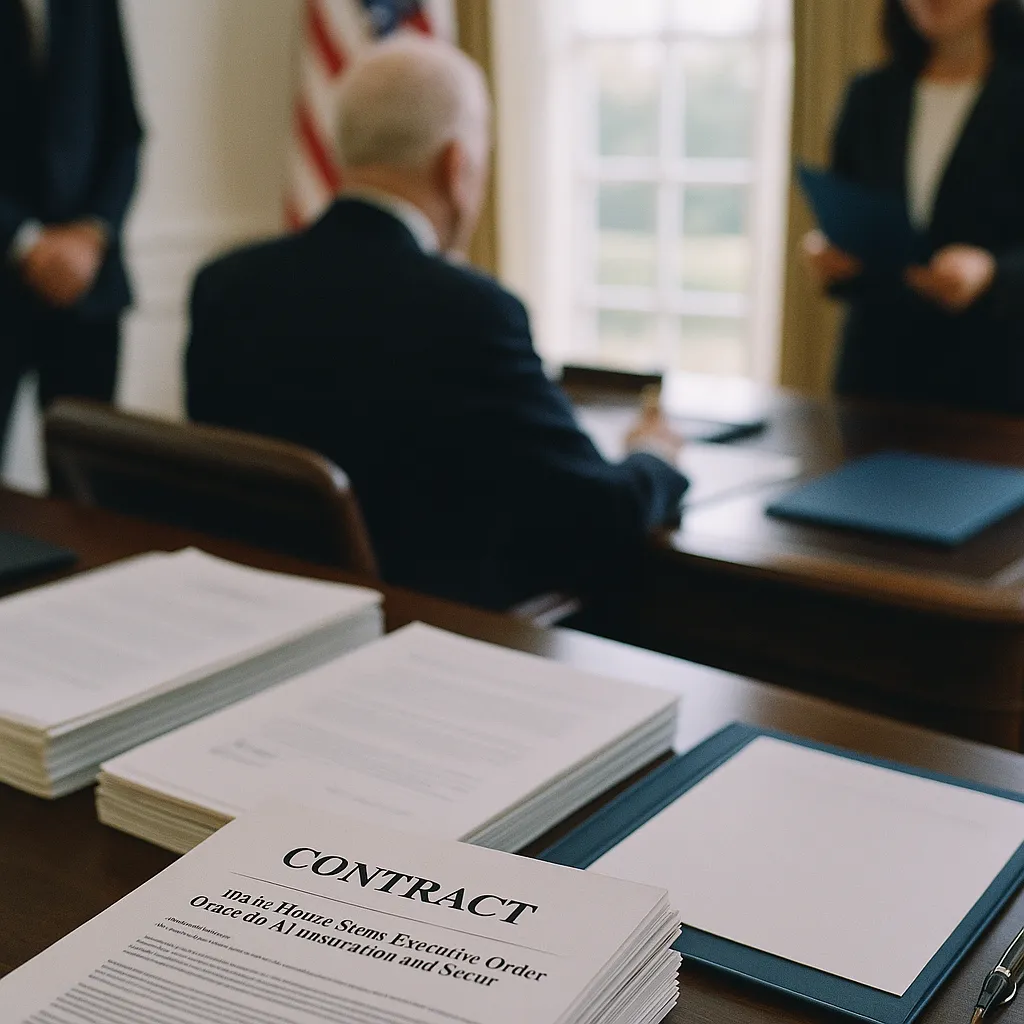
President Trump signed an executive order on June 2 directing agencies to slash AI regulatory constraints, accelerate federal AI adoption, and protect American AI intellectual property from foreign adversaries.
White House Signs Executive Order on AI Innovation and Security
By Hector Herrera | June 3, 2026 | Government
President Trump signed a new executive order on AI on June 2, 2026, directing federal agencies to remove regulatory barriers facing AI developers, accelerate AI adoption across government operations, and protect American AI intellectual property from foreign adversaries. The order marks the administration's most comprehensive AI policy action since revoking the Biden-era AI safety executive order in January 2025 — and it signals a clear federal posture: speed and competitiveness over precautionary oversight.
What the Order Does
The executive order has three primary directives:
1. Slash regulatory constraints on AI developers. Agencies are instructed to identify and remove existing regulatory requirements that slow AI development or deployment. This directive applies to pending rulemaking at the FTC, the EEOC, the OCC, and sector-specific regulators who have been developing AI guidance over the past two years. Any rule that cannot demonstrate a clear and proportionate benefit relative to its compliance cost is subject to withdrawal or delay.
2. Accelerate AI adoption across the federal government. Agencies have 90 days to submit plans to the Office of Management and Budget for modernizing their information systems to support AI-driven workflows. Federal agencies collectively run some of the largest legacy IT systems in the world — systems that predate the internet in several cases. The directive creates procurement momentum that will benefit Microsoft (which holds major government cloud contracts through Azure), Google, Amazon, and specialized defense AI vendors.
Get this in your inbox.
Daily AI intelligence. Free. No spam.
3. Protect American AI from foreign adversaries. The order explicitly frames AI model weights, training methodologies, and proprietary datasets as strategic national assets requiring active protection. Agencies are directed to work with private sector partners to identify vulnerabilities in AI supply chains that could be exploited by foreign actors — a mandate that aligns with existing semiconductor export controls and extends them explicitly into the AI software layer.
What Changed From the Biden Era
The Biden administration's October 2023 AI executive order required developers of powerful AI models to share safety testing results with the federal government and directed agencies to study AI's risks to civil rights, competition, and employment. Trump revoked most of that order in January 2025.
The June 2026 order goes further in the opposite direction. Where the Biden order created accountability checkpoints — requirements for disclosure, study, and review — this order treats those checkpoints as obstacles. The underlying policy theory is that the cost of regulatory friction on American AI competitiveness exceeds the cost of the risks that friction was designed to address.
The National Security Framing
The intellectual property protection provisions are the most operationally significant part of the order for the AI industry. By framing model weights and training methodologies as strategic assets equivalent to defense technology, the order:
- Creates a legal basis for restricting foreign access to US AI research output beyond existing export controls
- Signals that the government views AI talent flows — researchers leaving US labs for foreign employers — as a national security issue
- Provides authority for agencies to condition government contracts on AI security practices, effectively establishing a security standard for federal AI vendors
This framing is consistent with the approach China has taken with its own AI strategic assets. Both governments are now operating on the explicit premise that AI capability is a dimension of geopolitical competition, not just economic competition.
What the Order Cannot Do
It does not override state AI laws. Colorado, Connecticut, Texas, Illinois, and roughly 20 other states have enacted or are advancing their own AI-specific legislation covering employment, healthcare, credit decisions, and automated systems. A federal executive order cannot preempt state law under the current constitutional framework. The practical result is that AI developers still face a patchwork of state requirements even as the federal government removes its own constraints.
It does not produce immediate deregulation. Agency rulemaking is a process governed by the Administrative Procedure Act. Withdrawing pending rules requires notice-and-comment periods and legal justification. The order sets direction; the actual removal of specific regulations will take months and will face legal challenges from consumer and civil rights groups.
What to Watch
Watch for agency responses over the next 90 days, particularly from the FTC and EEOC, which have been most active in AI enforcement. Any pending AI guidance that conflicts with the "slash regulatory constraints" directive faces pressure to be abandoned. Also watch for foreign policy responses — the EU is building its AI governance framework on explicit contrast with the US permissive approach, and China will respond to the intellectual property protection provisions with its own countermeasures.
Did this help you understand AI better?
Your feedback helps us write more useful content.
Get tomorrow's AI briefing
Join readers who start their day with NexChron. Free, daily, no spam.